Define what clean means for the application
A communications transmitter may need low out-of-band emission after gating. A precision actuator may need displacement below a threshold. An optical cavity may need low residual photon flux or stored energy. These objectives are related but not identical. A device can satisfy one and fail another, such as producing little output at one port while retaining energy internally.
Write an operational specification with a quantity, threshold, delay, and measurement location. For example, require output power below one percent of its initial value within a stated time at a named port. If the relevant concern is stored energy, say so and explain how it will be inferred. Include the range of initial amplitudes, loads, temperatures, or frequencies over which the requirement applies. This turns shutdown design into an optimization problem with observable constraints instead of an undefined demand for instantaneous silence.
Inventory the energy that remains at cutoff
List the places where energy can persist: inductance, capacitance, mechanical motion, strain, cavity fields, material polarization, and waves already in transit. Each store has a natural release path and timescale. The source switch may control only one of them. Disconnecting a power supply does not remove energy already held in the load.
A simple energy-flow diagram can reveal whether the design needs dissipation, recovery, rerouting, or delayed detection. If a resonator contains 1 millijoule and the required shutdown interval is 1 millisecond, removing that energy within the interval implies an average transfer scale of 1 watt, before efficiency or peak constraints. This is an illustrative lower-level bookkeeping estimate, not a complete actuator specification. Peak power, thermal concentration, and coupling limits can be more restrictive. The energy destination should be intentional rather than left to parasitic loss or uncontrolled transients.
Use the natural lifetime as a baseline
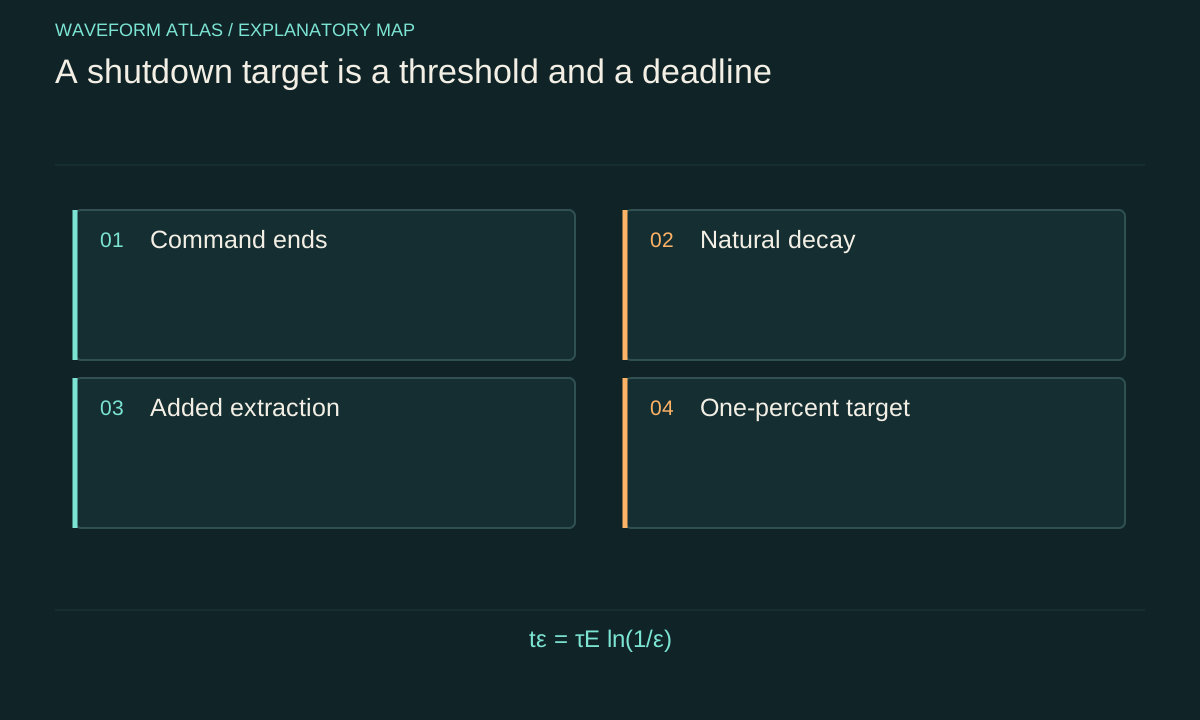
For an exponential energy decay U(t) = U0 exp(−t/τE), reaching a fraction ε takes t = τE ln(1/ε). One percent requires about 4.61 lifetimes; one part per million requires about 13.82 lifetimes. These thresholds differ substantially even though both might be described casually as off.
An illustrative energy lifetime of 2 milliseconds therefore gives about 9.21 milliseconds to one percent and 27.6 milliseconds to one part per million. Detector background may limit whether the smaller level can be verified. If the measured quantity is amplitude, use its own lifetime and threshold rather than substituting the energy formula. This baseline tells the designer whether passive decay already meets the requirement. If it does not, the added control should be evaluated against the specific amount of acceleration needed and the extra complexity or noise it introduces.
Interactive model: Cross a waveguide cutoff. Enable JavaScript to adjust its controls.
β/k_c = √[(f/f_c)² − 1]
Ideal uniform vacuum rectangular guide, TE₁₀ mode, perfectly conducting walls and no loss. Below cutoff, β is imaginary and the depicted field is evanescent. Finite barrier transmission requires a separate matching calculation.
Shape the edge to avoid unnecessary excitation
A smooth source envelope can reduce high-frequency components that excite unwanted modes. The useful shape depends on the system transfer function and the allowed duration. A slower ramp may reduce ringing but prolong direct output, so its benefit must be judged against the defined settling metric rather than the appearance of the command waveform.
Compare several candidate envelopes using the measured or modeled system response. Include hardware bandwidth and actuator limits. A mathematically optimal waveform that the source clips or distorts may perform worse than a simpler one. Check the delivered waveform at the system input and measure both time-domain settling and spectral leakage. The control should also be robust to small changes in resonance frequency and damping. A waveform that works only at one perfectly known parameter value may fail under ordinary temperature drift or changing load.
Active extraction changes the energy path
An additional damping or output-coupling path can shorten the stored-energy lifetime. In a cavity, increasing an extraction rate sends energy out faster. In a mechanical system, a controlled force opposing velocity can remove mechanical energy. In a circuit, an energy-recovery path can transfer stored energy to another reservoir instead of dissipating it locally.
These methods do not eliminate the energy balance. The controller, actuator, and receiving reservoir must be included, and their limits can determine the achievable shutdown. A force that is delayed or incorrectly phased can add energy rather than remove it. Increased coupling can also create unwanted emission in a different port. Specify where the extracted energy goes and whether that output is acceptable for the application. A quiet target subsystem can coexist with a substantial transient elsewhere in the apparatus.
Coherent cancellation has a defined scope
A properly phased control field can cancel an observed field or help empty a known resonant mode. The result depends on phase, amplitude, timing, mode matching, and the system model. Canceling a field at one detector is weaker evidence than demonstrating reduced stored energy, because interference can redistribute energy into other spatial or output channels.
For a two-path optical measurement, a dark detector port can coexist with a bright complementary port. For a driven oscillator, canceling displacement at one instant can leave nonzero velocity and therefore substantial energy. A complete shutdown criterion must constrain the relevant state variables, not only one instantaneous signal. If coherent control is used, measure the other ports or infer stored energy from a validated model and later response. The control pulse's energy and work belong in the same account as the original excitation.
Feedback must respect delay and noise
Feedback can suppress motion or output by measuring it and applying a correction. The loop has delay, finite bandwidth, actuator limits, and measurement noise. A correction that is appropriately opposing at one frequency can become reinforcing at another because of phase lag. Increasing gain without checking stability can turn a shutdown controller into a self-oscillating system.
Characterize the open-loop response or an equivalent stability model and test the controller over the expected parameter range. Measurement noise fed back through the actuator can set a residual-motion floor. Saturation during a large transient can also invalidate a controller designed around small signals. Use an independent out-of-loop measurement when possible to verify the physical suppression. A low in-loop error signal may partly reflect correlations created by the controller rather than an equally low true disturbance at the application point.
Propagation limits when a remote site becomes quiet
Even an ideal local shutdown cannot remove waves already traveling toward a remote observer. The earliest direct trailing edge arrives after the path delay, and reflections or dispersive tails can extend the response. A system-level requirement must include that delay rather than assigning all settling time to the source electronics.
For a remote acoustic detector 34.3 meters away in a medium modeled at 343 meters per second, the direct propagation delay is 100 milliseconds. Improving the source fall time from 1 millisecond to 0.1 millisecond cannot make the remote field vanish before the earlier emitted wave has passed. Local cancellation or absorption near the detector would be a different intervention with its own energy and control requirements. Distinguish source shutdown time from remote quiet time when specifying distributed systems.
Validate with disturbances and realistic initial states
Test shutdown at several initial amplitudes, phases, frequencies, and loads. Include parameter drift that is plausible in use. A linear model may predict one normalized response, but heating, nonlinear damping, saturation, and changing coupling can alter the actual tail. Repeating only the easiest initial condition gives an incomplete performance picture.
Measure the local source output, the target observable, and any significant redirected energy channel. Report worst-case or statistically defined performance under the tested conditions. Verify detector recovery after large signals and retain sufficient dynamic range to establish the required residual threshold. If the threshold lies below the instrument floor, report a bound rather than an exact settling time. Validation should show that the chosen control meets the operational requirement, not merely that the plotted command waveform looks smooth or that one trace happens to cross zero.
A good design leaves an understandable ending
The final design should explain the sequence from command to local source extinction, stored-energy release, propagation, and detector response. Each stage has a defined timescale and a measurement that can verify it. A simple passive solution may be preferable when it meets the target; active extraction or cancellation is justified when its additional controls provide a measurable benefit.
The shutdown specification should also identify the conditions outside which the model has not been validated. This is a practical boundary, not a claim that the physics is mysterious. Ending a signal is an exercise in controlling future emission and the fate of energy already present. When those two tasks are separated and measured, the result can be both fast and predictable without treating a switch as a device that erases waves throughout space.
Include repeated operation in the validation. Energy deposited during each shutdown can accumulate as heat when the repetition interval is shorter than the thermal relaxation time. A waveform that meets its target for one isolated event may drift during a long sequence. Measuring both early and late events tests that practical limitation.
What to take forward
- Specify residual quantity, threshold, delay, and location before optimizing shutdown.
- Active suppression moves or dissipates energy and must include controller work.
- Validate settling across loads, initial states, drift, and detector limits.
Go to the original work.
These links identify the sources behind specific claims. Verification scope varies by source and is stated below.
- 1 / University teachingSignals and Systems — Alan V. Oppenheim, lecture notes ↗
Alan V. Oppenheim. Signals and Systems — Alan V. Oppenheim, lecture notes. 2011.
Convolution, linear systems, filtering and feedback
Verification scope: Official course notes and topic records inspected
- 2 / University teachingFundamentals of Photonics: Quantum Electronics — lecture notes ↗
Franz X. Kärtner. Fundamentals of Photonics: Quantum Electronics — lecture notes. 2006.
Population dynamics, absorption/gain, Rabi oscillations and coupled modes
Verification scope: Official author-written course materials and topic mapping inspected
- 3 / University teachingDamped Oscillations — University Physics Volume 1 ↗
OpenStax. University Physics Volume 1, Section 15.5: Damped Oscillations.
Linear viscous damping and damping regimes
Verification scope: Official textbook section and equation record inspected
- 4 / University teachingElectromagnetics and Applications — lecture notes ↗
David H. Staelin. Electromagnetics and Applications — lecture notes. 2009.
Poynting theorem, boundary conditions, material response and polarization
Verification scope: Official author-written course and topic records inspected
- 5 / University teachingWave Propagation — Triantaphyllos Akylas, lecture notes ↗
Triantaphyllos Akylas. Wave Propagation — Triantaphyllos Akylas, lecture notes. 2017.
Transient wave propagation, elastic modes, interfaces and water waves
Verification scope: Official chapter contents and author-written course records inspected
- 6 / Primary researchCavity ring-down spectrometer for high-fidelity molecular absorption measurements ↗
H. Lin; Z. D. Reed; V. T. Sironneau; J. T. Hodges. Journal of Quantitative Spectroscopy and Radiative Transfer 161, 11–20 (2015).
DOI: 10.1016/j.jqsrt.2015.03.026
Exponential cavity decay fitting, baseline offsets and a loss budget separating mirror loss, etaloning, scattering and absorption.
Verification scope: NIST-hosted full text: title page and relevant decay-fit/loss-budget passages inspected; not every section reread.
- 7 / University teachingLecture 16: Fourier transform — Signals and Systems ↗
Lecture 16: Fourier transform — Signals and Systems.
Finite pulse Fourier transforms and time/frequency scaling
Verification scope: Official lecture equations inspected
- 8 / University teachingQuantum Optical Communication — Jeffrey H. Shapiro, readings and lecture slides ↗
Jeffrey H. Shapiro. Quantum Optical Communication — Jeffrey H. Shapiro, readings and lecture slides. 2016.
Author-written quantum attenuator, amplifier, detection and parametric interaction framework
Verification scope: Official course materials and topic mapping inspected
- 9 / University teachingElectromagnetics and Applications: Lecture 19, Electromagnetic Radiation ↗
Electromagnetics and Applications: Lecture 19, Electromagnetic Radiation.
Retarded electromagnetic propagation and radiated fields
Verification scope: Official author-written lecture description inspected
Found a problem with a claim or calculation? Send the page, the claim and the evidence. Read how these articles were prepared.