An observation belongs to a location and a time
The statement that a source is off refers to an event at the source. The statement that a detector still sees a wave refers to a different event at the detector. Comparing them requires a propagation model and a timing convention. Without those, the apparent disagreement is merely an incomplete description.
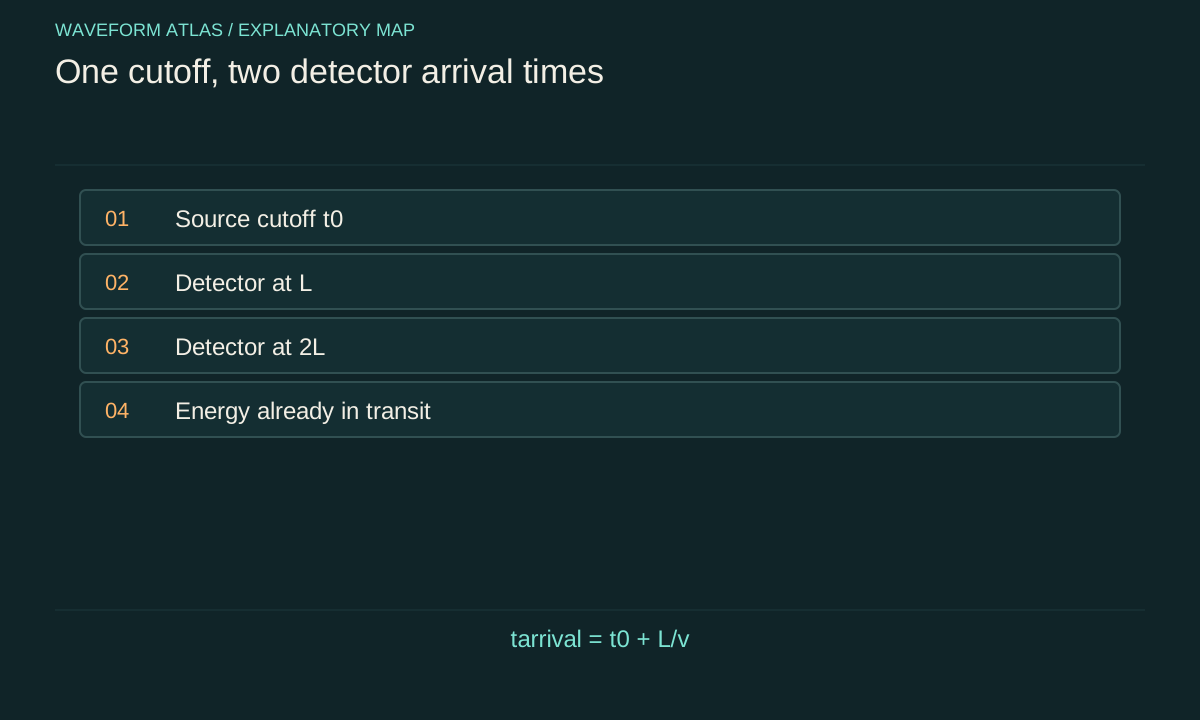
For a direct wave traveling at speed v over distance L, the detector samples the source history at the earlier time t−L/v. The relevant source setting is therefore not generally its setting at detector time t. This is familiar in echoes and distant light, but it is equally important in fast laboratory switching. The finite delay is not evidence that a source-off command failed. It is a consequence of local propagation. A complete experiment records where clocks and monitors are located and how their timing offsets were established.
A traveling-wave equation makes the delay explicit
Consider u(x,t) = f(t−x/v), a solution for a right-moving nondispersive waveform. If the source function changes at t0, the same feature appears at x = L at t0+L/v. The mathematical argument t−x/v is called a retarded time because it refers to earlier source behavior. A finite source pulse maps into a finite traveling region rather than disappearing everywhere at t0.
Suppose a source emits for 2 milliseconds and a detector is 6.86 meters away in air modeled at 343 meters per second. The direct pulse begins at the detector about 20 milliseconds after emission begins and ends about 22 milliseconds after that start time. During the final 20 milliseconds before the trailing edge arrives, the source can already be off. The calculation assumes a direct path and constant speed; room reflections and temperature variation introduce additional measurable effects.
Electromagnetic propagation has the same causal structure
In vacuum, electromagnetic disturbances propagate at c. A one-meter path corresponds to about 3.34 nanoseconds, and a one-kilometer path to about 3.34 microseconds. Those delays are small on human timescales but large enough to matter in high-speed electronics, optical timing, and distributed experiments. Cables and materials generally have different propagation characteristics from vacuum.
The retarded-field description relates a field at an observation event to source behavior at earlier events. Near-field structure and radiation fields differ in their spatial dependence, so a single far-field approximation is not appropriate everywhere. Nevertheless, switching a source does not instantaneously reset a remote electromagnetic field. A practical timing calculation should use the actual propagation path and measured transfer response. Replacing an optical path with a cable, waveguide, or dispersive medium changes the delay and potentially the waveform, not the need for a causal account.
Synchronizing clocks is part of the measurement
A measured arrival time includes source triggering, cable delays, detector latency, and clock offsets. A two-channel oscilloscope with a common timebase can simplify comparison, but unequal cable lengths and electronics still introduce offsets. Separate clocks need a synchronization procedure whose uncertainty is included in the result.
One useful method varies the path length while leaving most electronics unchanged. The change in arrival time then estimates propagation delay with many fixed offsets canceled. If increasing an acoustic path by 3.43 meters shifts a feature by about 10 milliseconds under the chosen conditions, the slope supports the propagation model. The absolute intercept can still contain source and detector delays. Distinguishing slope from intercept prevents an instrumental latency from being mistaken for a different wave speed. Repeating at several lengths also reveals deviations from a simple constant-speed model.
Which feature is being timed?
A pulse has a leading edge, a peak, a centroid, and a trailing edge, and these need not experience identical apparent shifts in a reshaping medium. A threshold crossing depends on amplitude and noise. A pulse peak can move when filtering removes one part of the waveform more strongly than another. Cross-correlation estimates a delay by comparing shapes, but it too depends on how much the shape changes.
Specify the timing estimator before interpreting a result. For a nearly unchanged pulse, several estimators may agree within uncertainty. For a strongly distorted pulse, their disagreement is evidence that one number is insufficient. The time when a newly introduced disturbance can influence a detector is a causal question distinct from the motion of an intensity maximum. An unusual group delay or advanced peak does not by itself demonstrate that a fresh message outran the causal response of the system.
Dispersion spreads the source history
A linear medium can be represented by an impulse response h(t). The output is the convolution of h with the source signal. If the response is causal, it does not depend on future input. A simple pure delay corresponds to a sharply localized impulse response; a dispersive or resonant medium has a more extended response that mixes contributions from a range of earlier source times.
After shutdown, the detector can therefore receive a tail shaped by the medium's memory. Some of that memory is propagation over multiple paths, and some can be temporary energy storage in material or resonant degrees of freedom. Measuring the transfer function over frequency helps predict the tail. A narrowband measurement may hide the details of the earliest response. The appropriate conclusion is that the path has a causal memory, not that the source's current setting acts backward on already propagated portions of the wave.
Reflections add separate delayed histories
A reflecting boundary creates an additional path from source to detector. Each path carries a delayed and modified version of earlier emission. If the path-delay differences exceed pulse duration, distinct echoes can appear. If they overlap, interference changes the waveform and can make the apparent ending gradual or oscillatory.
For a simple acoustic reflection whose path is 6.86 meters longer than the direct route, the additional delay is about 20 milliseconds at 343 meters per second. Moving the reflecting surface changes that delay in a predictable geometric way. Absorbing or blocking the reflected path provides another control. These tests distinguish an echo from a source that remains active or a detector that rings. In a complex room, many paths form a reverberant tail, so one delayed replica may be an inadequate model even though the same causal principle applies.
Energy already in transit belongs to the budget
At the moment a source stops, energy can occupy the space between source and detector. The amount depends on the field distribution and path geometry. For an ideal lossless transmission path carrying steady power P with travel time τ, the energy in transit is approximately Pτ, subject to the appropriate mode and boundary assumptions.
An illustrative 1-watt beam along a 300-meter vacuum path has a travel time near 1 microsecond and about 1 microjoule in that path at steady state. After the source turns off, the detector can still receive that previously emitted energy. This is a bookkeeping estimate, not a statement that the beam is a rigid object. Reflections, loss, and standing-wave storage change the account. Integrating the detector power after shutdown can test how much energy was in transit or stored, provided the detector captures the relevant outgoing channels.
A source-off test can separate delays from lifetimes
Use a local source monitor and detectors at two or more distances. A propagation delay shifts the trace in time with path length. A resonator lifetime changes the shape or decay scale after a local excitation ends. Detector latency often remains a fixed offset when the path is varied. These different dependencies make a combined experiment more informative than a single waveform.
If the medium itself changes with path length, the separation is less simple: extra material can add both delay and absorption or dispersion. A reference path and an independently measured transfer function help identify those effects. Record the switching waveform rather than assuming an ideal step. A realistic source has finite edge duration, and that duration sets the time resolution with which the trailing edge can be followed. The uncertainty should include feature definition and waveform distortion, not only the clock's sampling interval.
What the delay does and does not imply
Delayed observation demonstrates that information about a source change reaches different locations through a physical path. It does not imply that the source continues supplying new energy after shutdown, nor that the detector's remaining signal is mysterious. The signal can be explained by earlier emission, stored energy, and response filtering under an appropriate model.
The same reasoning limits claims about instantaneous collapse inferred from a disappearing classical wave. A remote field trace is not a direct measurement of a universal quantum-state update. Quantum correlations and conditional state assignments require their own operational description, and they do not replace local propagation of usable signals. For the shutdown experiment, the clearest result is a measured relation between source history and detector history. Giving the path, timing convention, and response model makes that relation precise without adding claims the data cannot establish.
What to take forward
- A detector sees earlier source behavior delayed by the propagation path.
- Timing a peak, edge, or centroid can give different answers after reshaping.
- Varying path length separates propagation from fixed source and detector latency.
Go to the original work.
These links identify the sources behind specific claims. Verification scope varies by source and is stated below.
- 1 / University teachingElectromagnetics and Applications: Lecture 19, Electromagnetic Radiation ↗
Electromagnetics and Applications: Lecture 19, Electromagnetic Radiation.
Retarded electromagnetic propagation and radiated fields
Verification scope: Official author-written lecture description inspected
- 2 / University teachingWave Propagation — Triantaphyllos Akylas, lecture notes ↗
Triantaphyllos Akylas. Wave Propagation — Triantaphyllos Akylas, lecture notes. 2017.
Transient wave propagation, elastic modes, interfaces and water waves
Verification scope: Official chapter contents and author-written course records inspected
- 3 / University teachingElectromagnetics and Applications — lecture notes ↗
David H. Staelin. Electromagnetics and Applications — lecture notes. 2009.
Poynting theorem, boundary conditions, material response and polarization
Verification scope: Official author-written course and topic records inspected
- 4 / University teachingSignals and Systems — Alan V. Oppenheim, lecture notes ↗
Alan V. Oppenheim. Signals and Systems — Alan V. Oppenheim, lecture notes. 2011.
Convolution, linear systems, filtering and feedback
Verification scope: Official course notes and topic records inspected
- 5 / Primary researchCavity ring-down spectrometer for high-fidelity molecular absorption measurements ↗
H. Lin; Z. D. Reed; V. T. Sironneau; J. T. Hodges. Journal of Quantitative Spectroscopy and Radiative Transfer 161, 11–20 (2015).
DOI: 10.1016/j.jqsrt.2015.03.026
Exponential cavity decay fitting, baseline offsets and a loss budget separating mirror loss, etaloning, scattering and absorption.
Verification scope: NIST-hosted full text: title page and relevant decay-fit/loss-budget passages inspected; not every section reread.
- 6 / University teachingQuantum Optical Communication — Jeffrey H. Shapiro, readings and lecture slides ↗
Jeffrey H. Shapiro. Quantum Optical Communication — Jeffrey H. Shapiro, readings and lecture slides. 2016.
Author-written quantum attenuator, amplifier, detection and parametric interaction framework
Verification scope: Official course materials and topic mapping inspected
Found a problem with a claim or calculation? Send the page, the claim and the evidence. Read how these articles were prepared.