A sinusoid is an ideal reference, not a finite event
An exact monochromatic sinusoid extends indefinitely in time. A laboratory source operates for a finite duration, so its field is better written as a carrier multiplied by an envelope, such as E(t) = A(t) cos(ω0t+φ). The envelope describes the slowly or rapidly changing strength, while the carrier identifies a central oscillation frequency when that separation is useful.
If the envelope changes on a timescale comparable to one carrier period, the distinction between carrier and envelope becomes less clean. A pulse may contain only a few oscillations, and its detailed electric-field phase can matter. The total field remains the primary quantity. Calling a finite burst a pure frequency is therefore an approximation whose quality depends on duration and the measurement bandwidth. This distinction is essential when a sharp shutdown is interpreted as simply deleting the last part of an otherwise perfectly monochromatic wave.
The source window becomes a traveling packet
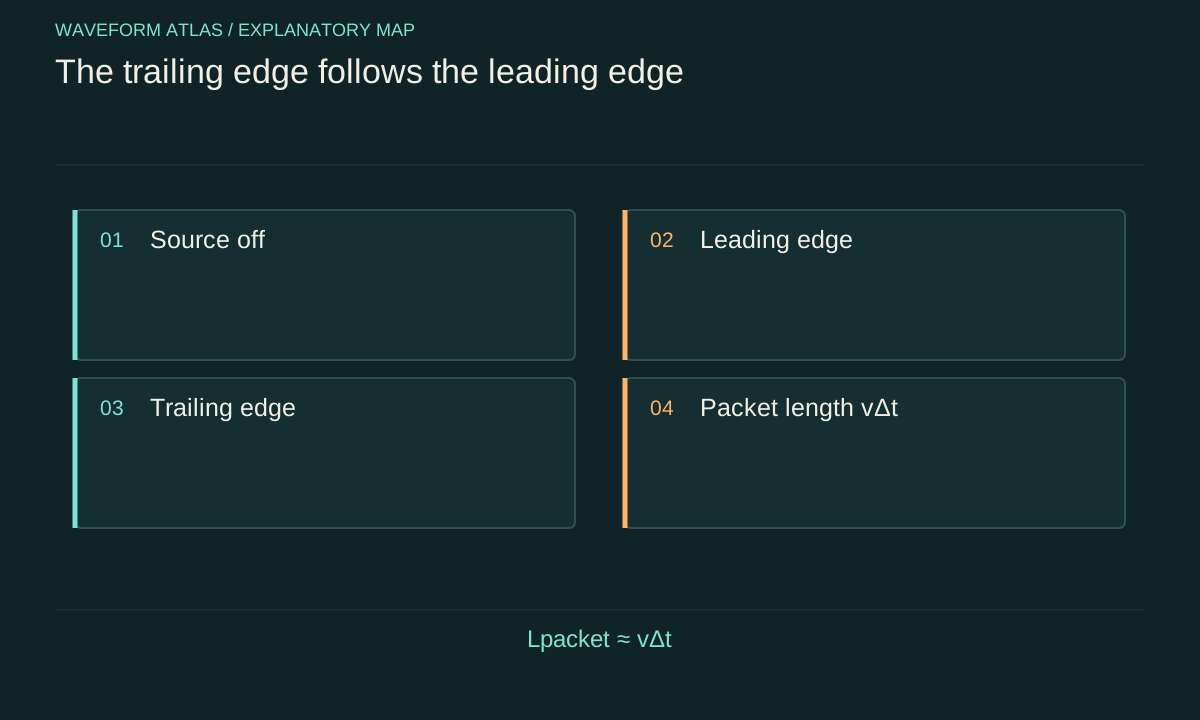
For an ideal nondispersive wave, the envelope at distance x is A(t−x/v). If emission occurs from time zero to Δt, the packet occupies a length vΔt after it has fully left the source. Its trailing edge marks the last emitted portion, not the destruction of the earlier portions. At a fixed detector, the pulse arrives, passes, and leaves.
Consider an illustrative one-microsecond electromagnetic burst in vacuum. Its spatial length is approximately 300 meters. The same temporal duration in an acoustic medium with speed 343 meters per second corresponds to about 0.343 millimeter. Equal durations do not imply equal physical sizes because propagation speed matters. The estimate assumes a well-defined propagation direction and ignores transverse spreading. A real beam also has a cross-sectional energy distribution, so its total energy requires both temporal and spatial integration of the appropriate flux.
A rectangular envelope has a sinc spectrum
For a complex envelope equal to one between zero and T and zero elsewhere, the Fourier transform is proportional to T exp(−iωT/2) sinc(ωT/2), where sinc(z) = sin(z)/z. Its spectral power has a central lobe and sidelobes. The first envelope-frequency zeros occur at ±1/T when frequency is expressed in hertz.
A 10-microsecond rectangular envelope therefore has first zeros 100 kilohertz from its center. Multiplying by a carrier shifts the envelope spectrum to frequencies near that carrier, with the usual positive and negative frequency structure for a real field. The sharp edges generate the extended sidelobes. This example is a mathematical calculation, not a claim that a physical switch has infinite bandwidth. Finite rise and fall times smooth the discontinuities and modify the high-frequency tail, which is why realistic pulse specifications include edge timing rather than duration alone.
Interactive model: A freely spreading quantum packet. Enable JavaScript to adjust its controls.
σₓ(t) = √[σ₀² + t²/(4σ₀²)]
One-dimensional free particle, initial unchirped minimum-uncertainty Gaussian. Dimensionless units: ℏ = m = 1. The plotted position density broadens under unitary evolution.
Smooth envelopes trade edge speed for spectral concentration
A Gaussian envelope has a Gaussian Fourier transform, making it a convenient model without abrupt discontinuities. Other smooth windows can suppress sidelobes at the cost of broadening the central spectral feature or changing the effective duration. There is no single pulse shape that is best for every purpose; the relevant compromise depends on timing accuracy, spectral selectivity, peak power, and acceptable tails.
Duration-bandwidth products also depend on definitions. An rms width, an amplitude full width at half maximum, and an intensity full width at half maximum are different quantities. Likewise, angular frequency and ordinary frequency differ by 2π. Quoting a numerical transform limit without these conventions creates avoidable confusion. A well-specified pulse comparison gives the measured intensity profile, the spectral profile, and the width definitions. Phase across the spectrum matters too: equal spectral intensities can correspond to different temporal durations when the phases differ.
Pulse energy is an integral, not a peak
For a beam with power P(t), pulse energy is U = ∫P(t)dt. A flat 2-watt pulse lasting 5 microseconds carries 10 microjoules in the ideal model. If that same energy is spread over 10 microseconds with a comparable shape, its characteristic power is lower. A lower measured peak does not necessarily imply that energy was absorbed.
For electromagnetic fields, power is related to the Poynting flux integrated across the beam. For mechanical and acoustic waves, the corresponding flux involves the relevant forces, velocities, pressures, or displacements. The exact relation between a measured amplitude and power depends on impedance and mode normalization. A pulse can also change transverse area, altering local intensity while keeping total power similar. Energy comparisons must therefore use a detector aperture and integration time sufficient to capture the whole packet, including delayed components and spatial redistribution.
Dispersion changes the packet during travel
In a dispersive medium, the wave number k depends on frequency. Different spectral components accumulate different phases over distance. Expanding k near a central frequency separates a group delay from higher-order terms that broaden or distort the envelope. A pulse that is short at the source can become longer at a distant detector even in a medium with negligible absorption.
For an illustrative linear group-delay slope, suppose two significant spectral components arrive 20 nanoseconds apart after a path. That spread contributes to temporal broadening, but the exact output shape depends on the entire spectrum and phase, not merely two frequencies. A prearranged spectral phase can sometimes compensate the medium's dispersion and compress the pulse later. Such compression redistributes energy in time; it does not create energy. The source can be off throughout the later propagation, broadening, and recompression process.
A finite packet can reflect and split
At an interface, part of a pulse can reflect and part can transmit, with possible conversion into other modes. The resulting packets may travel in different directions or at different speeds. A detector on the original path can therefore report a much smaller pulse even when the total outgoing energy remains substantial. The interface, rather than the source cutoff, determines that redistribution.
Multiple reflections create a sequence of delayed replicas or a more complicated reverberant response. If the replicas overlap, interference changes the instantaneous waveform. If they are separated, they appear as echoes. The distinction depends on pulse duration relative to path-delay differences. A short pulse can make paths easier to resolve, but its broader spectrum may encounter more dispersion or frequency-dependent loss. Pulse design and interpretation are linked: improving temporal resolution can introduce additional physical effects that must be included in the model.
Single-photon packets need a quantum description
A single photon can occupy a temporal wave-packet mode with a distribution of possible detection times. That statement does not mean the photon is a tiny classical bead with a hard front and back, nor does it mean a weak classical pulse is automatically a single-photon state. Photon-number statistics and mode structure are separate properties of a prepared field.
Temporal shaping matters for coupling a photon to an emitter or cavity. The incoming envelope can be matched to the system's response, changing the probability of excitation or transfer under specified conditions. A detection-time histogram is shaped by the photon state, propagation, and detector response. Turning off the preparation source does not remove a photon already propagating in a mode. Its subsequent absorption, scattering, or detection requires an interaction at a later location and time, described by the relevant quantum dynamics.
A useful packet measurement combines time and frequency
Record the temporal profile and spectrum under a stated calibration, and measure spectral phase when it matters to the claim. Compare pulse energy before and after the system with sufficient aperture and integration time. Vary path length to test dispersion, and vary detector bandwidth to expose instrumental tails. These measurements distinguish attenuation, broadening, ringing, and simple travel delay.
A report should state which duration is quoted and whether it refers to field amplitude, intensity, or a detection-time distribution. It should also identify the point at which the source duration was measured. The central result is modest but powerful: a finite emission window creates a packet with its own subsequent trajectory and internal structure. Once launched, that packet does not require the source to remain active. Its later shape is evidence about propagation and interaction, not a retroactive record of whether the switch is still on.
What to take forward
- A finite pulse continues traveling after its source has stopped.
- Duration, bandwidth, and width conventions must be specified together.
- Peak reduction can arise from broadening or splitting without an equal reduction in pulse energy.
Go to the original work.
These links identify the sources behind specific claims. Verification scope varies by source and is stated below.
- 1 / University teachingLecture 16: Fourier transform — Signals and Systems ↗
Lecture 16: Fourier transform — Signals and Systems.
Finite pulse Fourier transforms and time/frequency scaling
Verification scope: Official lecture equations inspected
- 2 / University teachingUltrafast Optics — lecture notes ↗
Franz X. Kärtner. MIT Ultrafast Optics: Lecture Notes. 2005.
Pulse amplification and ultrafast optical dynamics
Verification scope: Official course material records inspected
- 3 / University teachingWave Propagation — Triantaphyllos Akylas, lecture notes ↗
Triantaphyllos Akylas. Wave Propagation — Triantaphyllos Akylas, lecture notes. 2017.
Transient wave propagation, elastic modes, interfaces and water waves
Verification scope: Official chapter contents and author-written course records inspected
- 4 / University teachingElectromagnetics and Applications: Lecture 19, Electromagnetic Radiation ↗
Electromagnetics and Applications: Lecture 19, Electromagnetic Radiation.
Retarded electromagnetic propagation and radiated fields
Verification scope: Official author-written lecture description inspected
- 5 / University teachingElectromagnetics and Applications — lecture notes ↗
David H. Staelin. Electromagnetics and Applications — lecture notes. 2009.
Poynting theorem, boundary conditions, material response and polarization
Verification scope: Official author-written course and topic records inspected
- 6 / University teachingSignals and Systems — Alan V. Oppenheim, lecture notes ↗
Alan V. Oppenheim. Signals and Systems — Alan V. Oppenheim, lecture notes. 2011.
Convolution, linear systems, filtering and feedback
Verification scope: Official course notes and topic records inspected
- 7 / University teachingQuantum Optical Communication — Jeffrey H. Shapiro, readings and lecture slides ↗
Jeffrey H. Shapiro. Quantum Optical Communication — Jeffrey H. Shapiro, readings and lecture slides. 2016.
Author-written quantum attenuator, amplifier, detection and parametric interaction framework
Verification scope: Official course materials and topic mapping inspected
- 8 / Primary researchTime-resolved scattering of a single photon by a single atom ↗
V. Leong; M. A. Seidler; M. Steiner; A. Cerè; C. Kurtsiefer. Nature Communications 7, 13716 (2016).
Time-dependent single-atom excitation for rising and decaying exponential single-photon envelopes; the reported 56(11)% peak-excitation increase, not an increase in total scattering.
Verification scope: Publisher bibliographic record and abstract inspected; full article not reread in this repair
- 9 / Primary researchSingle Photon Absorption by a Single Quantum Emitter ↗
D. Pinotsi; A. Imamoglu. Physical Review Letters 100(9), 093603 (2008).
DOI: 10.1103/PhysRevLett.100.093603
Near-unit single-photon absorption for a three-level Lambda emitter under stated rate and spatial-mode-matching conditions.
Verification scope: Publisher abstract and primary full-text first-page excerpt inspected; not a full-paper reread
Found a problem with a claim or calculation? Send the page, the claim and the evidence. Read how these articles were prepared.