Define the quadratures and reference
A single harmonic mode can be described by dimensionless quadratures X and P with commutator [X,P]=i. In this convention the vacuum has variance one half in each quadrature, and the uncertainty product satisfies ΔXΔP≥1/2. Other conventions place factors of two differently, so the definitions must accompany every numerical squeezing claim. A variance cannot be called reduced without naming its reference and units.
For a mechanical oscillator, quadratures relate to position and momentum after scaling by mass and frequency. For an optical mode, they describe field components relative to a phase reference. Neither interpretation means a material object has been squeezed between plates. The operation acts on the quantum state of a specified mode. Mechanical pressure, smaller trap size and narrower quadrature noise can interact in an apparatus, but they remain distinct variables.
Write the ideal transformation
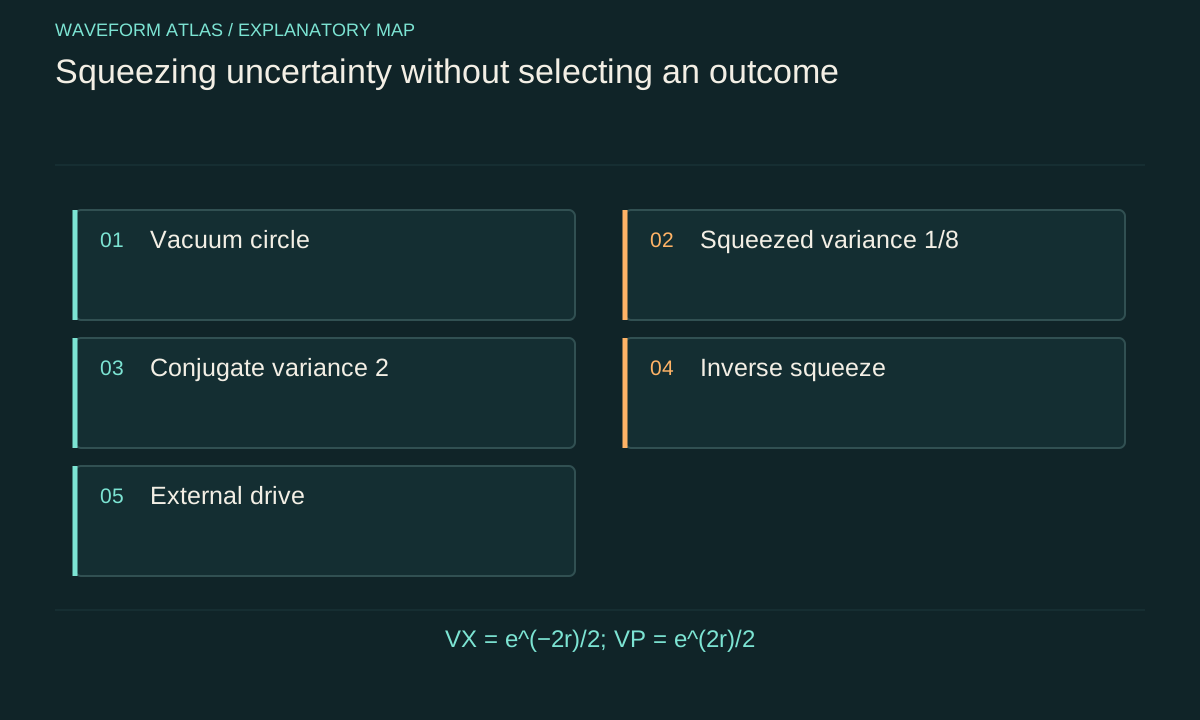
An ideal squeeze with parameter r transforms the selected quadratures as X→e^(−r)X and P→e^r P for a suitable orientation. Starting from vacuum, the variances become e^(−2r)/2 and e^(2r)/2. Their product remains one quarter. The uncertainty ellipse becomes narrow in one direction and broad in the other while its minimum-uncertainty area remains unchanged in this pure-state idealization.
The operation has an inverse obtained by reversing the sign of r with the appropriate phase. Applying the inverse after the squeeze restores the initial state if no other dynamics or noise intervenes. This reversibility is a direct reason squeezing cannot universally be identified with irreversible outcome selection. It does not imply that every laboratory sequence called squeezing is lossless, or that an imperfect inverse must succeed without calibration.
Work through a numerical ellipse
Choose r=ln 2. The standard deviation of X is halved and that of P is doubled. Their variances become one eighth and two, respectively, compared with one half initially. The squeezed variance is one quarter of the reference variance, corresponding to approximately six decibels of noise reduction under the conventional variance-ratio definition. The conjugate variance increases by the reciprocal factor.
The means can remain zero throughout this transformation. A mean-field detector alone would therefore see no change, even though the fluctuation pattern changes substantially. Measuring quadratures at several reference phases reveals the ellipse. The minimum and maximum variances identify its axes in the ideal Gaussian case. These calculated values illustrate a controlled state transformation and are not measurements from a particular squeezing apparatus.
Interactive model: Squeezing an uncertainty ellipse. Enable JavaScript to adjust its controls.
σₓ = e⁻ʳ/√2; σₚ = eʳ/√2; σₓσₚ = 1/2
Ideal pure one-mode Gaussian squeezing with ℏ = 1. The ellipse represents one-standard-deviation widths, not a particle trajectory. Loss and technical noise are omitted.
Position narrowing has a normalized form
For a one-dimensional wavefunction, the map ψ_s(x)=√s ψ(sx), with s>0, scales the position spread to Δx/s. It narrows the distribution for s>1 and broadens it for 0<s<1. Substituting u=sx in the normalization integral shows that total probability remains one. Momentum scales oppositely because differentiation with respect to x introduces s. The resulting spreads are Δx/s and sΔp, preserving their product for this particular unitary dilation.
This mathematical map should not be confused with discarding particles outside an aperture. A spatial filter has unsuccessful outcomes or loss channels whose probabilities must be included. The dilation acts on the complete state, preserving inner products. A physical implementation requires a Hamiltonian and control sequence that approximates the map. Writing the normalized transformation establishes its mathematical possibility, not the engineering feasibility of arbitrary compression rates or strengths.
Squeezing changes oscillator energy
For a mode of fixed frequency ω, a squeezed vacuum has mean excitation number sinh²r and energy ℏω[sinh²r+1/2]. At r=ln 2, sinh r=3/4, so the mean excitation number is 9/16. The state has more energy than the unsqueezed vacuum even though one quadrature variance is smaller. The increased conjugate fluctuations contribute to that energy, and the driving interaction supplies it.
This example prevents a misleading inference that lower uncertainty in one observable means lower total energy. It also distinguishes squeezing at fixed Hamiltonian from adiabatically changing the oscillator frequency, which changes the reference ground-state widths and energy scale. Comparing experiments requires specifying both the state and the Hamiltonian against which squeezing and excitation are defined. A narrower position distribution can arise through either route, with different bookkeeping.
Squeezed does not mean a technical coherent state
In quantum optics, a coherent state has a specific technical meaning: it is a displaced vacuum state with vacuum-level isotropic quadrature noise. A squeezed state is generally not a coherent state in that narrow terminology. Nevertheless, it can retain quantum coherence and be a pure state. The everyday phrase coherent control therefore should not be confused with membership in the coherent-state family.
A squeezed vacuum also differs from a mixture of randomly displaced states that happens to have a similar width along one measured direction. Complete discrimination can require several quadrature distributions or other state information. A single low-noise measurement is valuable evidence about that observable, but it does not reconstruct every feature of the state. State which properties were directly measured and which follow from preparation assumptions or a fitted Gaussian model.
Experimental reversal demonstrates a bounded claim
Burd and colleagues reported a trapped-ion protocol using squeezing, a small coherent displacement and reversed squeezing to amplify a motion signal. The NIST author publication record identifies the method and its sensing purpose. This supplies an experimental example of controlled squeezing used within a coherent sequence. It is not evidence that every compressed material or rapidly changing cavity shares the same dynamics.
The relevant inference is limited but useful: squeezing is not intrinsically equivalent to destructive state selection. The experiment’s detailed performance depends on its motional mode, control and noise. Our discussion relies on the verified publication abstract and does not reproduce a full uncertainty analysis. A proposed compression-induced collapse law must specify why it would apply to one physical implementation and how its prediction differs from this established control framework.
Loss mixes in additional fluctuations
For an illustrative linear attenuation channel with transmission η and an independent vacuum environment, the measured quadrature variance is ηV+(1−η)/2 in the present convention. Starting with V=1/8 and η=1/2 gives 5/16. The squeezing is reduced but not eliminated. If the environment is thermal or the detector adds electronic noise, the corresponding additional contribution changes and must be modelled separately.
Loss also affects the interpretation of purity and correlations. A surviving narrow distribution does not establish that the complete state remained isolated. Measure transmission and calibrate the detector reference before correcting a variance for inefficiency. Report raw and inferred values separately. A model-dependent correction can estimate the input state, but it should not be described as a direct observation of a quantity the detector did not resolve.
Phase jitter rotates the noise ellipse
A squeezed quadrature must be measured at the appropriate reference angle. Small phase errors mix the expanded quadrature into the narrow one, which can strongly degrade observed squeezing when antisqueezing is large. For a fixed angle θ, the variance is V_min cos²θ+V_max sin²θ in an aligned Gaussian covariance model. The measured result can therefore change even if the underlying state preparation remains unchanged.
Scan the reference angle and fit the full phase dependence rather than relying on one optimized point. Monitor phase stability during the acquisition interval and test the analysis with known controls. A loss of the minimum-noise signature can result from reference uncertainty, state noise or detector loss; those mechanisms predict different accompanying observations. Distinguishing them is essential before attributing the change to an intrinsic loss of quantum coherence.
Test squeezing as an operation
Prepare a reproducible reference state, apply a controlled squeeze, measure quadrature distributions, and compare with a squeeze–inverse sequence. Include an unchanged control and account for free evolution between pulses, which rotates phase space. Record energy or excitation, survival probability and phase-sensitive correlations appropriate to the mode. Vary strength and duration independently where possible to distinguish the desired transformation from accumulated heating.
The embedded educational model illustrates normalized Gaussian narrowing and the conjugate uncertainty relation; it is not a reconstruction of a specific laboratory sequence. Its calculated curves should be read with their ideal assumptions visible. A successful experiment can establish reduced noise and recoverable state control over a tested range. It cannot establish that every form of compression is reversible, but it decisively motivates keeping quantum squeezing separate from material pressure and measurement outcome selection.
The covariance determinant supplies a useful consistency check for a Gaussian model. With the present dimensionless quadratures, a physical single-mode covariance matrix obeys det V≥1/4. An ideal pure squeeze saturates that bound even after a rotation introduces off-diagonal covariance. Multiplying only the two displayed axis variances is therefore insufficient when the ellipse is tilted; the covariance term must be included. A numerical interface should either keep its axes aligned with the ellipse or show that correlation explicitly. This check prevents arbitrary slider settings from creating an apparently impressive noise reduction that violates the assumed quantum-state model.
What to take forward
- Ideal squeezing is unitary and has an inverse.
- Reducing one quadrature variance enlarges its conjugate variance.
- Loss and phase jitter require independent calibration.
Go to the original work.
These links identify the sources behind specific claims. Verification scope varies by source and is stated below.
- 1 / Primary experimentBurd et al., Quantum amplification of mechanical oscillator motion ↗
S. C. Burd; R. Srinivas; J. J. Bollinger; A. C. Wilson; D. J. Wineland; D. Leibfried; D. H. Slichter; D. T. C. Allcock. Science 364(6446), 1163–1165 (2019).
A trapped-ion protocol uses squeezing interactions around a coherent displacement.
Verification scope: NIST author publication record and abstract inspected; journal DOI 10.1126/science.aaw2884 verified.
- 2 / University teachingAdams, MIT Quantum Physics I: Optional Problems on the Harmonic Oscillator ↗
Coherent states, uncertainty, sudden oscillator-frequency changes and time-dependent squeezed-state quadratures.
Verification scope: Official six-page problem sheet text inspected, including frequency-change and quadrature questions; original worked examples in our articles.
- 3 / ReviewLvovsky, Squeezed light ↗
A. I. Lvovsky, Squeezed light, arXiv:1401.4118 (2014; revised 2016).
Dimensionless quadratures, squeezed and thermal variances, photon number, homodyne readout and the vacuum-loss variance formula.
Verification scope: Targeted Eqs. (3), (5), (12), (22), (53), the thermal-state paragraph and homodyne section read in the 2016 preprint version.
- 4 / University teachingUC San Diego Physics 212A, Worksheet 6: Dilatations ↗
S. Kravec, Physics 212A, Worksheet 6, Problem 1: Dilatations (UC San Diego, Fall 2015).
Problem 1: unitary scale transformations and the symmetrized position–momentum generator. Normalization and kinetic-energy scaling are derived in the article.
Verification scope: Problem 1(a–c) read directly; this is an exercise sheet, not a worked solution.
Found a problem with a claim or calculation? Send the page, the claim and the evidence. Read how these articles were prepared.