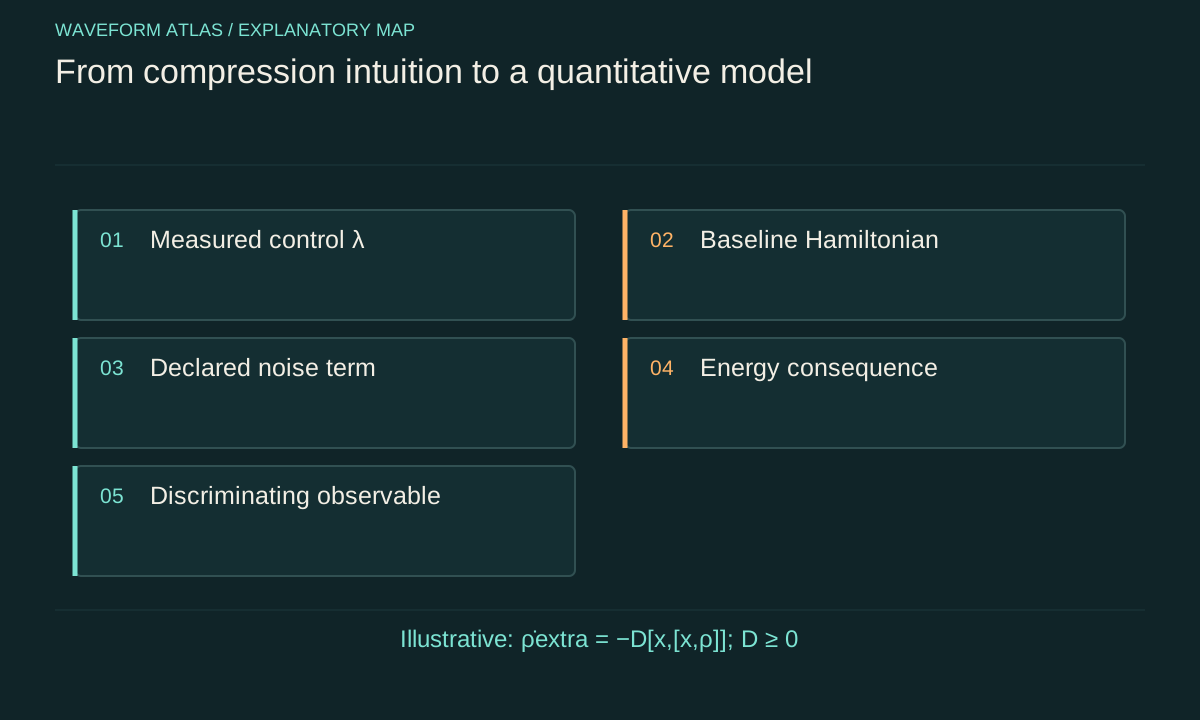
Choose one physical meaning of compression
Begin with a variable that the apparatus can control and measure: trap frequency, cavity length, material density, plate separation or pulse duration. These variables have different units and enter different equations. A model that uses the word compression without choosing among them cannot make an unambiguous prediction. A dimensionless ratio can be useful, but it must be defined from the physical variables rather than treated as a universal substance.
For example, λ=L₀/L describes a geometric width ratio, while a squeezing parameter r describes a particular quadrature transformation. They can be related in a specified ideal protocol, but that relation is not automatic for every material or cavity. Write down how the control is implemented and which other quantities change with it. This prevents an appealing analogy from silently replacing the dynamics that the experiment actually uses.
Start with the established baseline
For a trapped particle, choose a potential V(x,t) and solve the corresponding Schrödinger dynamics or an appropriate approximation. For a pulse, specify dispersion and spectral phase. For a material, provide an equation of state and constitutive response. The baseline should already predict ordinary mode changes, work and propagation. An added hypothesis can then be expressed as a deviation from that explicit reference.
Test simple limits before adding complexity. No control change should reproduce the unmodified system. Slow and sudden limits should agree with known results where applicable. A harmonic model should be identified as such and not extended uncritically into an anharmonic regime. These checks reduce the risk that a numerical or conceptual error is mistaken for evidence requiring new physics.
Define the observable and measurement map
A model predicts a state or field, but the experiment records detector outputs. Include the measurement map connecting them: finite resolution, bandwidth, efficiency and any selection rule. If the proposed effect concerns coherence, specify an interference probability or correlation rather than only a spatial width. If it concerns energy, include a calibrated integral or mode-energy estimate rather than a peak height.
The comparison should use the same quantity on both sides. A simulated instantaneous density cannot be compared directly with a long-exposure blurred image without applying the instrument response. Likewise, a conditional probability in a selected output differs from an unconditional detection rate. Writing the measurement map explicitly reveals where a claim depends on assumptions about unobserved or rejected events.
Add a hypothetical term with a declared role
Suppose the research question asks whether stronger confinement introduces extra phase randomization. An illustrative model might assign a nonnegative rate Γ(λ) to decay of an identified coherence, giving c(t)=c(0)exp[−∫Γ(λ(t′))dt′] in a simplified regime. This is a proposed phenomenological test model, not an established compression-induced collapse law. Its validity depends on the chosen basis and on neglected dynamics.
Specify whether the term represents ordinary technical noise, an environmental interaction or a hypothesized fundamental modification. The same reduced-state equation can sometimes arise from different underlying accounts, so fitting it does not uniquely establish an ontology. A claim about individual objective outcomes requires more than an ensemble contrast-decay curve. State what additional assumptions connect the mathematical term to that stronger interpretation.
Check probability and positivity
A physical quantum-state evolution must preserve normalization and assign nonnegative probabilities. Complete positivity is a standard consistency requirement for maps that act on a subsystem potentially correlated with another system. Lindblad's primary work and the independent finite-dimensional result of Gorini, Kossakowski and Sudarshan characterize important classes of completely positive Markovian generators. Its mathematical role is to constrain allowable dynamics, not to provide evidence that compression activates a particular additional mechanism.
When building a finite-dimensional numerical model, verify trace preservation and positivity over the tested parameter range. For continuous variables with unbounded operators, domain and mathematical assumptions require additional care; a formal equation is not automatically a rigorous global solution. State the approximation and check convergence of any truncation. A curve that fits one observable is unacceptable if the same model predicts negative probabilities elsewhere.
A diffusion example exposes an energy consequence
Consider an illustrative additional term −D[x,[x,ρ]] with D≥0, alongside the usual Hamiltonian evolution and appropriate domain assumptions. In position representation it suppresses off-diagonal elements at a rate proportional to D(x−x′)². The coefficient has units of inverse length squared per time. The same term increases momentum second moment at rate 2Dℏ², so it is not merely a cosmetic deletion of interference.
For a free particle, that momentum diffusion gives a mean kinetic-energy increase Dℏ²/m. This is a calculated consequence of the stated model, not a measured heating rate or a proposed universal constant. Any compression dependence assigned to D would therefore predict both coherence changes and heating. Comparing those observables can constrain the model more strongly than fitting visibility alone.
Separate fitted parameters from predictions
If every run receives its own adjustable rate, a model can reproduce many observations without explaining their relation. Prefer a shared functional form and a limited parameter set that predicts several conditions. Fit on one subset of data and test on another when feasible. Include uncertainty and covariance of fitted parameters. A precise-looking best-fit curve can conceal weak identifiability when several parameters compensate one another.
Choose units and scales that make the parameter meaning transparent. A rate of one inverse second has a different effect from a dimensionless compression coefficient unless multiplied by a stated timescale. Dimensional analysis catches many accidental model changes. It also exposes whether a suggested dependence requires an additional length, energy or mass scale that has not yet been physically justified.
Design controls that break degeneracies
Ordinary heating, reference-phase drift and detector mismatch can all reduce recovered interference. A compression-dependent signal is therefore not automatically diagnostic if those effects also change with compression. Measure them independently and vary control dimensions that give different predictions. Holding the endpoint fixed while changing ramp duration can distinguish some drive effects from a static geometry dependence.
Vary the hold time separately from the ramp, compare different initial states, and monitor survival and energy. If a model predicts separation-dependent dephasing, test more than one separation rather than absorbing that dependence into an overall fitted rate. The useful controls are those that make competing explanations diverge quantitatively within the instrument's sensitivity. Repeating the same ambiguous comparison with more counts may not solve the underlying identification problem.
Use existing experiments at their actual scope
Verified examples already show that squeezing can be part of coherent trapped-ion control and that driven effective boundaries can generate radiation. These findings establish distinct mechanisms in distinct systems. They prevent a proposed model from treating every narrower distribution or changing boundary as the same irreversible event. They do not by themselves exclude every possible additional effect in every material or parameter regime.
Translate an existing result into a constraint only after mapping its physical parameters and measured observable to the proposed model. An abstract-level source check may establish the reported mechanism but not provide all numerical details needed for a new bound. Do not invent those missing values. A defensible research plan identifies the required data and distinguishes a qualitative consistency check from a quantitative exclusion.
Declare a falsifiable comparison
State which outcomes would favour the baseline, which would support the added term and which would remain inconclusive. Specify the parameter range and uncertainty required to separate the predictions. If the predicted difference lies below the instrument's resolution, the experiment cannot adjudicate it even if the data look smooth. A null result then gives a sensitivity-limited bound rather than a universal rejection.
If an anomaly appears, repeat with independent calibration or a different readout that probes the same predicted mechanism. A model that explains both coherence and energy changes with shared parameters is more constrained than one explaining only a single trace. Conversely, a failure of one predicted companion effect is informative. The aim is a connected set of quantitative tests, not an interpretation that can accommodate every outcome after the fact.
A completed model specification includes equations, parameter definitions, preparation, control history, measurement response and numerical checks. Publish calculated illustrative curves as calculations and reserve experimental markers for actual observations. Record source access limits and separate settled foundations from the proposed extra dynamics. This makes the work reviewable even before an experiment has been performed.
Compression can then serve as a useful research variable rather than a universal explanation. The model may describe reversible control, dissipative material response or a carefully stated new hypothesis. Its scientific value comes from predicting distinguishable observations while respecting probability, energy and the limitations of the apparatus. That is the step that turns an intuition about bringing things closer into a claim another researcher can test.
Archive the parameter values and numerical resolution used for each prediction. A result that changes substantially under refinement is a computational issue to resolve before comparing it with a new physical mechanism.
What to take forward
- A model needs a physical control variable and a detector-level prediction.
- Added coherence-loss terms can imply testable heating as well.
- Check normalization, positivity and falsifiable differences from the baseline.
Go to the original work.
These links identify the sources behind specific claims. Verification scope varies by source and is stated below.
- 1 / University teachingMIT Quantum Physics I: lecture notes ↗
Course materials cover normalization, observables, wells, scattering and angular momentum.
Verification scope: Official course index inspected; linked lecture topics verified.
- 2 / University teachingAdams, MIT Quantum Physics I: Optional Problems on the Harmonic Oscillator ↗
Coherent states, uncertainty, sudden oscillator-frequency changes and time-dependent squeezed-state quadratures.
Verification scope: Official six-page problem sheet text inspected, including frequency-change and quadrature questions; original worked examples in our articles.
- 3 / Primary theoryLindblad (1976), On the generators of quantum dynamical semigroups ↗
G. Lindblad. Communications in Mathematical Physics 48, 119–130 (1976).
Completely positive Markovian dynamical generators; used as a mathematical consistency framework, not evidence for a compression-induced collapse law.
Verification scope: Publisher abstract and metadata inspected; full subscription article not read.
- 4 / Primary experimentBurd et al., Quantum amplification of mechanical oscillator motion ↗
S. C. Burd; R. Srinivas; J. J. Bollinger; A. C. Wilson; D. J. Wineland; D. Leibfried; D. H. Slichter; D. T. C. Allcock. Science 364(6446), 1163–1165 (2019).
A trapped-ion protocol uses squeezing interactions around a coherent displacement.
Verification scope: NIST author publication record and abstract inspected; journal DOI 10.1126/science.aaw2884 verified.
- 5 / Primary experimentWilson et al. (2011), Observation of the dynamical Casimir effect in a superconducting circuit ↗
C. M. Wilson; G. Johansson; A. Pourkabirian; M. Simoen; J. R. Johansson; T. Duty; F. Nori; P. Delsing. Nature 479(7373), 376–379 (2011).
A modulated superconducting circuit produced radiation with two-mode squeezing; energy is supplied by modulation.
Verification scope: Primary-paper abstract in PubMed inspected; DOI 10.1038/nature10561 verified.
- 6 / Primary theoryGorini, Kossakowski and Sudarshan, Completely positive dynamical semigroups of N-level systems ↗
V. Gorini; A. Kossakowski; E. C. G. Sudarshan. Journal of Mathematical Physics 17(5), 821–825 (1976).
Independent finite-dimensional characterization of completely positive Markovian generators.
Verification scope: Publisher bibliographic record and abstract inspected; full paper not read.
- 7 / ReviewBassi et al., Models of wave-function collapse, underlying theories, and experimental tests ↗
Angelo Bassi; Kinjalk Lochan; Seema Satin; Tejinder P. Singh; Hendrik Ulbricht. Reviews of Modern Physics 85, 471 (2013). Linked record is the author preprint.
DOI: 10.1103/RevModPhys.85.471
Stochastic collapse-model consistency, ensemble dynamics, diffusion and heating constraints; not evidence that stretching or compression itself induces collapse.
Verification scope: Publisher metadata and targeted collapse-model and energy-increase passages inspected; not a full-paper audit.
Found a problem with a claim or calculation? Send the page, the claim and the evidence. Read how these articles were prepared.