First identify what is being compressed
Compression sounds like one action: bring things closer together. In wave physics, however, the object of that action matters. A piston can compress the material carrying a sound wave. Moving mirrors can reduce the space available to an electromagnetic field. An optical device can shorten a pulse in time. A controlled quantum operation can narrow the position distribution of a particle. These are related by a geometrical intuition, but they are not interchangeable experiments.
Before asking whether a wave has collapsed, specify the quantity that decreases. Is it volume, separation, duration, spatial width or uncertainty in a particular observable? Then specify what is held fixed and how the apparatus does work. A drawing that becomes narrower is not yet a physical model. The same visual change can result from reversible evolution, selective absorption, a measurement, or simply a different choice of plotting scale.
Compressing the material changes its properties
A sound wave is a moving disturbance of pressure and density. Compressing its host material changes the background through which that disturbance travels. Density, temperature, elastic response and losses may all change. Consequently, increasing pressure does not supply a universal rule that every wave becomes faster, slower, larger or smaller.
For an ideal gas at fixed composition, the small-signal sound speed depends on temperature. Isothermal compression can increase pressure and density together without changing that ideal sound speed. Adiabatic compression also heats the gas and gives a different result. Real materials introduce additional complications, including phase changes and frequency-dependent response.
The same discipline applies to a vibrating string. Its normal-mode frequencies depend on vibrating length, tension and mass per unit length. A manipulation that changes several of those quantities cannot be described reliably by saying that compression always lowers pitch or that stretching always raises it. The constraints are part of the experiment.
Bringing cavity walls closer changes the available modes
For two ideal reflecting boundaries, a simple standing-wave model has wavelengths determined by how an integer number of half-wavelengths fits across the gap. Reducing the gap makes those particular wavelengths shorter. This is a change in spatial variation, not a command that their amplitudes become zero.
The Casimir problem adds quantum field fluctuations and material boundaries. Casimir's original calculation compares electromagnetic vacuum energies for different configurations of ideal conducting plates. Their interaction energy depends on separation, producing a force. The field has not been wiped away between the plates. Real measurements must also account for conductivity, surface geometry, temperature and unwanted electrostatic forces.
Closing the gap can deliver mechanical work as the plates attract; reopening it requires an energy input. A complete cycle must include the actuator and losses. A changing vacuum interaction energy is not a license to omit that accounting. Read Casimir's original paper.
A shorter pulse is not an extinguished wave
A pulse contains a range of frequencies with particular phase relationships. Those components can arrive at different times, spreading the pulse out. In a suitable optical arrangement, correcting that timing can bring the components together and shorten the pulse. The central frequency need not rise merely because the envelope becomes shorter.
Imagine the same pulse energy delivered over half the duration, with the transverse area unchanged and losses neglected. Its characteristic power increases. That is a concentration of energy in time, not its destruction. Real pulse compressors have finite bandwidth, imperfect phase control and losses, so duration alone cannot establish the result.
A useful comparison therefore measures the pulse before and after compression: energy, spectrum, temporal profile and phase. A low peak on one detector might mean successful attenuation, poor collection, spatial spreading or a timing error. It does not identify collapse.
Strickland and Mourou demonstrated amplified chirped-pulse recompression in 1985.
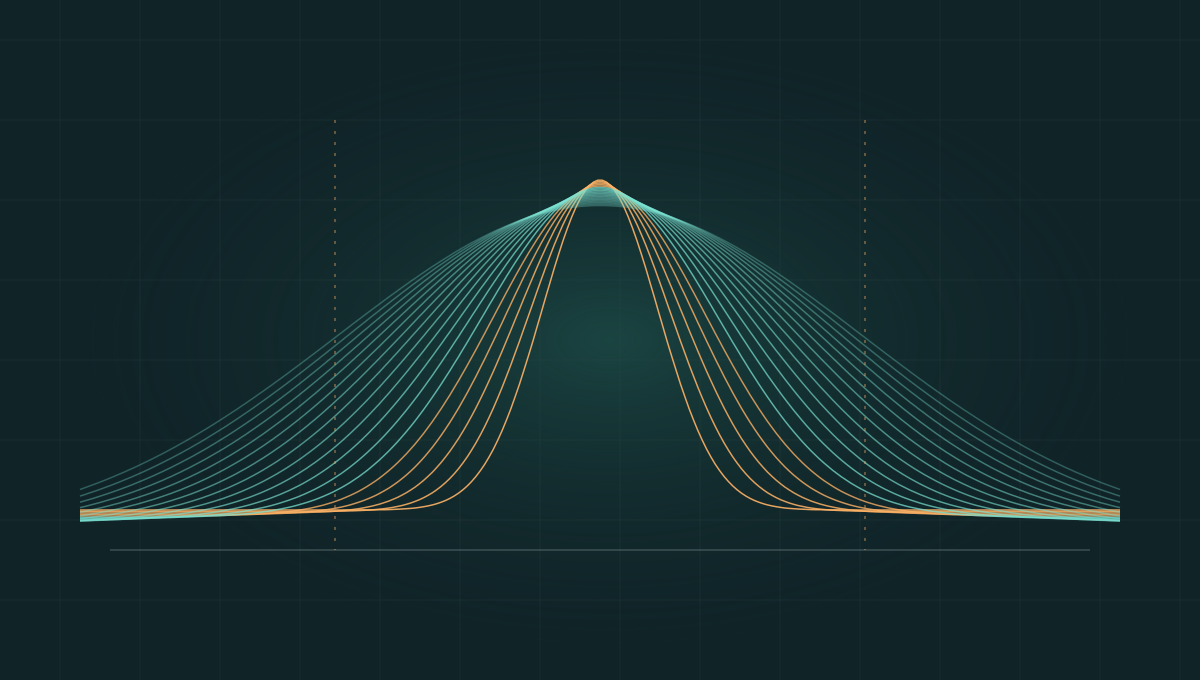
Narrower in position.
Wider in momentum.
This ideal minimum-uncertainty example changes the width coherently. It does not simulate a measurement or material under pressure.
A quantum squeeze can be written as a reversible map
Consider a normalized one-dimensional wavefunction ψ(x), and define a scale factor s greater than one. The transformation ψs(x) = √s ψ(sx) narrows its position distribution. Substituting u = sx into the probability integral shows that the total probability remains one. The height changes because a normalized distribution occupies a smaller width; it has not lost probability.
For this ideal dilation, the position spread becomes Δx/s and the momentum spread becomes sΔp. Equivalently, the state transformation scales position by 1/s and momentum by s. The uncertainty product is unchanged. This is a statement about this particular reversible operation, not a claim that every laboratory procedure producing a narrower distribution must have exactly the same momentum statistics.
The inverse scale transformation restores the original wavefunction. If two alternatives were coherent before the operation, applying this map to both does not select one of them. A squeezed state can retain coherence even though it is not generally a coherent state in the narrower technical sense used for an unsqueezed harmonic oscillator.
Narrowing a distribution and selecting an outcome are different tasks
Suppose two experiments produce similarly narrow position histograms. In the first, a controlled potential reshapes every prepared state coherently. In the second, an apparatus measures position and the analyst keeps only runs with results in a small interval. The retained histogram may look similar, but the physical operations and the accounting of discarded outcomes differ.
A third possibility is loss: particles outside a region are absorbed. Looking only at survivors can again make a distribution appear narrower. These alternatives show why a plot of position probability cannot, by itself, determine how the state was prepared.
Quantum collapse concerns the relation between a superposition and a definite outcome. Decoherence concerns the accessibility of interference after information becomes correlated with an environment. Compression might accompany either process in a particular apparatus, but the accompaniment is not proof of a universal compression-induced collapse law. The interaction and its observable consequences must be specified.
What a reversible squeezing experiment establishes
Burd and colleagues demonstrated a trapped-ion protocol that uses squeezing, a small displacement and reversed squeezing to amplify a motion signal. Their work establishes an experimentally implemented coherent control technique, rather than a rule that squeezing destroys quantum states. NIST's accompanying account explains the reversible operation and its sensing purpose.
This evidence is useful but bounded. A controlled motional mode of a trapped ion is not the same system as two macroscopic plates pressing on a material. The experiment supplies a concrete counterexample to equating all quantum squeezing with irreversible collapse. It does not establish that every form of mechanical compression is harmless to coherence. Read the research paper and NIST's explanation.
Fast boundary changes can create excitations
A slow change and a rapid change need not leave a system in the same state. The relevant comparison is with the system's own dynamical timescales, not whether the motion looks fast to a person. Changing a boundary can inject energy into modes rather than flatten them.
Wilson and colleagues observed the dynamical Casimir effect in a superconducting circuit. They rapidly modulated an effective electrical boundary and detected generated microwave radiation with quantum correlations. The setup simulated a moving boundary; it did not require physically driving a metal plate near light speed.
The control system supplied the drive. Emitted photons do not demonstrate energy obtained at no cost from an untouched vacuum. For compression experiments, the practical lesson is to monitor what the boundary drive excites, including frequencies outside the detector's original band. Read the published study or its author manuscript.
Design a test that can distinguish the explanations
Begin with a declared system and a measurable compression parameter: cavity separation, pulse duration or position variance. Record the initial state and predict the result of ordinary wave evolution before collecting a new data set. Specify the compression waveform, timing, detector response and collection efficiency. Otherwise an apparent disappearance can be produced by looking in the wrong place or at the wrong frequency.
Run a compression-and-reversal sequence alongside an unchanged control. Measure output energy or population, spatial or temporal profiles, and a phase-sensitive observable when coherence is the question. Vary the rate independently of the final compression, and monitor temperature and environmental coupling. This helps distinguish geometry from heating, absorption and drive-induced excitation.
A proposed new collapse mechanism needs a prediction that differs from these conventional alternatives. That might be a particular dependence of interference visibility on compression, mass, duration or geometry, with parameters fixed before the decisive test. An unexplained discrepancy is a reason to investigate calibration and models; it is not automatically evidence for objective reduction. These are proposed design principles, not a report of an experiment performed by this project.
A recovered intensity profile alone is weaker evidence than recovered phase-sensitive behavior. Different states can share the same position probability distribution. Report the tested range of compression and the uncertainty of each observable, including unsuccessful reversal. A theory predicting an effect outside that range has not been tested by the experiment. This keeps a successful control demonstration from becoming an unjustified claim about every possible compression process.
Follow the mechanism beyond the visual analogy
Compression is a productive research direction because it links geometry to measurable changes in fields, materials and quantum states. Its scientific value grows when the operation is specified closely enough to reproduce and reverse, or to explain why reversal fails.
The next step is to choose one implementation. A cavity study asks about modes and boundary work. A pulse study asks about bandwidth and phase. A quantum-state study asks about uncertainty, coherence and measurement. Following those separate paths gives the original intuition a testable form without deciding the outcome in advance.
Go to the original work.
Links support the claims identified in the article. Source verification covers accessible publications and official records; this sample has not undergone independent scientific peer review.
- Burd et al. (2019), Quantum amplification of mechanical oscillator motion, Science ↗
- NIST (2019), NIST Team Supersizes Quantum Squeezing to Measure Ultrasmall Motion ↗
- Casimir (1948), On the attraction between two perfectly conducting plates ↗
- Wilson et al. (2011), Observation of the dynamical Casimir effect in a superconducting circuit ↗
- OpenStax, University Physics Volume 1, Speed of Sound ↗
- Strickland and Mourou (1985), Compression of amplified chirped optical pulses, corrected version ↗
Return to Penrose’s proposed mechanism ↗
Compare a different operation, its observable consequences, and the evidence needed to identify it.