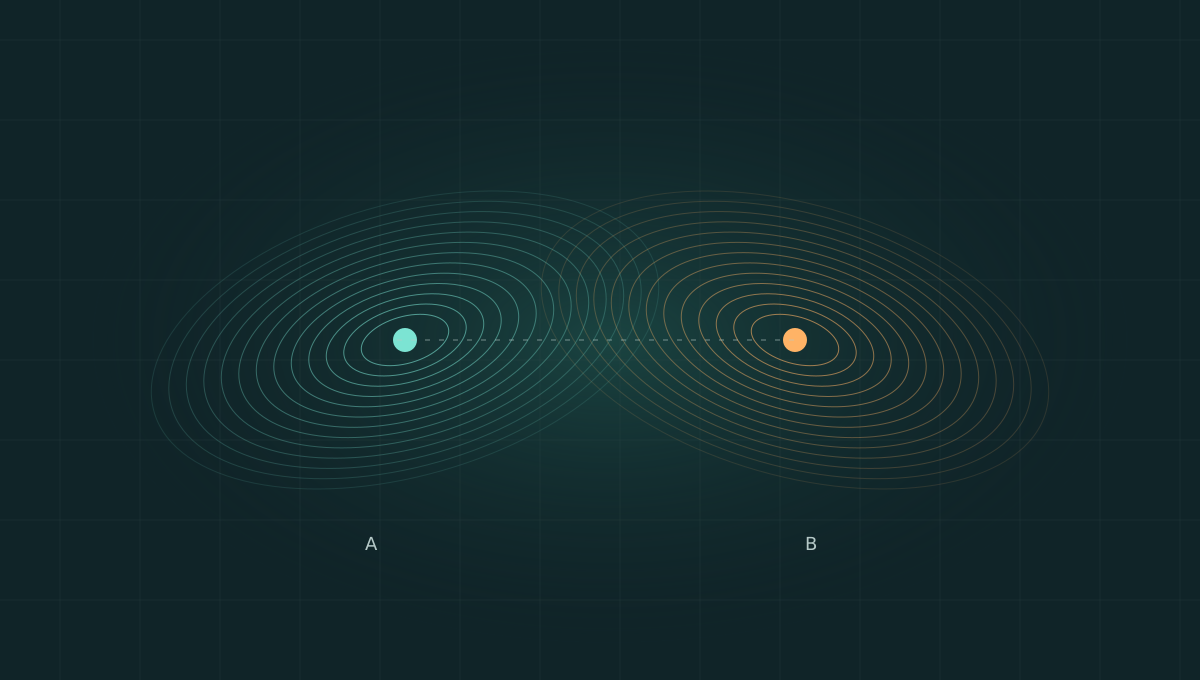
The question that opens the atlas
What happens between a quantum system having several possible outcomes and an instrument recording one result? Roger Penrose places that question at the meeting point of gravity and quantum mechanics. His proposal is that a superposition can have a finite lifetime for reasons connected to spacetime itself. It would not require a person to look at the experiment.
That is the starting question for Waveform Atlas. It also exposes a problem with everyday language: we use collapse for many events that have different physical explanations. A water crest breaks. A sound fades. An interference fringe disappears. A detector clicks. These observations deserve different entries in an investigation, even when they look similar in an animation.
The purpose of this opening chapter is to make the comparison precise enough to follow. We begin with Penrose's proposal, identify what would count as evidence, and then examine the other ways a wave or quantum state can change.
Start with Penrose's own account
Penrose's 1996 paper, On Gravity's Role in Quantum State Reduction, develops the gravitational argument. His 2019 Oxford lecture on consciousness, computation and physical law supplies an official recorded account connecting that argument to his wider thinking.
These are complementary sources: the paper supports technical statements, while the lecture presents the researcher's own explanation. The Oxford recording is not identified here as the particular clip that inspired this project. That clip remains unidentified.
A useful way to read either source is to keep two questions separate. What does the author propose? What observation establishes that proposal? A respected scientist's argument can be worth careful study without becoming an experimental result through attribution alone. The distinction protects the interesting question from both exaggerated promotion and premature dismissal.
Two arrangements of mass, two gravitational descriptions
Consider an isolated object prepared in a superposition of two locations. Let ρA(x) describe the mass distribution associated with one alternative and ρB(x) the other. These are alternative descriptions within one quantum state, not a claim that the experiment contains two independently existing copies of the object.
Each distribution corresponds to a different gravitational field. In general relativity, gravity is related to spacetime geometry. Penrose argues that combining the different geometries creates a difficulty in defining a common time evolution. He associates that difficulty with an effective energy uncertainty and suggests that the superposition should be unstable.
The important object is the difference between the mass distributions. Total mass alone is not enough to specify it. The object's size, shape and displacement matter. Nor does the proposal mean that an ordinary gravitational pull mechanically crushes a wave. It concerns the compatibility and lifetime of alternative gravitational configurations. This remains a proposed departure from standard quantum dynamics, rather than an established consequence of general relativity alone.
A lifetime estimate, not a complete machine for outcomes
The characteristic estimate is τ ≈ ℏ/EG. Here τ is a proposed lifetime, ℏ is the reduced Planck constant, and EG measures the gravitational self-energy associated with the difference between the alternatives. The related reasoning and rate estimate are discussed by Lajos Diósi, whose work gives the shared Diósi–Penrose name.
The inverse relationship is the first prediction to understand: a larger mismatch energy implies a shorter estimated lifetime. It is not simply a rule that collapse waits until an object reaches one universal size or separation.
For an arithmetic illustration, choosing EG = 10−34 joule gives about 1.05 seconds. Choosing ten times that energy gives about 0.105 second. Those are calculations using hypothetical inputs, not measured lifetimes or a proposed apparatus. A physical prediction still requires a justified mass-density model, its parameters, and a complete account of what the experiment measures.
What does the estimate predict?
Supply a hypothetical gravitational mismatch energy. The model converts that input into a proposed lifetime; it does not calculate the energy of an actual apparatus.
τ ≈ ℏ/EG, using ℏ = 1.054571817 × 10⁻³⁴ J s. Penrose’s heuristic relation is a hypothesis, not a validated universal collapse law. A test requires a specified mass distribution and complete model.
Why a disappearing shape is not enough
Suppose a camera records a wave becoming flatter. That observation leaves several possibilities open. Energy might have entered the surrounding material. Contributions might have cancelled at the camera's location. The wave might have moved outside the observed region. The detector might have lost sensitivity. A smaller trace does not distinguish these explanations.
The same discipline applies to a quantum experiment. An image of a narrower probability distribution does not, by itself, establish a random selection of one outcome. A controlled operation can change a state in a predictable way. A measurement result can also change the state assigned to a system. Distinguishing those situations requires information about preparation, interaction and readout.
For every mechanism in this atlas, the useful question is therefore more specific than whether a wave has collapsed: which measurable quantity changed, and which competing explanation did the experiment exclude?
Compression gives a concrete comparison
Compression might refer to narrowing a spatial distribution, reducing a cavity gap, increasing a material's density, or changing the uncertainties of a quantum state. These are different operations. They should not share an experimental conclusion merely because they share a word.
One instructive result comes from Burd and colleagues' experiment on quantum amplification of mechanical oscillator motion. The team used a trapped ion, applied quantum squeezing, and reversed the squeezing as part of a sensing protocol. NIST's explanation describes how uncertainty can be redistributed between position and momentum.
This demonstrates a particular reversible quantum operation. It does not prove that every mechanical compression preserves coherence, or that arbitrary squeezing is harmless to a real apparatus. It does show why the operation and its outcome must be named separately: reducing one uncertainty can be part of coherent control rather than an instance of objective collapse.
Loss of interference has an environmental explanation to test
A quantum system rarely remains completely isolated. Its surroundings can become correlated with the alternatives in a superposition. When those environmental degrees of freedom are not available to the observer, interference in measurements on the original system can be suppressed. This is the central setting of environmental decoherence.
Schlosshauer's review of decoherence and the measurement problem explains why this mechanism matters and why its interpretation requires care. Decoherence does not, by itself, provide a selection of one global outcome from an otherwise unitary evolution.
For an experiment, that creates a practical requirement. Before interpreting lost contrast as new gravitational dynamics, investigate gas collisions, thermal radiation, fluctuating fields, vibration, imperfect control and information carried away by the apparatus. These are alternative explanations to quantify, not reasons to abandon the investigation.
What an underground test actually ruled out
A concrete collapse model can have consequences beyond the disappearance of interference. In the Diósi–Penrose implementation studied by Donadi and colleagues, the stochastic dynamics imply motion fluctuations and radiation from charged constituents. Their Gran Sasso experiment searched for the associated emission.
The result, published online in 2020 in Nature Physics, excluded the natural parameter-free version of that model. The constraint concerns how the relevant mass density is represented and the radiation that follows from the chosen dynamics.
It is important to preserve that scope. The experiment did not establish gravitational collapse. It also did not exclude every theory in which gravity might affect quantum-state reduction. Different dynamics or parameters require their own predictions and tests. The scientific result is a restriction on a specified implementation, which is more useful than an unrestricted statement that either gravity or quantum mechanics has won.
Where consciousness enters—and where it does not
In objective reduction, a conscious observer is not required to trigger the proposed event. Penrose and Stuart Hameroff's Orch OR proposal adds a further hypothesis: suitably organized quantum processes in neuronal microtubules are associated with conscious experience.
The gravitational proposal and its biological extension therefore ask different questions. Evidence about neural activity does not automatically establish a gravity-driven reduction law. A successful test of a collapse law would not, on its own, establish a theory of consciousness. Each connection needs evidence at its own level.
This atlas begins with the physical mechanism. It treats the consciousness connection as a named research proposal, not a demonstrated explanation of awareness.
Turn the question into a comparison that can fail
A useful next step is to specify one preparation, one controlled change and one readout. For example, compare otherwise matched runs with different spatial separations while measuring interference visibility, heating and environmental conditions. That is a design principle, not a claim that Waveform Atlas has performed such an experiment.
Before collecting data, write down the baseline prediction and the alternative prediction. State the parameters that are fixed independently and those that will be fitted. Define what result would count against the proposed mechanism. Record uncertainty, calibration and exclusion criteria before interpreting an unexpected trace.
Keep an audit trail that another researcher could follow: the prepared state, the intervention, the observable, the calibration record and the competing explanations. A compelling image is an invitation to investigate; the reproducible comparison is the evidence. If two mechanisms predict the same measured quantity, add a second observable rather than deciding between them by visual resemblance. If an effect survives the controls, repeat it under changed conditions that make the rival predictions diverge.
The remaining chapters follow that discipline through stretching, compression, interference, absorption, scattering, measurement and other transformations. Some change geometry. Others transfer energy or redistribute correlations. Penrose's proposal asks whether new dynamics are also needed. Readers can follow each route from a precise definition to a model, an experiment, a limitation and a next question—without treating every altered wave as the same event.
Go to the original work.
Links support the claims identified in the article. Source verification covers accessible publications and official records; this sample has not undergone independent scientific peer review.
- Penrose, On Gravity's Role in Quantum State Reduction (1996) ↗
- Penrose, AI, Consciousness, Computation, and Physical Law — Oxford lecture (2019) ↗
- Diósi, On the conjectured gravity-related collapse rate EΔ/ℏ of massive quantum superpositions (2021) ↗
- Burd et al., Quantum amplification of mechanical oscillator motion (2019) ↗
- NIST, Reversible quantum squeezing to measure ultrasmall motion (2019) ↗
- Schlosshauer, Decoherence, the measurement problem, and interpretations of quantum mechanics (2005) ↗
- Donadi et al., Underground test of gravity-related wave function collapse (online 2020; volume 2021) ↗
- Hameroff and Penrose, Consciousness in the universe: A review of the Orch OR theory (2014) ↗
What compression does to a wave ↗
Compare a different operation, its observable consequences, and the evidence needed to identify it.