State the ideal problem before using its formula
The elementary Casimir model considers two parallel perfectly conducting plates separated by a vacuum gap. Their area is taken large enough that edge effects can be neglected, and the standard zero-temperature expression isolates an ideal interaction. The boundary conditions alter the allowed electromagnetic modes. Comparing configurations yields a separation-dependent energy and force. This is not a model in which every field or fluctuation inside the gap disappears.
The ideal assumptions are useful because they produce a clear scaling law. They are also restrictive. Real conductors have finite, frequency-dependent response; surfaces are not perfectly smooth; finite samples have edges; and temperature can matter. A calculation should state which of these effects is neglected and why that approximation is adequate for the separation and observable being considered. A simple diagram of two plates does not establish those conditions.
Relate pressure to interaction energy
The ideal interaction energy per area is U/A=−π²ℏc/(720d³), where d is the gap. Differentiating with respect to d gives pressure P=−π²ℏc/(240d⁴), with the negative sign indicating attraction under the chosen outward-positive convention. The energy is defined relative to an appropriate separated reference configuration. The physically relevant change in energy, not an arbitrary absolute vacuum-energy offset, determines the mechanical force.
Keeping the derivative visible clarifies the work. As the gap decreases, the interaction energy becomes more negative. The plates can transfer that decrease into mechanical motion or work on a controller. To separate them quasistatically along the reverse ideal path requires an equal energy input before losses. The equations therefore describe an interaction-energy landscape, not an unlimited supply of energy from repeatedly returning to the same state.
Calculate the separation scaling
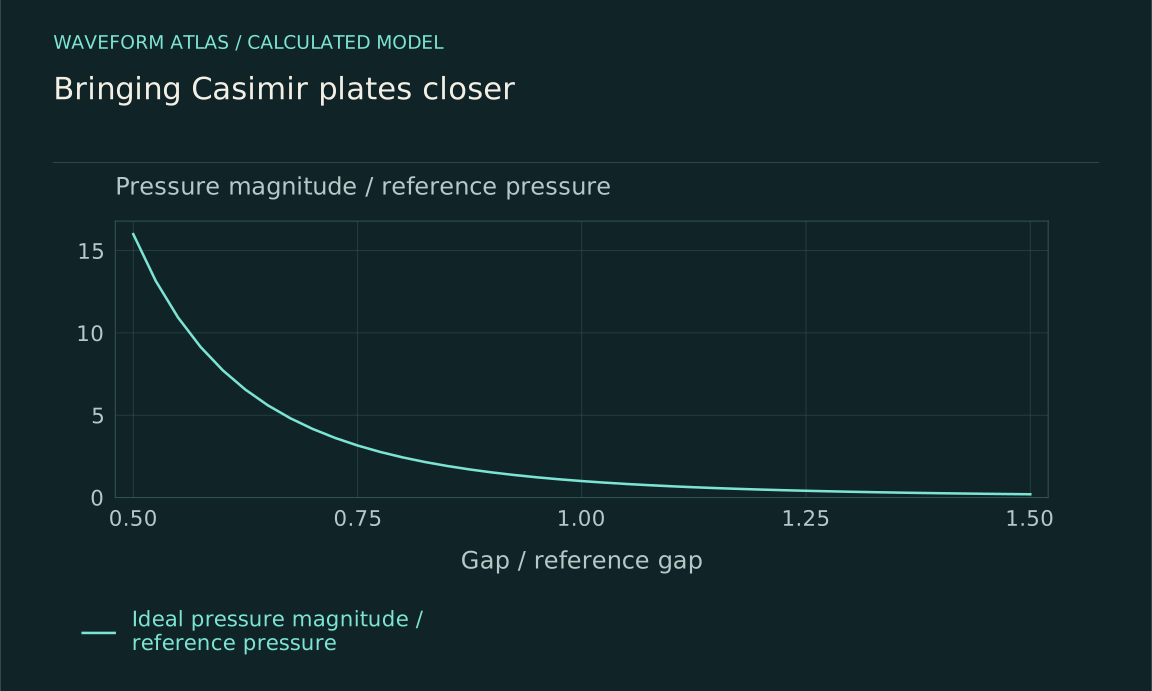
Halving d multiplies the magnitude of ideal pressure by sixteen and the magnitude of interaction energy per area by eight. These different powers arise because force is an energy derivative. Confusing them would produce an incorrect prediction for actuator load or work. A pressure curve and an energy curve should therefore have distinct labels even when both rise sharply in magnitude at small gaps.
Using standard constants, the ideal pressure magnitude at one micrometre is approximately 0.00130 pascal. At half a micrometre it is approximately 0.0208 pascal. These are calculated ideal-model values, not measurements. Their applicability to a real device depends on material, temperature, geometry and surface effects. The large separation sensitivity also means that uncertainty in gap calibration can dominate uncertainty in a force prediction.
Understand what the mode picture does and does not say
Boundary conditions constrain electromagnetic fluctuations and their correlations. A mode-counting argument can help explain why the interaction depends on geometry, but it should not be interpreted as a literal absence of all modes in the gap. Nor should each constrained mode be treated as an independently removable packet of extractable energy. The complete field-plus-material description determines the observable stress and interaction.
Different theoretical formulations can describe the same force through equivalent physical quantities, including material response and field correlations. For an introductory experiment, the useful invariant is the predicted measurable force for a specified configuration. Avoid building a new claim solely on a pictorial phrase such as fewer waves between plates. That phrase is a heuristic, whereas the separation, response functions and boundary conditions define the calculation.
Real materials change the interaction
A perfect conductor is an ideal boundary condition. A real material responds differently at different frequencies and can absorb. Its optical response enters a more realistic force calculation. Surface coatings, contamination and finite thickness can matter as well. A measured departure from the ideal d^(−4) pressure law therefore does not automatically signal a failure of quantum theory or an additional collapse process.
Temperature introduces thermal field contributions whose importance depends on separation and material response. Geometry can also change the functional form and the relation between force and pressure. A sphere near a plate is often mechanically convenient but is not the same geometry as two infinite parallel plates. Any approximation connecting those geometries should be named and checked within its range rather than silently using a parallel-plate formula for every setup.
Surface structure is experimentally relevant
Intravaia and colleagues reported that metallic surface nanostructuring changed a measured Casimir interaction relative to a planar-like approximation. The NIST author publication abstract identifies the experiment and its geometry dependence. This provides a concrete reason to treat surface structure as part of the physical system rather than as a cosmetic detail. Our use of that record is limited to the reported mechanism and does not reproduce its full uncertainty analysis.
For a new device, record roughness, pattern geometry and alignment at scales relevant to the force calculation. A small region of closer approach can contribute disproportionately because the ideal interaction is strongly separation dependent. An average gap alone may therefore be inadequate. Compare the measured surface distribution with the model, and distinguish a deliberately structured sample from uncontrolled roughness that introduces uncertain corrections.
Electrostatic forces are a competing explanation
Nominally neutral conducting surfaces can still have contact potentials, patch variations or residual charge. These can create forces that must be distinguished from the Casimir contribution. A force measurement therefore needs electrical calibration and control, not merely a claim that no external voltage was intentionally applied. The geometry and separation dependence of the backgrounds should be included in the uncertainty analysis.
Varying an applied compensation voltage can help characterize an electrostatic contribution, but a single compensating value may not remove every spatially varying patch effect. Instrument drift, mechanical stiffness and distance offsets can also influence the inferred force. The appropriate controls depend on the apparatus. A residual after one subtraction is a reason to examine the complete model, not an automatic identification of the desired quantum interaction.
A complete cycle includes reopening
Imagine plates released from a larger gap to a smaller gap while a controller extracts mechanical work. In the ideal reversible model, the extractable work equals the decrease in interaction energy. Returning the same system to its initial gap requires supplying that energy back. With friction, electrical loss or other dissipation, the full cycle requires additional input rather than producing a net surplus.
Changing material properties or geometry during the cycle introduces additional control work and heat exchange. Those steps cannot be omitted from the ledger simply because the separation motion itself appears favourable. Define the complete initial and final states, including the actuator, material and environment. A cyclic energy claim is meaningful only when every component that supplies or stores energy is returned or explicitly accounted for.
Moving boundaries are a different dynamical experiment
The static Casimir force and the dynamical Casimir effect concern related field-boundary physics but different observables and protocols. A rapidly varying effective boundary can generate excitations by drawing energy from the modulation. Wilson and colleagues reported such radiation in a superconducting circuit with a modulated electrical boundary. The verified primary abstract supports that specific experimental example, not a claim that slowly closing ordinary plates automatically emits the same signal.
The distinction matters for compression. A quasistatic force calculation predicts work along a sequence of near-equilibrium configurations. Rapid driving requires time-dependent dynamics and can populate modes beyond the initial state. Measure the drive and outgoing spectrum when investigating that regime. Generated radiation is an energy-transfer channel supplied by the controller, and its presence does not demonstrate extraction from an unchanged undriven vacuum.
Design a gap-dependent measurement
Measure force or force gradient over a calibrated range of separations, with the geometry and electrical backgrounds characterized. Repeat the sweep in both directions and check for drift or irreversible surface changes. Compare a realistic material-response model with the data, and retain the ideal law as a clearly labelled reference rather than the sole possible prediction. Independent distance calibration is especially valuable because of the strong gap dependence.
For the ideal pressure magnitude, a small fractional gap error contributes approximately four times that fractional error to the predicted pressure. A one-percent separation uncertainty therefore contributes about four percent before other terms are included. This sensitivity estimate is calculated from the power law and does not replace a full uncertainty budget. It explains why a visually tiny alignment or offset error can materially affect the conclusion.
A successful experiment can establish a separation-dependent force consistent with a specified quantum-electromagnetic interaction model and its corrections. It does not establish that waves are extinguished in a small region, that probability has collapsed to one outcome, or that repeated compression provides free energy. Those are different claims requiring different observables and additional equations.
The useful physical lesson is that changing a boundary changes the energy landscape and the supported field structure. Follow that dependence through force, work and realistic response. State whether a plotted curve is the ideal calculation, a more complete model or measured data. With those distinctions preserved, the Casimir gap becomes a precise example of geometry influencing fields, rather than a metaphor that obscures the actual energy and measurement accounting.
What to take forward
- The ideal Casimir pressure scales as the inverse fourth power of gap.
- Real material, geometry and electrostatic backgrounds affect a force measurement.
- A complete closure-and-opening cycle includes actuator work and losses.
Go to the original work.
These links identify the sources behind specific claims. Verification scope varies by source and is stated below.
- 1 / Primary theoryCasimir, On the attraction between two perfectly conducting plates ↗
H. B. G. Casimir. Proceedings of the Royal Netherlands Academy of Arts and Sciences 51, 793–795 (1948).
Original ideal-conductor parallel-plate calculation, used with the explicitly stated idealization.
Verification scope: MIT-hosted reprint title and publication metadata inspected; pressure formula independently checked in NIST-hosted text.
- 2 / ReviewDecca, Aksyuk and López, Casimir Force in Micro and Nano Electro Mechanical Systems ↗
R. Decca, V. Aksyuk and D. López, Casimir Force in Micro and Nano Electro Mechanical Systems, in Casimir Physics, Lecture Notes in Physics 834, 287–309 (Springer, 2011), doi:10.1007/978-3-642-20288-9_9.
DOI: 10.1007/978-3-642-20288-9_9
Ideal parallel-conductor pressure and importance of real-material, surface and geometry corrections.
Verification scope: Springer chapter metadata and abstract verified; NIST-hosted chapter introduction and ideal pressure equation used. Entire chapter not audited.
- 3 / Primary experimentIntravaia et al., Strong Casimir force reduction through metallic surface nanostructuring ↗
F. Intravaia et al.. Nature Communications 4, 2515 (2013).
Measured force changes with engineered metallic surface geometry.
Verification scope: NIST author publication abstract inspected; detailed uncertainty analysis not read.
- 4 / Primary experimentWilson et al. (2011), Observation of the dynamical Casimir effect in a superconducting circuit ↗
C. M. Wilson; G. Johansson; A. Pourkabirian; M. Simoen; J. R. Johansson; T. Duty; F. Nori; P. Delsing. Nature 479(7373), 376–379 (2011).
A modulated superconducting circuit produced radiation with two-mode squeezing; energy is supplied by modulation.
Verification scope: Primary-paper abstract in PubMed inspected; DOI 10.1038/nature10561 verified.
Found a problem with a claim or calculation? Send the page, the claim and the evidence. Read how these articles were prepared.