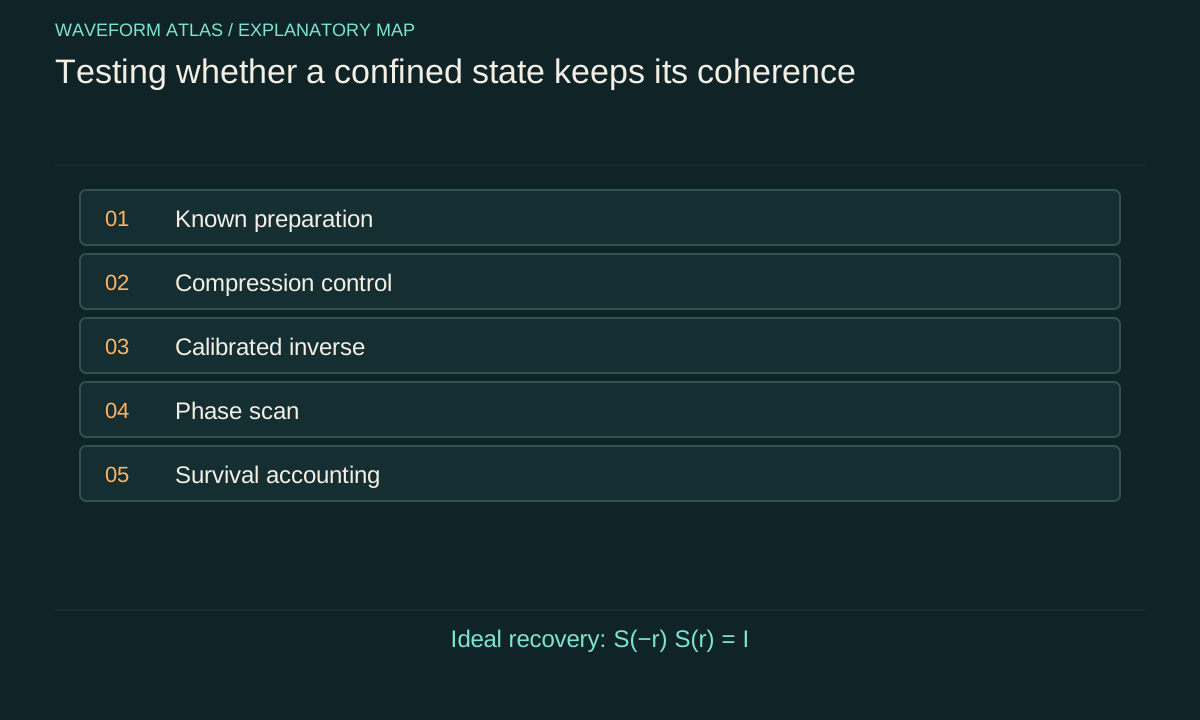
Decide which coherence is being tested
Coherence is defined relative to alternatives and measurements. A superposition of two paths, two oscillator levels or two spatial modes has different experimental readouts. Name the basis in which the proposed compression might remove phase relations. A statement that the state remains quantum is too broad to guide the apparatus. The test needs a preparation and observable whose probabilities depend on the relevant off-diagonal density-matrix elements.
For a two-alternative state, an equal coherent superposition and an equal incoherent mixture can have identical populations. Recombining the alternatives with a variable phase distinguishes them. For a Gaussian oscillator state, quadrature correlations provide another useful set of observables, although a complete claim about arbitrary non-Gaussian states may require more information. Choose the test to match the state family and the physical hypothesis.
Establish preparation before adding compression
Characterize the initial state under the same timing and detection conditions used in the main sequence. Measure baseline interference or quadrature distributions, survival probability and relevant mode populations. If the source drifts during the experiment, interleave reference preparations rather than relying on a calibration made long before the decisive measurements. A poorly known initial state can mimic a change attributed to compression.
Include a control sequence with the same duration and as much of the same hardware activity as possible but without the intended compression. This helps separate the geometric or squeezing operation from accumulated background noise. The control need not be identical in every respect, but its differences should be understood. A useful comparison holds fixed the quantities that competing explanations would otherwise use to reproduce the result.
Specify a reversible baseline operation
An ideal squeeze S(r) has inverse S(−r) when its orientation and intervening evolution are correctly accounted for. Acting on a state and then applying the inverse returns the original state in the closed-system model. A unitary map also preserves inner products between alternatives, so it does not select one component merely because position width decreases. This supplies a clear baseline prediction against which added noise can be tested.
A physical trap compression may implement a different unitary transformation from a simple squeeze. Use the measured time-dependent Hamiltonian to calculate that transformation and its intended inverse. Free evolution between pulses rotates oscillator phase space, so reversing a control amplitude alone may not undo the sequence. The baseline must include those phases before a failed recovery can be interpreted as evidence for anything beyond ordinary dynamics.
Use phase scans rather than a single bright point
For a two-path readout, record output probability over a controlled reference-phase scan. Fit the contrast, phase offset and background using a declared model. Measuring only the highest point after tuning the apparatus can conceal changing offset, unequal amplitudes or selection bias. A full scan shows whether the expected sinusoidal dependence remains and whether the fitted phase is stable across repeated runs.
For a squeezed oscillator, scan the measurement quadrature angle and compare the full variance dependence with the predicted covariance matrix. A narrow variance at one angle does not establish that the entire state was restored. Record the expanded quadrature and correlations as well. The complementary measurements help distinguish genuine recovery from a partial match in one observable produced by a different final state.
Recovery of density alone is insufficient
Different states can have the same position probability density. A phase-distorted pure state, a target pure state and a suitably chosen mixture may therefore produce similar images. Returning the density to its initial width is useful evidence of shape control, but it is weaker than returning phase-sensitive measurement statistics. Include a basis change or reference interference when the claim concerns coherence.
The distinction also applies to classical fields. An optical intensity pattern can be restored while its phase remains aberrated. Classical coherent-wave demonstrations can validate the control optics but do not by themselves establish a uniquely quantum resource. If the intended claim requires quantum coherence beyond a classical description, specify the additional preparation and witness that support it rather than relying on the visual appearance of interference alone.
Account for survival and postselection
A compressor or trap can lose particles or photons. Analysing only detected survivors may yield a clean-looking recovered state while hiding a low overall success probability. Report both conditional state properties and unconditional survival. If events are rejected according to arrival time, mode or detector threshold, document that selection and include its probability in the comparison.
A loss channel can also change the relative weights of alternatives and reduce observed interference without fundamentally selecting a path in every surviving event. Measure the populations separately and correct only using justified calibration. A normalized histogram is not evidence that all initial probability remained within the measured system. The complete accounting must include unsuccessful outcomes and known detector inefficiency.
Separate environmental records from technical uncertainty
Coupling to an environment can correlate different alternatives with distinguishable states and reduce interference accessible to the system alone. Technical phase noise can also reduce an ensemble-averaged fringe. A recorded phase reference may permit correction of the latter in some protocols, whereas an inaccessible environmental record presents a different recovery problem. The same reduced contrast does not uniquely identify its cause.
Monitor plausible environmental channels such as temperature, vibration, fluctuating fields and scattered light. Vary one at a time when practical to establish sensitivity. A correlation between noise and loss of recovery can guide the model, but it should be tested against controlled changes rather than inferred from coincidence. The aim is to explain the observed contrast with a quantitatively adequate noise account before invoking an additional fundamental process.
Use an experimental precedent narrowly
Burd and colleagues used squeezing and reversed squeezing around a small displacement in a trapped-ion motion-amplification protocol. The verified NIST publication abstract identifies an implemented coherent control sequence. It demonstrates that squeezing can participate in recoverable dynamics rather than inevitably destroying a quantum state. This is a concrete counterexample to an unrestricted identification of all squeezing with collapse.
Its scope remains a particular motional system and protocol. It does not certify that every macroscopic compression experiment preserves coherence or that arbitrary squeeze strengths can be reversed perfectly. A new experiment should compare its own control rates, noise and state preparation with its model. The precedent supplies a mechanism and motivation; it does not substitute for measurements of the apparatus being evaluated.
Vary endpoint and rate independently
A proposed geometry-dependent effect may scale with the final confinement, while ordinary nonadiabatic excitation depends strongly on the ramp history. Vary the endpoint at several ramp durations and vary duration at fixed endpoint. Also compare different hold times at the compressed setting. These dimensions of the experiment can separate static confinement effects from drive-induced excitation and accumulated environmental noise.
Predefine a parameter range where the apparatus remains calibrated. Large compression can change detector coupling, trap anharmonicity or material response, so the same analysis model may not remain valid throughout. Record those changes and restrict conclusions accordingly. A trend in visibility is not automatically a new physical law if the measurement efficiency or control error changes systematically along the same axis.
Interpret a recovery metric with uncertainty
A return probability is the probability of obtaining a chosen reference-state outcome after the recovery sequence. It is useful but depends on the preparation, inverse and measurement. State tomography or several complementary measurements can provide more detail, at greater experimental cost. Choose the metric required by the claim and estimate its uncertainty, including calibration and finite sample statistics.
If one thousand independent trials have a success probability near 0.9, the binomial standard deviation of the estimated fraction is approximately √(0.9×0.1/1000), or 0.00949. This is an illustrative sampling estimate, excluding systematic error and correlations. A reported recovery change smaller than the combined uncertainty is unresolved. More trials improve counting precision but cannot by themselves remove a biased preparation or inverse control.
A proposed compression-induced reduction law must predict something beyond the calibrated baseline and environmental model. It might specify a dependence on width, mass or hold time with shared parameters across runs. Test that dependence against alternatives and identify an observation that would count against it. An unexplained failure of one recovery attempt is not sufficient because many conventional errors produce the same outcome.
A successful recovery supports the narrower conclusion that the tested transformation preserved the phase information required by the chosen observable within uncertainty. A failed recovery constrains the combined sequence until its sources are separated. This measured, operational conclusion is stronger than a blanket declaration that compression either always collapses states or can never damage coherence. It makes the next experiment depend on evidence rather than on the visual metaphor of squeezing.
Record the planned rejection criteria before analysing recovery data. Changing which trials count after seeing the result can bias both the apparent coherence and the reported survival fraction.
What to take forward
- A recovered density is weaker evidence than recovered phase-sensitive statistics.
- Report survival and postselection beside conditional state quality.
- Compare endpoint, ramp-rate and hold-time dependence with calibrated noise.
Go to the original work.
These links identify the sources behind specific claims. Verification scope varies by source and is stated below.
- 1 / University teachingAdams, MIT Quantum Physics I: Optional Problems on the Harmonic Oscillator ↗
Coherent states, uncertainty, sudden oscillator-frequency changes and time-dependent squeezed-state quadratures.
Verification scope: Official six-page problem sheet text inspected, including frequency-change and quadrature questions; original worked examples in our articles.
- 2 / Primary experimentBurd et al., Quantum amplification of mechanical oscillator motion ↗
S. C. Burd; R. Srinivas; J. J. Bollinger; A. C. Wilson; D. J. Wineland; D. Leibfried; D. H. Slichter; D. T. C. Allcock. Science 364(6446), 1163–1165 (2019).
A trapped-ion protocol uses squeezing interactions around a coherent displacement.
Verification scope: NIST author publication record and abstract inspected; journal DOI 10.1126/science.aaw2884 verified.
- 3 / ReviewHornberger, Introduction to decoherence theory ↗
K. Hornberger, Introduction to Decoherence Theory, in Entanglement and Decoherence, Lecture Notes in Physics 768, 221–276 (2009). Author manuscript: arXiv:quant-ph/0612118.
DOI: 10.1007/978-3-540-88169-8_5
Section 5.1: reduced density matrices, environmental-state overlaps and distinctions between decoherence and phase averaging.
Verification scope: Targeted sections 5.1.1–5.1.4 and Eqs. (5.5)–(5.7) read in the author preprint; entire 57-page chapter not read.
Found a problem with a claim or calculation? Send the page, the claim and the evidence. Read how these articles were prepared.