Squeezing an uncertainty ellipse
Adjust the controls, inspect the calculated response and use the reading links to place the model in its physical context.
Interactive model: Squeezing an uncertainty ellipse. Enable JavaScript to adjust its controls.
σₓ = e⁻ʳ/√2; σₚ = eʳ/√2; σₓσₚ = 1/2
Ideal pure one-mode Gaussian squeezing with ℏ = 1. The ellipse represents one-standard-deviation widths, not a particle trajectory. Loss and technical noise are omitted.
What this model assumes
Ideal pure one-mode Gaussian squeezing with ℏ = 1. The ellipse represents one-standard-deviation widths, not a particle trajectory. Loss and technical noise are omitted.
How to explore it
Begin with the default values. Change one control at a time and watch both the graph and the readouts. Then reset the model and change another parameter. This isolates which input produces the effect you are seeing.
The plotted values are generated from the displayed equation. Downloading the calculated data lets you inspect the numerical series or compare it with a calculation of your own. The data are synthetic model outputs, not observations from an apparatus.
Before carrying a prediction into an experiment, match the model’s assumptions to the actual system: the relevant degrees of freedom, boundary conditions, noise, losses and measurement convention. The linked articles explain which comparison is physically meaningful.
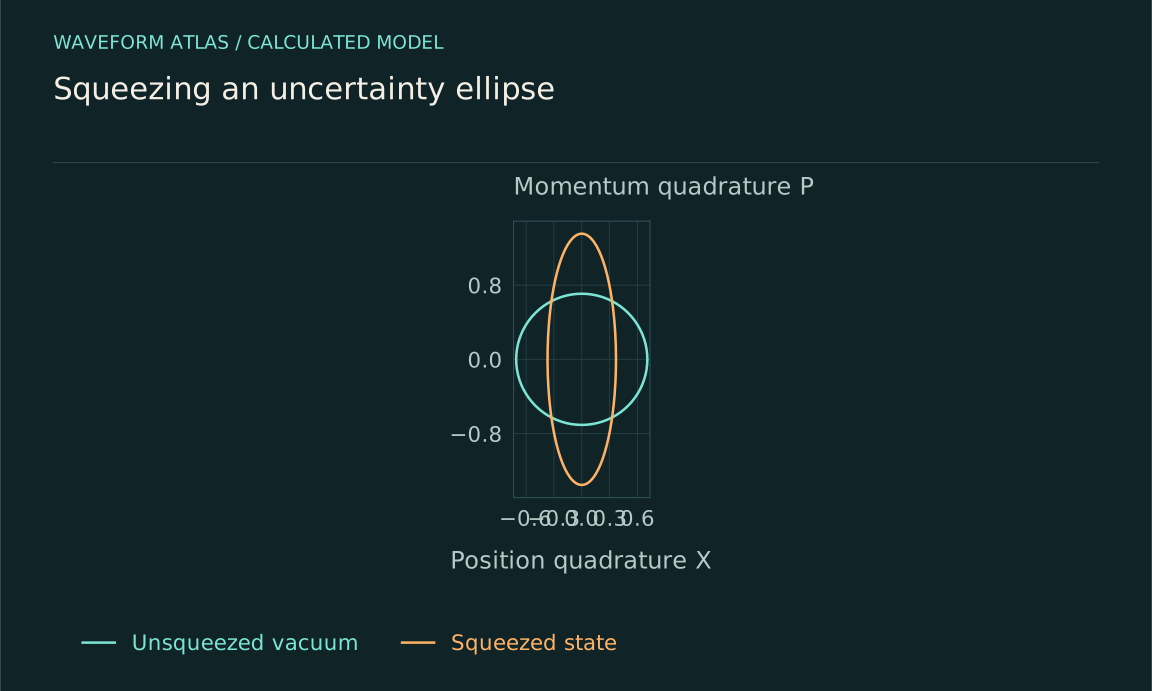
Calculated model curves. Ideal pure one-mode Gaussian squeezing with ℏ = 1. The ellipse represents one-standard-deviation widths, not a particle trajectory. Loss and technical noise are omitted. Default control values are used in this fixed figure.
Download SVG ↓Compression and confinement
What compression does to a wave
What happens when a wave or its supporting system is confined more tightly?
Confining a wave in a smaller region
How do boundary placement and confinement alter allowed spatial patterns?
Squeezing uncertainty without selecting an outcome
How can one quantum uncertainty shrink while its conjugate grows?
A shorter pulse can require a broader spectrum
How do chirp and dispersion compensation compress a pulse in time?
Compressing the carrier rather than the wave
How do pressure and density changes affect sound or elastic waves?
Bringing Casimir plates closer
How does a changing gap alter field modes and interaction energy?
What changes when confinement varies with time?
When does changing a boundary preserve an instantaneous mode or excite new ones?
Who supplies or receives the work of compression?
How are mechanical work, stored field energy, and losses balanced?
Testing whether a confined state keeps its coherence
What reversal and interference measurements distinguish squeezing from collapse?
From compression intuition to a quantitative model
What equations and predictions make a compression hypothesis testable?