Begin with the property that was actually established
If two oscillators become phase locked, the immediate result is a stabilized relation between their phases under the stated conditions. Other benefits may follow, but they are not contained in that definition. A larger combined signal, reduced timing error or changed energy consumption requires additional observables and a model connecting them to the phase relation.
This distinction is useful in both experiments and applications. A demonstration can establish coordination without showing that the devices are more accurate clocks. A phase-locked pair can consume more, less or similar power depending on its interaction. A quantum synchronization diagnostic can change without establishing entanglement. Treat the timing result as the starting point for evaluating consequences rather than a shortcut to every desirable property.
Relative phase and collective phase are separate
For a symmetric two-oscillator model, define the relative phase φ=θ₁−θ₂ and collective phase Θ=(θ₁+θ₂)/2. Coupling can restore φ toward a stable offset while leaving Θ free to advance and fluctuate. The pair may therefore remain tightly coordinated even as both drift together relative to an external clock.
This is the difference between relative precision and absolute timing accuracy. A common reference can constrain Θ, but then its stability and accuracy enter the result. Without that reference, a stable internal relationship does not establish an accurate external frequency standard. Measure both relative phase and phase against an independent reference when the application requires both properties.
A phase-only model does not contain a power meter
Equations such as φ̇=Δ−Ksinφ describe timing after other degrees of freedom have been reduced away. Their parameters can depend on physical energy flows, but the equation alone does not determine electrical input power, mechanical dissipation or heat. Its tilted phase potential is a mathematical device for stability analysis, not automatically the energy stored in the original apparatus.
To infer power, return to the physical coordinates and coupling forces. For a rotational oscillator, instantaneous mechanical work can involve torque times angular velocity. For an electrical oscillator, voltage-current products and supply power matter. The same phase relation can occur in systems with very different energy costs, so a synchronization metric cannot replace a calibrated energy budget.
Coupling can redistribute work and dissipation
In coupled mechanical oscillators, the mediator can store energy, transmit work and dissipate through its own damping. An antiphase state may produce little net support motion in a symmetric configuration, while an in-phase state can drive the support more strongly. The resulting power differences depend on the actual geometry, losses and sustaining mechanism, not on the labels alone.
Measure individual drive work, mediator motion and dissipative channels if energy efficiency is claimed. A small summed displacement does not mean each oscillator has stopped or that total energy is zero. Opposing motions can cancel one measured coordinate while retaining substantial kinetic and potential energy. Synchronization changes a relationship; the energy consequences follow from the complete dynamics of that relationship.
Collective output can become more useful
If synchronized sources radiate into a common mode with the appropriate relative phases, their fields can add constructively there. The target intensity may increase compared with an unsynchronized baseline. This is a coherent-combining effect layered on top of timing coordination. Spatial overlap, polarization, amplitude balance and propagation phases still determine how much supplied power reaches the target.
A locked relation is not necessarily the relation that maximizes a chosen output. Antiphase locking can suppress one direction and enhance another, and a phase offset selected by detuning may be suboptimal for a particular combiner. Measure the output pattern and total power. The energy remains supplied by the sources; synchronization can improve its distribution without creating an additional source of power.
Stability has several directions
A stable relative-phase fixed point restores small timing errors at a rate determined by the coupling model. In φ̇=Δ−Ksinφ, that rate is √(K²−Δ²) on the stable branch. This describes one direction in the full dynamical state space. Amplitude perturbations, common-phase drift and mediator motion can have different stability rates or instabilities.
A pair can therefore be phase locked while its amplitude slowly changes, or have stable amplitudes while its relative phase slips. Strong coupling can destabilize a mode not represented in a phase-only model. Test the perturbations relevant to the intended application and distinguish local stability from the basin of attraction. Returning after a small kick does not prove recovery from every large disturbance.
Noise reduction is conditional, not automatic
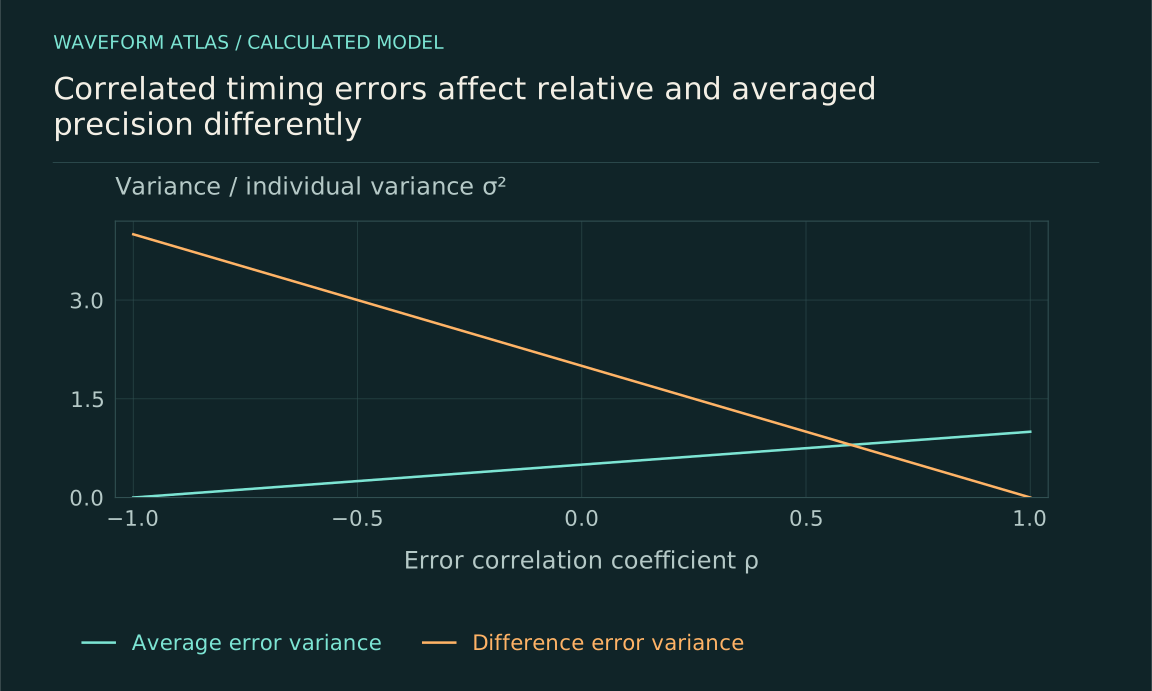
Averaging two independent unbiased timing estimates with equal variance σ² gives variance σ²/2. That familiar improvement assumes independence. If the errors have correlation coefficient ρ, the average variance is σ²(1+ρ)/2. Perfectly common errors give no reduction. Synchronization often introduces or preserves correlations, so the independent-average formula cannot be assumed merely because two devices are coordinated.
Relative noise can improve while collective noise remains. A shared reference may suppress differential drift but transfer its own fluctuations to both oscillators. Measure noise spectra or timing statistics relative to the relevant reference, including correlations. The useful question is which error variable improved over which bandwidth and time scale, not whether the word synchronization generally implies quieter or more accurate operation.
For two identical phase oscillators with independent diffusion coefficients D and symmetric sinusoidal coupling strength K per direction, the near-in-phase relative variable approximately obeys dφ=−2Kφdt+√(4D)dW. Its local stationary variance is D/K. The collective phase has diffusion coefficient D/2 in the same ideal reduction. Coupling suppresses relative wandering while the collective phase still diffuses.
If an additional identical noise term drives both phases, it cancels from φ but remains in Θ. The pair can then appear exceptionally stable relative to each other while sharing substantial absolute timing noise. This explicit model explains why a narrow relative-phase distribution should be supplemented by an independent reference measurement when clock performance is claimed. The numerical noise coefficients are model parameters, not a universal improvement factor for coupled hardware.
A numerical timing example shows how different metrics can move in opposite directions. Let each clock's error relative to an external reference have standard deviation one microsecond. With independent errors, their average has standard deviation about 0.707 microseconds and their difference has standard deviation about 1.414 microseconds. If the errors instead have correlation coefficient 0.8 while each individual variance stays fixed, the average error is about 0.949 microseconds and the difference error about 0.632 microseconds.
The pair has become much more consistent internally while its averaged estimate is less improved relative to the external reference. These are calculated covariance identities, not a claim that synchronization always creates this exact correlation. They demonstrate why the relevant error variable must be selected before declaring a performance gain.
A feedback architecture can deliberately trade differential noise for common noise, or a shared reference can impose that tradeoff unintentionally. Measuring only the phase difference would miss it. Record both individual phases against an independent standard when absolute accuracy matters, and preserve covariance information when combining their outputs. A single synchronization score cannot summarize all three error quantities.
Quantum coherence and entanglement remain separate
A quantum system can show a localized phase distribution or a large relative coherence under a specified synchronization protocol. Those observables do not automatically establish entanglement. Separable coherent states and classical mixtures with a shared phase can produce strong timing correlations. A state witness or suitable reconstruction is needed for a specifically nonclassical claim.
The converse also matters: entanglement can exist in states without useful local oscillatory phases. Changes in drive or dissipation can affect synchronization and entanglement differently. If both are relevant, map both observables under the same conditions rather than assuming they rise and fall together. The physical model determines their relationship; the terminology does not supply a universal implication.
Compare outcomes under matched conditions
To evaluate a claimed benefit, compare synchronized and unsynchronized operation at matched input power, load, detector bandwidth and observation time where feasible. Record changes in amplitude and frequency so that a performance improvement is not attributed solely to phase coordination when other operating conditions changed. State the baseline and uncertainty for each metric.
Useful separate outputs include phase-slip rate, collective timing error, target-mode power, total supplied power and recovery after disturbance. A system can improve one while worsening another. Presenting those quantities separately makes the tradeoff visible and prevents a single high order parameter from becoming an unsupported proxy for efficiency, reliability or quantum advantage.
State what changes and what remains open
Synchronization can organize timing and thereby enable useful collective behavior. The directly established result is the defined phase or frequency relation and its stability. Energy flow, noise, absolute accuracy and quantum resources are additional properties whose changes depend on the implementation. Each needs the corresponding measurement and a model linking it to the coordination.
A precise conclusion might report tighter relative phase, stronger power in a target mode and unchanged total input power, while leaving absolute clock accuracy untested. Another system might trade increased dissipation for faster recovery. Such outcomes are scientifically meaningful without a universal claim. The value of synchronization lies in the particular dynamical relationship it creates and the measurable consequences that follow in that system.
What to take forward
- Relative locking can coexist with collective drift against an external clock.
- Power and noise consequences require a physical model beyond phase-only dynamics.
- Evaluate synchronization, efficiency and quantum correlations with separate observables.
Go to the original work.
These links identify the sources behind specific claims. Verification scope varies by source and is stated below.
- 1 / Primary theoryAdler (1946), A Study of Locking Phenomena in Oscillators ↗
A reduced phase equation describes injection locking and phase drift under specified oscillator assumptions.
Verification scope: IEEE publisher bibliographic record and abstract inspected; the phase equations used here state their own conventions and assumptions.
- 2 / Primary theoryHoogeboom, Pogromsky and Nijmeijer (2015), Huygens’ Synchronization: Experiments, Modeling, and Local Stability Analysis ↗
Platform parameters affect the stability of in-phase and antiphase metronome states.
Verification scope: Publisher abstract and bibliographic record inspected; no claim of full-paper review.
- 3 / University teachingMIT: Entanglement, Density Matrices, and Decoherence ↗
Density operators and reduced states distinguish local observables from joint correlations.
Verification scope: Official university chapter record inspected; elementary examples here are independently worked.
Found a problem with a claim or calculation? Send the page, the claim and the evidence. Read how these articles were prepared.