Define the desired output first
Combining several sources can mean overlapping beams in a filled aperture, steering radiation from a tiled aperture, or routing multiple input modes into one selected output. These geometries share phase-sensitive addition but have different losses, sidelobes and collection metrics. Before quoting an efficiency, define the target mode or angular region and the total supplied input power used as the denominator.
MIT Lincoln Laboratory describes an active architecture in which a photodetector provides feedback for adjusting phases of several laser elements. That official description supports the role of measured-output feedback in coherent combining. Its advertised performance is not used here as a universal efficiency bound. The calculations below concern explicitly normalized ideal models, which make the dependence on phase and amplitude transparent.
A normalized N-input model
Let input j carry amplitude aⱼ=√Pⱼexp(iφⱼ), with power Pⱼ. Choose a symmetric lossless combiner whose desired output amplitude is b₀=(1/√N)Σaⱼ. Its target power is |b₀|², and define η=|Σaⱼ|²/[NΣPⱼ]. By the Cauchy–Schwarz inequality, η≤1. Equality requires all complex input amplitudes to be equal for this particular symmetric target mode.
The remaining power occupies other orthogonal outputs in the ideal complete transformation. The inequality is therefore not a mysterious efficiency penalty; it follows from projecting the input vector onto one normalized output mode. A different combiner can be matched to unequal known amplitudes, but its target vector must still be normalized and the total transformation must account for every output.
Equal powers expose the phase requirement
For equal input powers P, η=|Σexp(iφⱼ)|²/N². If all phases agree, the sum has magnitude N and η=1. If phases spread, the phasor sum shortens and some power leaves through undesired modes. A common phase shift of every input changes the overall output phase but leaves η unchanged; only relative phases matter for this power metric.
With four equal inputs, phases (0,0,0,π) give phasor sum two, so η=1/4. The target receives one quarter of the total power even though three inputs are perfectly aligned with each other. This example shows why one badly controlled channel can materially reduce a coherent output. It also shows why measuring only the total laser power misses the phase problem.
Random phase errors give a useful budget
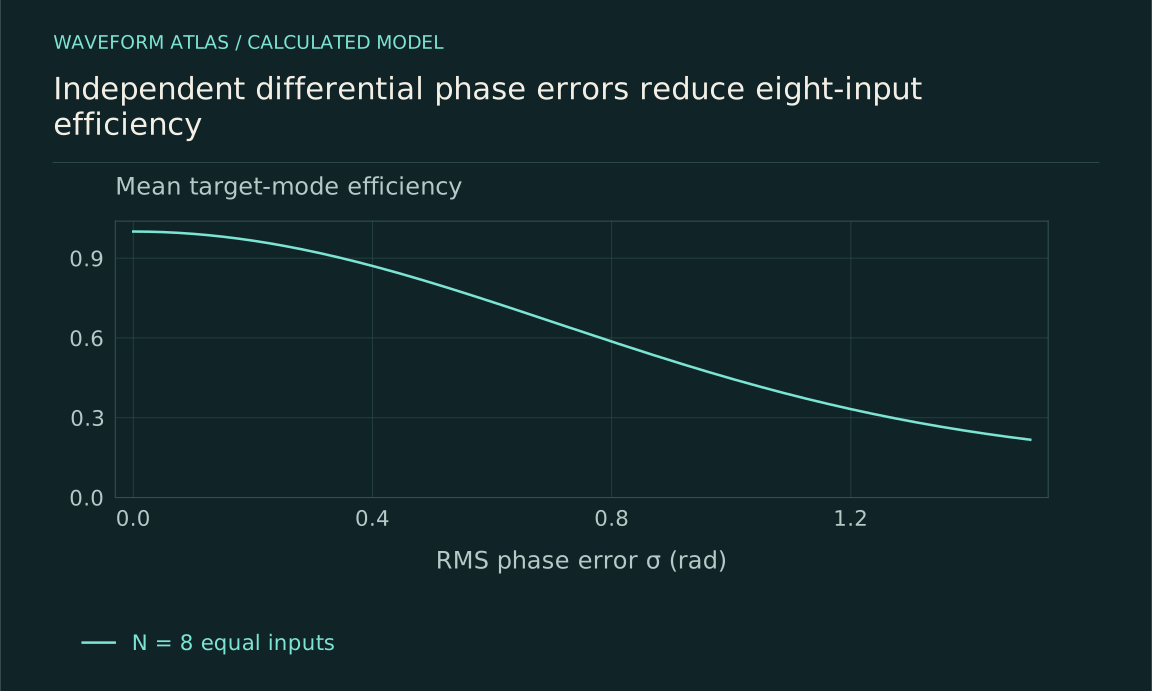
Assume N equal inputs with independent zero-mean Gaussian phase errors of variance σ² about the desired setting. Averaging the target efficiency gives ⟨η⟩=1/N+(1−1/N)exp(−σ²). The diagonal terms contribute 1/N, while each distinct pair contributes the average relative-phase factor exp(−σ²). This is an original calculation under the stated independent-error model.
For N=8 and σ=0.3 radians, the predicted mean efficiency is about 0.925. The result changes if errors are correlated. A phase fluctuation shared equally by every input does not reduce combining efficiency at all, while differential fluctuations do. A control system should therefore measure and suppress the phase combinations relevant to its target, rather than treating every absolute phase fluctuation as equally harmful.
For small independent phase errors and large N, the mean efficiency is approximately 1−σ² to leading order. A target loss below one percent therefore suggests an rms differential phase scale of order 0.1 radians in that simplified regime. At optical wavelength λ, a path-length error δL produces phase error 2πδL/λ in a single-pass path. A 0.1-radian allowance corresponds to δL≈0.016λ.
This converts a phase specification into a mechanical or optical-path tolerance, but only after the path geometry is stated. A double-pass displacement changes optical path by twice the mirror motion, and refractive-index fluctuations can change phase without a comparable physical displacement. The controller should be calibrated in optical phase at the combining plane. A mechanical position tolerance alone does not capture every source of differential phase error in a real system.
Amplitude imbalance has its own penalty
With all phases aligned, the symmetric-combiner efficiency becomes (Σ√Pⱼ)²/[NΣPⱼ]. It is below one when powers differ. For two inputs of four watts and one watt, η=9/10. Perfect phase stabilization cannot remove the remaining mismatch in this fixed balanced combiner. Adjusting amplitudes or choosing a different coupling ratio addresses a different degree of freedom.
Losses before and after combining further change the measured efficiency. Report whether the denominator is power generated by the sources, power reaching the combiner, or power in the controlled modes. A device can have excellent coherent-mode overlap yet poor wall-plug efficiency, or the reverse. Those metrics answer different engineering questions and should not be combined into one unexplained percentage.
A phased array controls direction
For equally spaced emitters at positions xⱼ=jd, the far-field array factor contains Σaⱼexp[ikjd sinθ]. Applying a phase ramp φⱼ=−kjd sinθ₀ aligns contributions toward angle θ₀. The resulting beam direction follows the imposed phase gradient, while the individual-element radiation pattern multiplies the array factor. Finite aperture size determines the main-lobe width and sidelobe structure.
Spacing that is too large for the wavelength and scan range can create additional strong directions, often called grating lobes. Restricting spacing to about half a wavelength is a familiar sufficient design choice for broad angular scanning in a simple uniform array, but practical arrays require their own element and scan assumptions. A narrow target beam is not equivalent to all power occupying only that direction.
Pulses require timing and spectral phase
Continuous nearly monochromatic beams mainly require stable relative phase at their operating frequency, along with spatial and polarization overlap. Short pulses also require their envelopes to overlap. A delay that seems small compared with a control cycle can be large compared with the pulse duration. Matching one carrier phase does not guarantee that the pulse energy arrives together.
Broadband pulses can have different chirp or higher-order spectral phase in different channels. Their central frequencies may align while other spectral components interfere imperfectly. Measure delay-dependent overlap and spectral phase when those effects matter. A combiner optimized using average power can miss a degraded peak pulse shape, so peak intensity, pulse energy and average power should be reported separately when the application depends on them.
Feedback acts through a physical plant
A controller can perturb input phases, observe the target signal, and adjust toward a maximum. The actuator has a finite range and bandwidth; the detector has noise and latency; the optical paths drift. These properties set how rapidly the controller can follow disturbances without instability or excessive residual error. A successful static alignment does not establish performance under a changing environment.
Feedback can also change source operating conditions. If a laser current controls phase through temperature or refractive index, it may simultaneously change amplitude or frequency. The measured target increase must then be separated from increased input power. Independent input monitors and calibration of actuator cross-couplings make that distinction possible. The phase-control problem is embedded in a real source and propagation system, not an isolated numerical optimizer.
Verify efficiency with all relevant channels
Measure input powers at the stated reference plane, target-mode power, and significant unwanted outputs or sidelobes. Scan or perturb phases to confirm the predicted sensitivity. Compare active alignment with a clearly defined baseline, such as randomized relative phases at the same inputs. Record how long alignment remains stable and how recovery behaves after a controlled disturbance.
Use a detector aperture that matches the claimed target definition. Enlarging an aperture may collect more sidelobe power and inflate a nominal combining metric without improving the desired beam. Conversely, an overly small aperture can report a low efficiency because it clips a good mode. Calibration, collection geometry and the stated denominator are what make results from different configurations meaningfully comparable.
A phase perturbation test can reveal whether a reported optimum is reproducible. Deliberately shift one channel by a known angle, predict the target-power change from the measured input amplitudes, and then restore the original setting. Repeat for several channels. This checks that the feedback signal responds to coherent addition rather than to an unrelated detector drift. It also exposes weakly coupled channels that contribute little to the target despite substantial input power. Such channels may need alignment or polarization correction before increasing control bandwidth can improve the result.
Combining concentrates supplied power
Coherent combining is valuable because it directs power from multiple sources into a useful mode while controlling phase relationships. Its benefits can include stronger target illumination or better beam quality, depending on the design. The energy still comes from the sources and their pumps. A passive phase transformation redistributes that supplied power; it does not create an additional supply.
The normalized vector model provides a compact way to evaluate the result. Amplitude balance, relative-phase errors and mode overlap determine the projection onto the target. Array geometry determines where the remaining angular structure lies. Keeping those pieces explicit turns a large brightness increase into an understandable engineering achievement with measurable limits, rather than an ambiguous claim that coherent waves multiply total energy without cost.
What to take forward
- Combining efficiency is power in a defined target divided by a stated total input.
- Differential phase errors and amplitude mismatch reduce target-mode projection.
- Array sidelobes, pulse timing and feedback dynamics require separate characterization.
Go to the original work.
These links identify the sources behind specific claims. Verification scope varies by source and is stated below.
- 1 / Official researchMIT Lincoln Laboratory: Coherent Beam Combination in a Laser Oscillator Using Active Phase Control ↗
A described beam-combining architecture uses a photodetector and feedback to regulate phases of multiple laser elements.
Verification scope: Official technology description inspected; no advertised efficiency or scalability claim is treated as a universal bound.
Found a problem with a claim or calculation? Send the page, the claim and the evidence. Read how these articles were prepared.