A brighter outcome is a limited observation
A detector becomes brighter when more energy reaches its collected mode or when its response changes. In a coherent experiment, a phase adjustment can cause that increase through ordinary amplitude addition. The observation is valuable, but it does not identify every aspect of the system's dynamics. Brightness alone does not establish whether energy was supplied, redistributed, stored, or converted from another form.
The same discipline applies to quantum probabilities. A more likely output can result from a different measurement basis or a unitary transformation of a prepared state. It need not mean that alternatives irreversibly merged or that a stochastic reduction occurred before detection. The appropriate next step is to write a normalized model and identify which further measurements would distinguish competing explanations.
A unitary combiner already predicts enhancement
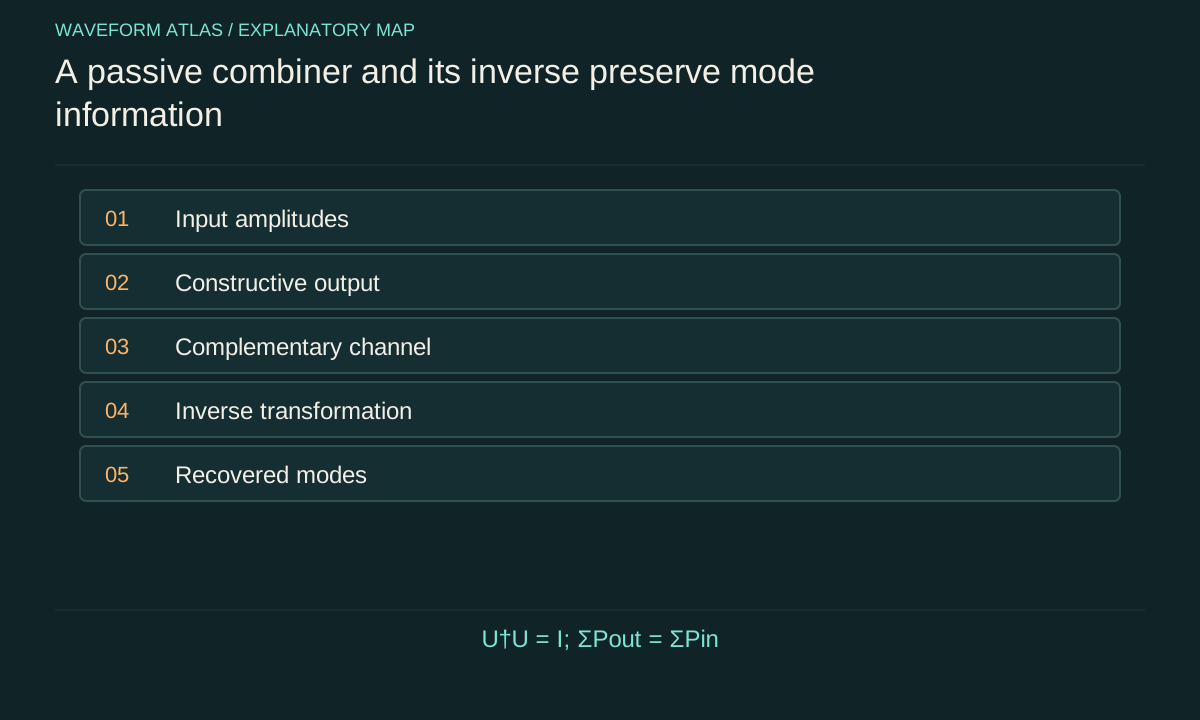
Use a normalized two-port transformation b₊=(a₁+a₂)/√2 and b₋=(a₁−a₂)/√2. Equal in-phase inputs put all their combined power into the + output. A relative phase of π moves it to the − output. The total remains |a₁|²+|a₂|². No gain term or irreversible operation is required to explain the changing brightness.
The transformation has an inverse that reconstructs the input mode amplitudes in the ideal model. This is more than a bookkeeping identity: it predicts that suitable subsequent optics can recover phase information encoded in the output state. A claim that reinforcement necessarily destroys the original distinctions is therefore incompatible with the reversible model unless additional interactions, losses or measurements are specified and demonstrated.
Test reversibility with more than one input
Applying an inverse to one specially chosen input can be a weak test because several different devices may reproduce that one result. Prepare multiple input states or phase settings and compare their reconstructed outputs with predictions. For a classical field, measure complex amplitudes relative to a reference when possible. For a quantum system, use enough independent preparation and measurement settings for the claimed process characterization.
A practical inverse will have loss and calibration error. Quantify those effects rather than treating any imperfection as evidence of fundamental irreversibility. Conversely, do not claim complete state recovery from one restored intensity image: different fields can share an intensity distribution while differing in phase. The recovery observable must match the information that the proposed inverse is supposed to preserve.
For example, two output fields with the same intensities can have opposite relative phases. An intensity-only recovery test would regard them as identical, yet a later recombiner can send them to opposite ports. A phase-sensitive comparison therefore tests information that a power meter misses. In quantum language, measuring populations in one basis does not determine off-diagonal coherence in that basis.
A practical test can insert a known analysis phase and record a complete fringe after the nominal inverse. Compare its contrast and phase with the original preparation, not only its maximum. This checks whether the recovered field carries the relationship needed for subsequent interference. It still characterizes only the measured modes and settings, but it makes the reversibility claim substantially more concrete than a visual resemblance between two bright images.
Linear overlap does not imply fusion
Two wave packets can overlap, interfere, and later separate while retaining the information needed to describe their evolution. In a linear wave equation, the sum of two solutions remains a solution. There is no additional rule that turns the overlap into a permanently merged object. Calling the combined field one resultant wave is a convenient description of the sum, not evidence of a new particle or irreversible reaction.
If an interaction binds objects, changes particle species, or transfers energy between frequencies, that is additional physics. It requires an interaction term, conservation accounting and appropriate measurements. The visual similarity between two overlapping waves and two merging objects is not sufficient. A time-resolved observation after the overlap can help distinguish reversible passage from a genuine change in the system's degrees of freedom.
Passive routing differs from active gain
An amplifier obtains additional energy from a pump or power supply. A passive combiner directs the energy already entering its input modes. A bright target can arise in either system, but their complete power budgets differ. Measure all supplied energy and any stored-energy changes before assigning the increase to amplification. A local intensity ratio is not a substitute for that budget.
A device may contain an amplifier followed by a coherent combiner, so both processes can contribute. Separate their roles by measuring the amplified inputs before combining and the distribution after it. Phase optimization can improve useful output without increasing total amplified power. This separation makes engineering performance clearer and prevents coherent alignment from being credited with energy that was actually supplied by the gain medium's pump.
High intensity can activate additional physics
At sufficiently strong fields in a particular material, nonlinear polarization, saturation, heating or damage can change the response. These effects do not follow merely from the existence of constructive interference; they depend on intensity, material properties, duration and geometry. A linear superposition calculation may predict where the field is large, but a nonlinear constitutive model is needed to predict what the material then does.
Look for discriminating observables such as new frequency components, intensity-dependent phase shifts, hysteresis, changed absorption or persistent structural modification. Vary input power to test scaling. A purely linear combiner has a field response proportional to input amplitude and an intensity response with the corresponding quadratic scaling. Departure from that model can motivate a nonlinear explanation, but the specific mechanism still needs evidence.
Duration also matters when testing nonlinear thresholds. A short pulse and a continuous beam with the same peak intensity can deposit very different total energies and produce different thermal responses. Separate instantaneous field-dependent effects from accumulated heating by varying duration or repetition rate while monitoring average power. The resulting scaling helps identify the additional mechanism rather than attributing every high-brightness change to interference itself.
Quantum coherence is not a particle-count multiplier
In a frequency-preserving passive optical model, the mode transformation redistributes field excitations without an external gain source. Constructive probability-amplitude addition can raise one detector's probability while other outcomes compensate. It does not permit the sum of mutually exclusive outcome probabilities to exceed one. The normalization factors in preparation and beam splitting are essential to this conclusion.
A bright classical fringe also does not establish a nonclassical state. Coherent classical light can produce high-contrast interference. Claims about entanglement or special photon-number statistics require their own measurements. Interference is evidence of a phase relationship for the measured observable, while the quantum character of a resource depends on additional criteria. Conflating these levels can turn a correct wave observation into an unsupported foundational claim.
Environmental loss of information is another process
If outputs become correlated with an unobserved environment, the accessible subsystem can lose coherence even while the complete state evolves unitarily. If energy is absorbed, it leaves the monitored radiation modes and enters matter or other channels. These processes can occur near a bright region, but their presence must be modeled and measured. The constructive cross term itself does not specify them.
A reduced nonunitary description can therefore be appropriate without establishing objective collapse of the whole state. Different physical implementations can produce the same local channel. To distinguish them, access environmental records, measure losses, or vary interactions in ways that competing models predict differently. A stronger signal at one detector carries too little information to settle the global dynamics by itself.
A collapse claim needs an extra prediction
An objective-collapse proposal adds specified physical dynamics beyond ordinary unitary evolution and conventional conditional state assignment. It must identify what changes, at what rate, and under which conditions. A prediction that merely reproduces the ordinary bright-port formula does not distinguish the proposal from standard interference. A useful test targets a measurable difference and includes the known technical and environmental effects.
The same principle applies to claims of spontaneous merging or new collective entities. Define the observable that ordinary reversible routing cannot reproduce. That might concern persistence after separation, altered spectra, correlations or energy transfer, depending on the actual model. Without such a prediction, attaching a new name to a familiar enhancement does not add explanatory content or make the claim experimentally testable.
Use a hierarchy of specific conclusions
First establish calibrated enhancement in a defined mode. Then show its phase dependence and complete power or probability accounting. Test reversibility if that is the issue, and measure additional nonlinear or quantum observables if those are claimed. Each step answers a different question and can be evaluated independently. A dramatic maximum is a starting observation, not the final argument for every proposed mechanism.
Ordinary coherent reinforcement remains a powerful result within those limits. It enables concentration, routing and sensitive phase measurements through well-defined amplitude relationships. Keeping the surrounding dynamics explicit makes it possible to recognize genuine additional physics when it appears, rather than assuming that brightness alone has already demonstrated gain, irreversible fusion or a solution to the quantum measurement problem.
What to take forward
- Reversible mode routing can fully explain a stronger output.
- Gain, nonlinear conversion and irreversible merging require additional dynamics and measurements.
- A collapse proposal must predict an observable difference beyond the ordinary interference formula.
Go to the original work.
These links identify the sources behind specific claims. Verification scope varies by source and is stated below.
- 1 / University teachingMIT: Mach–Zehnder interferometers and beam splitters ↗
Beam splitters combine quantum path amplitudes.
Verification scope: Official course record inspected; the matrices and worked examples here are independently specified.
- 2 / University teachingMIT: Entanglement, Density Matrices, and Decoherence ↗
Density operators and reduced states distinguish local observables from joint correlations.
Verification scope: Official university chapter record inspected; elementary examples here are independently worked.
Found a problem with a claim or calculation? Send the page, the claim and the evidence. Read how these articles were prepared.