Identify the mathematical question
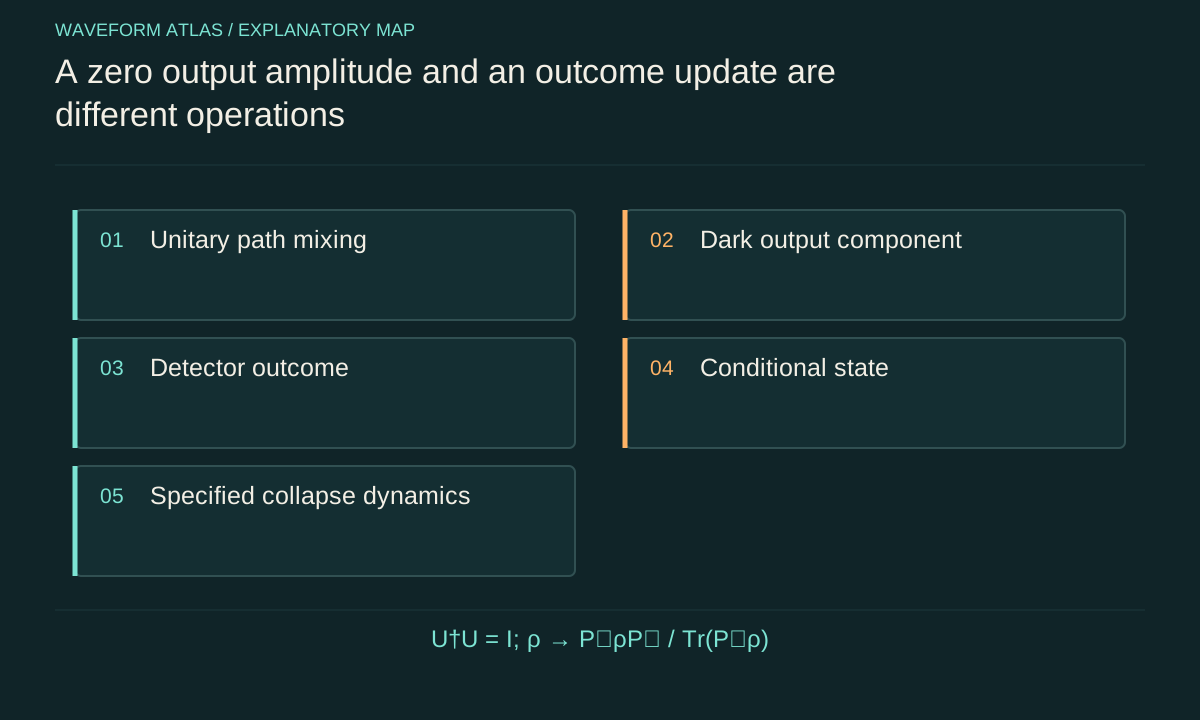
An interferometer can send every ideal input particle to one output and none to another. It is tempting to describe the empty port as a wavefunction collapsing through cancellation. That wording confuses two mathematical operations. Amplitudes can cancel in one basis component while the state continues to evolve reversibly. A measurement update concerns the state assigned after an outcome is recorded, and a physical collapse proposal makes an additional claim about dynamics.
The distinction matters because experimental appearances do not label their own mechanism. A dark detector establishes a low probability for its outcome under the preparation and measurement used. To decide whether that probability arose through interference, absorption, environmental correlations, or a new stochastic process, one needs a model and discriminating measurements. Ordinary interferometer calculations already explain the first possibility without adding a reduction mechanism.
A unitary transformation can make a component zero
Use two path states |0> and |1> and the balanced transformation H=(1/√2)[[1,1],[1,−1]]. Acting on |0>, it produces (|0>+|1>)/√2. A phase shifter changes this to (|0>+exp(iφ)|1>)/√2. Applying H again gives output amplitudes (1+exp(iφ))/2 and (1−exp(iφ))/2. Their squared magnitudes are cos²(φ/2) and sin²(φ/2).
At φ=0, the second amplitude is zero and the first has unit magnitude. No norm has disappeared. The apparatus has mapped the input to a particular output state. Changing φ to π exchanges the bright and dark outputs. The calculation involves only normalized states and unitary matrices; no random variable selects a surviving branch at the recombination stage.
Reversibility supplies a concrete distinction
Every unitary transformation U has an inverse U†. In the ideal two-path model, applying the inverse optical sequence restores the original state for any input superposition. That possibility is stronger than merely observing constant total probability. It preserves the phase relations needed to reconstruct an arbitrary state, including states that were not used when the apparatus was aligned.
An actual device can have loss or imperfect control, so a practical inverse may not restore the state exactly. Nevertheless, the theoretical distinction remains testable through multiple preparations and output measurements. A device that maps many distinguishable input states to the same output while discarding their distinctions cannot be represented as a unitary map on those accessible modes alone. One must include additional channels, environmental records, or a genuinely nonunitary description.
A recorded measurement uses different objects
Suppose a detector measures the output-path basis. For state |ψ>, the probability of outcome j is pⱼ=<ψ|Pⱼ|ψ>, where Pⱼ projects onto the corresponding output. Conditioned on that outcome in an ideal projective description, the assigned state becomes Pⱼ|ψ>/√pⱼ. This conditioning differs from adding two path amplitudes before detection. It explicitly refers to which outcome was obtained.
If the outcome is ignored, the measurement channel produces a density operator ΣⱼPⱼρPⱼ. That operation can remove off-diagonal terms in the measured basis. The conditional update and the unconditioned channel answer different questions, so they should not be compressed into one informal word. Neither is established merely by finding that a particular port has low intensity before asking how its detector is modeled.
A deterministic outcome is not a test of all collapse claims
At the ideal bright-port setting, the Born rule predicts one output with probability one. A detector still produces a record, but the observed certainty does not discriminate among interpretations or theories that share that prediction for this setup. A demonstration designed to eliminate one outcome is therefore a poor standalone probe of how genuinely uncertain outcomes become definite in individual trials.
Set φ=π/2 instead, and the ideal probabilities are one half at each output. Repeated detections test those probabilities, but the histogram alone still does not select a unique interpretation of quantum mechanics. A proposed modification must predict an observable departure from the standard model under specified conditions. Without such a departure, calling the same histogram evidence for a universal collapse mechanism adds a label rather than an experimental distinction.
Environmental records change local interference
Now correlate the two paths with environmental states: (|0>|E₀>+exp(iφ)|1>|E₁>)/√2. Ignoring the environment multiplies the path coherence by the overlap <E₁|E₀>. If those environmental states become orthogonal, the reduced path state has no off-diagonal coherence in this basis, and the recombined port probabilities lose their phase-dependent fringe.
The joint state can still be pure and evolve unitarily. Local loss of interference therefore does not logically establish an objective reduction of the complete state. A classical ensemble of unknown phases can also yield the same reduced density matrix for the path alone. Distinguishing these preparations requires access to correlations, preparation records, or other observables; a single local fringe-visibility number cannot recover their full history.
One concrete local ambiguity uses two different preparations. In the first, prepare |+>=(|0>+|1>)/√2 on half the trials and |−>=(|0>−|1>)/√2 on the others, retaining no accessible label. Their mixture is ρ=I/2. In the second, prepare the entangled state (|0>|E₀>+|1>|E₁>)/√2 with orthogonal environment states and inspect only the path. Its reduced density operator is also I/2. Every measurement confined to that path gives identical statistics for these two local descriptions.
The distinction can reappear when additional information is accessible. A retained preparation label lets the first ensemble be sorted into coherent subsets. A suitable joint measurement on the second system and environment can reveal correlations absent from the first preparation. Neither procedure follows from the flat local pattern alone. This example explains why statements about the complete physical state require more evidence than a measurement of one subsystem's density matrix.
Absorption and postselection are separate again
A detector that absorbs a photon removes it from the propagating optical mode while transferring energy and information to matter. A reduced optical description may show loss, but a complete accounting includes the absorber and its environment. That physical process is different from a lossless beam splitter making a particular optical output dark through coherent routing.
Postselection introduces another distinction. If an experiment keeps only trials with a specified detection event, its reported conditional probabilities must be accompanied by the success probability. Renormalizing the retained sample can make a small surviving signal look dominant. It does not show that all initial input energy reached that channel. The unconditional count rate, discarded events, and detector efficiencies are necessary to interpret the result and avoid confusing selection with amplification or collapse.
What an objective modification would need
An objective-collapse proposal must specify more than the statement that outcomes occur. It needs dynamics or a stochastic rule, the states or observables affected, parameter dependence, and predictions that can be compared with experiment. Depending on the model, relevant tests might concern loss of coherence, extra diffusion, heating, or changes in interference with size and time. These possibilities are model dependent, not consequences of the dark-port equation.
The proper comparison uses the same apparatus and known sources of decoherence in both hypotheses. If ordinary phase noise predicts the observed visibility loss, the data do not by themselves require a new term. If a proposed modification predicts a distinctive dependence, the experiment must have enough sensitivity and control to test that dependence. A broad philosophical description cannot substitute for a quantitative competing prediction.
A useful hierarchy of evidence
First establish that the source and detectors work. Next test the unitary interference model by scanning phase and accounting for complementary outputs. Then quantify known losses, fluctuations, and environmental couplings. Only after those steps can an unexplained discrepancy be characterized well enough to compare with a new dynamical model. Even then, a discrepancy is not automatically evidence for the first speculative explanation considered.
This hierarchy does not imply that interference experiments are unimportant for foundational physics. Their sensitivity to phase and coherence makes them valuable. It means that a particular observation must be connected to the parameter or mechanism it actually constrains. A high-contrast fringe tests coherence preservation in a specified preparation; an absent fringe places a different, often less specific constraint unless its cause has been isolated.
What remains after the comparison
The key missing step in a lossless interference calculation is a stochastic, outcome-selecting physical process. The unitary matrices route amplitudes and preserve the complete state norm. Adding a detector requires a measurement description, and proposing objective reduction requires further dynamical content. These are related parts of quantum theory, but they are not interchangeable descriptions of a zero amplitude.
A useful reading of a dark port is consequently precise and limited: the alternatives leading to that output cancel for the prepared state and chosen phase. The complementary output, inverse transformation, and environmental controls determine what else can be inferred. This interpretation explains the phenomenon while leaving the genuine measurement problem visible, rather than declaring it solved by a mathematical cancellation that standard quantum mechanics already contains.
What to take forward
- A unitary map can set one component to zero while preserving the whole state.
- Measurement conditioning refers to a recorded outcome and is a separate mathematical operation.
- Testing objective reduction requires a specified model with distinguishable predictions.
Go to the original work.
These links identify the sources behind specific claims. Verification scope varies by source and is stated below.
- 1 / University teachingMIT: Mach–Zehnder interferometers and beam splitters ↗
MIT: Mach–Zehnder interferometers and beam splitters. https://ocw.mit.edu/courses/8-04-quantum-physics-i-spring-2016/resources/mach-zehnder-interferometers-and-beam-splitters/
Beam splitters combine quantum path amplitudes.
Verification scope: Official course record inspected; the matrices and worked examples here are independently specified.
- 2 / University teachingMIT: Entanglement, Density Matrices, and Decoherence ↗
Density operators and reduced states distinguish local observables from joint correlations.
Verification scope: Official university chapter record inspected; elementary examples here are independently worked.
- 3 / University teachingChapter 2: Experiments with photons ↗
Barton Zwiebach (2016). Chapter 2: Experiments with photons. MIT 8.04 Quantum Physics I, lecture notes, 9 February 2016, pp. 1–8.
Normalized two-port amplitudes, beam-splitter phase conventions and Mach–Zehnder interference.
Verification scope: Official MIT Chapter 2 PDF inspected for the two-port convention and interferometer calculation; independently derived examples are identified in the articles.
- 4 / Primary theoryModels of wave-function collapse, underlying theories, and experimental tests ↗
A. Bassi, K. Lochan, S. Satin, T. P. Singh, and H. Ulbricht. Reviews of Modern Physics 85(2), 471–527 (2013). Linked record is the author preprint.
DOI: 10.1103/RevModPhys.85.471
Objective-collapse models require specified dynamics and parameters; their possible tests include coherence loss, diffusion and heating, with model-dependent size and time behavior.
Verification scope: APS publisher record and author-preprint passages on diffusion and heating inspected, including preprint pp. 35 and 109. This is a model review, not evidence that collapse is established.
Found a problem with a claim or calculation? Send the page, the claim and the evidence. Read how these articles were prepared.