An output port is one possible channel
An interferometer is built from physical paths and components, but its simplest quantum description uses modes. A state labeled 0 can denote one input or output path and a state labeled 1 the other. The labels refer to specified spatial modes, not two separate particles that must each carry half of a particle's substance. A single prepared excitation can have probability amplitudes associated with both alternatives. The experiment tests these amplitudes through the statistics of detector records.
An output called dark has a small probability of detection in its selected mode. This says nothing by itself about the probability in the other mode or about losses before detection. A complete account must include both outputs and the detector efficiencies. The distinction is particularly important when a diagram shows only the port used as a sensitive measurement channel. Omitting the complementary port can make ordinary amplitude routing look like the destruction of the entire state, even though the complete state remains normalized throughout the ideal calculation.
Pick a transparent beam-splitter convention
A convenient idealized balanced beam splitter acts as H=(1/√2)[[1,1],[1,−1]]. This is a unitary matrix, so it preserves the norm of a two-component state. Different optical conventions place factors of i on reflection amplitudes; those conventions are equally valid when phases are carried consistently through the whole apparatus. The simple H convention is chosen here to make the algebra visible, not to claim that every physical beam splitter uses those exact individual phases.
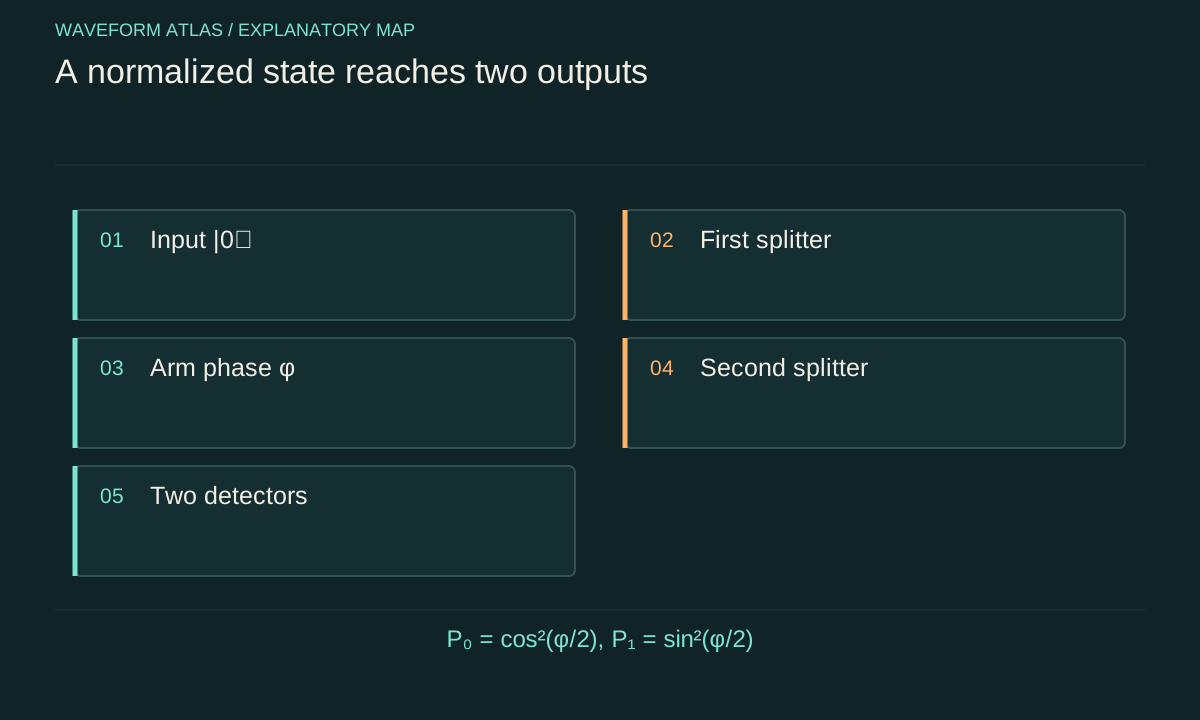
Send the input state |0⟩ through the first beam splitter. The state becomes (|0⟩+|1⟩)/√2. A phase shifter in the second arm gives (|0⟩+exp(iφ)|1⟩)/√2. Applying the second H produces amplitudes (1+exp(iφ))/2 and (1−exp(iφ))/2. Their squared magnitudes are cos²(φ/2) and sin²(φ/2). The probabilities sum to one. Writing every step makes it impossible to mistake cancellation in one output for a zero state in both.
Follow a complete phase sweep
At φ=0, the first port has probability one and the second has probability zero. At φ=π/2, each has probability one half. At φ=π, the first is dark and the second receives every ideal detection. Increasing phase to 2π returns the starting distribution. These predictions form a complete fringe rather than a special explanation invented for one minimum. A controlled experiment can compare the entire sweep with the model.
For a thousand independent ideal trials at φ=π/2, the expected counts are five hundred in each output, with statistical fluctuations. The standard deviation of either count in the binomial model is about sixteen. At an ideal dark setting the predicted probability is exactly zero, but actual dark counts, imperfect overlap and loss change the observed record. A real measurement should estimate those contributions instead of equating every rare count with a failure of quantum interference. The illustrative counts here follow directly from the stated model and are not experimental data.
Why blocking a path changes the experiment
If one arm is blocked between the beam splitters, the two alternatives are no longer both present at recombination. Conditional on an excitation reaching the second beam splitter through the surviving arm, its outputs are balanced in the ideal model. The earlier deterministic bright-and-dark routing depended on the coherent combination of both path amplitudes. Blocking a path changes the physical preparation, so its result cannot be substituted into the two-path calculation without changing the state.
This gives a strong control. Record both output distributions with both paths open, then block each arm in turn. The two-path fringe should disappear when the necessary alternative is removed. However, blocking also introduces loss, and conditional probabilities should not be confused with total detected fractions per original input trial. If half the input is absorbed by the blocker, conditioning on survival hides that loss. Reporting both preparation counts and output counts keeps the interference question separate from the detection-efficiency question.
Marking a path can change coherence without blocking it
A path can become correlated with another degree of freedom even when neither arm is physically blocked. Suppose the joint state is (|0⟩|e₀⟩+exp(iφ)|1⟩|e₁⟩)/√2. The output interference term depends on the overlap ⟨e₀|e₁⟩. If the environmental states are identical, the ideal fringe remains. If they are orthogonal, tracing over the unobserved environment removes the local cross term. This is a statement about joint-state correlations and what the detector accesses.
The local output distribution can then look phase independent despite continued population in both arms. That observation is different from a coherent dark port, where a stable relative phase directs amplitude into one output. In one case the phase scan has strong contrast; in the other its contrast may be absent. A careful experiment asks whether path information exists elsewhere, whether it can be controlled and whether conditioning on an auxiliary measurement changes the statistics. Lost local contrast alone does not identify a unique mechanism producing one final outcome.
A dark port can be a sensitive meter
Near φ=0, the nominally dark second-port probability is sin²(φ/2), approximately φ²/4 for small phase. Tiny changes in path length can therefore produce detectable counts against a low background. The useful sensitivity depends on photon number, detector noise, calibration and how the phase is estimated. Operating exactly at a symmetric zero also means the count rate does not reveal the sign of a small phase shift without an additional reference or bias.
A device may deliberately operate slightly away from darkness to obtain a locally linear signal. Balanced detection can compare both outputs and use their difference, proportional to cosφ in this convention, while monitoring their sum. Choosing an operating point is therefore a measurement-design decision. It is not automatically true that the darkest possible port gives the best estimate under every noise model. Specify the estimated parameter, available input resource and noise sources before comparing sensing schemes. The complete statistical model matters as much as the striking visual impression of a black output.
Loss is an additional set of channels
Real interferometers absorb, scatter or fail to collect some excitations. A convenient model adds loss modes to the complete state transformation. The observed two-port map alone may no longer be unitary, even when a larger description including the loss channels is. Detector inefficiency adds another distinction between an excitation reaching a port and a recorded count. These effects reduce measured rates and can bias an inference if the experiment normalizes only by the counts it happened to detect.
Measure arm transmission separately and calibrate detector efficiencies where the claim requires it. If the two outputs have different efficiencies, equal true probabilities do not yield equal raw counts. A phase-dependent total count can signal clipping or interference in an unmonitored channel rather than a new reduction process. Stable loss does not prevent interference, but it changes the relation between the ideal probabilities and the collected data. Honest reporting keeps the ideal model, the transmission model and the detector model visibly separate.
Reversal tests the coherent operation
The ideal sequence can be reversed by applying the inverse component operations in reverse order. In the chosen convention H is its own inverse, and a phase shift φ is undone by −φ. This reversibility is a concrete property of the unitary model. It explains how an excitation routed into one output can be coherently transformed again, provided the relevant modes remain available and no irreversible record has been discarded.
An actual detector usually absorbs or strongly interacts with the excitation, so reversing a detected event is a different undertaking from reversing an undetected optical transformation. A useful experiment therefore performs the inverse optical operation before detection. Agreement with the predicted restored distribution supports coherent control of the paths. Failure can arise from ordinary loss, phase noise or imperfect mode matching; it does not immediately prove a fundamental irreversible term. Reversal becomes informative when those competing explanations are independently constrained, rather than treated as interchangeable reasons for any unwanted result.
Place the dark port in the larger story
The dark port answers a precise question: how do controlled alternatives combine in a selected output basis? It provides an exceptionally clear demonstration that quantum probabilities cannot always be obtained by adding classical path probabilities. It also gives practical routes to sensing and state preparation. These are substantial results without claiming that interference itself solves the measurement problem.
An objective-collapse proposal adds a dynamical or interpretive account of how definite outcomes arise. To distinguish such a proposal from coherent routing, it must make a prediction beyond the standard interferometer calculation under specified conditions. A modified fringe alone would need controls for ordinary noise and loss. The correct comparison therefore begins with this normalized two-port model, follows the apparatus and then states exactly where an alternative theory differs. A disappearing amplitude component is the beginning of that comparison, not its conclusion.
What to take forward
- A zero amplitude in one port leaves a normalized state in the other.
- Path marking and coherent cancellation produce different phase scans.
- Reversal must occur before the relevant record or mode is discarded.
Go to the original work.
These links identify the sources behind specific claims. Verification scope varies by source and is stated below.
- 1 / University teachingMIT: Mach–Zehnder interferometers and beam splitters ↗
Beam splitters combine quantum path amplitudes.
Verification scope: Official course record inspected; the matrices and worked examples here are independently specified.
- 2 / University teachingMIT: Entanglement, Density Matrices, and Decoherence ↗
Density operators and reduced states distinguish local observables from joint correlations.
Verification scope: Official university chapter record inspected; elementary examples here are independently worked.
Found a problem with a claim or calculation? Send the page, the claim and the evidence. Read how these articles were prepared.