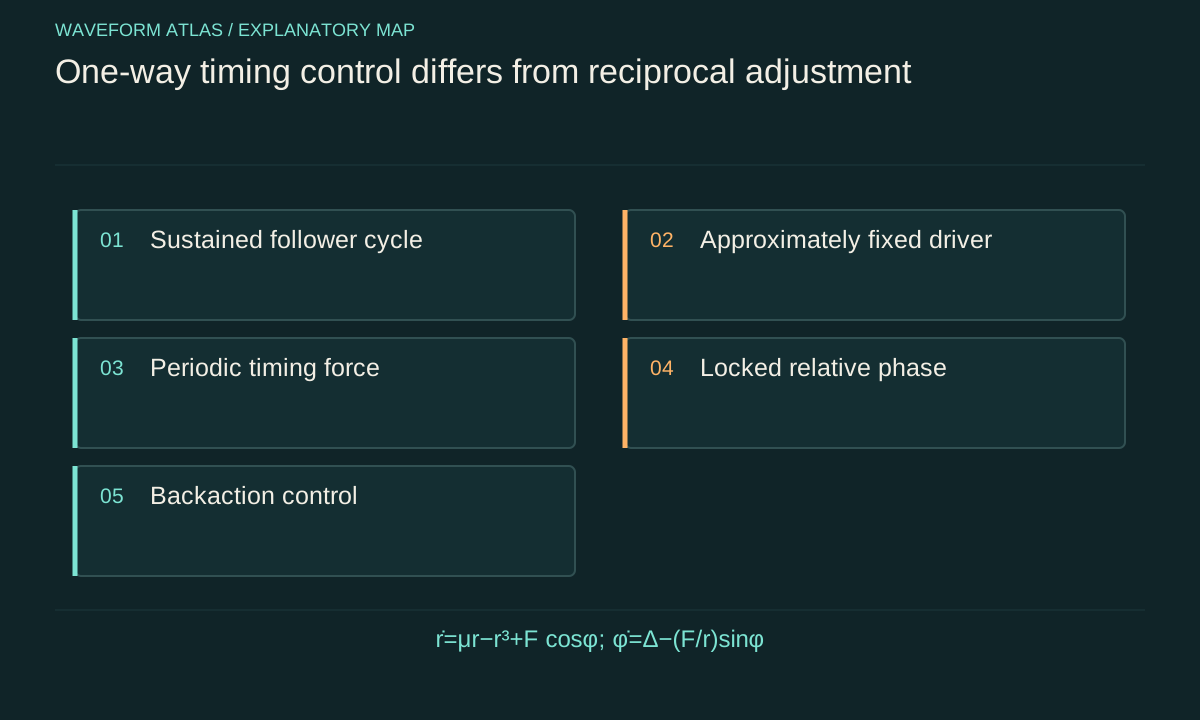
Separate a driver from a follower
In one-way entrainment, one system provides a timing signal and another adjusts to it, while backaction on the driver is negligible in the model. The follower has its own sustained rhythm when the timing signal is absent. This distinguishes entrainment from a passive object merely vibrating because a force is applied. It also distinguishes it from mutual synchronization, where both systems can shift their rates.
The approximation of an unaffected driver should be tested. A weak source can be pulled by the load it drives, or a shared support can transmit influence in both directions. Monitor the driver's phase and frequency while perturbing the follower or changing the coupling. If the driver changes appreciably, a two-way model may be more appropriate than a fixed external reference.
A driven limit cycle supplies an explicit model
Use the illustrative complex-amplitude equation ż=(μ+iω₀)z−|z|²z+Fexp(iωdt), with μ>0. Without the periodic forcing, its radius tends to r₀=√μ and its phase advances at ω₀. The constant μ represents amplitude growth balanced by nonlinear saturation in this normal form. It is not a literal energy source specification for every physical oscillator.
Write z=r exp[i(ωdt+φ)]. The equations become ṙ=μr−r³+Fcosφ and φ̇=ω₀−ωd−(F/r)sinφ. The forcing affects both amplitude and relative phase. A phase-only approximation replaces r by r₀ when amplitude perturbations are small and relax quickly. This derivation makes the approximation visible rather than assuming every entrained oscillator has a fixed amplitude by definition.
Weak forcing gives a finite locking interval
With r≈r₀, define Δ=ω₀−ωd and K=F/r₀. Then φ̇=Δ−Ksinφ. A stable stationary phase exists for |Δ|<K, with sinφ*=Δ/K and cosφ*>0. Inside that interval, the follower's mean frequency equals ωd. Outside it, the relative phase drifts, although the drive can still pull the mean frequency toward its own rate.
Adler's original locking analysis supports the use of a reduced phase equation under specified oscillator assumptions. The current normal-form example is independently stated and should not be treated as an exact model of every circuit or biological rhythm. Its value is that the coupling, detuning and phase offset have clear mathematical roles and lead to measurable predictions.
A numerical weak-drive example
Take μ=1 in dimensionless amplitude-time units, so r₀=1, and choose F=0.1. The approximate phase coupling is K=0.1 per unit time. At detuning Δ=0.05, the stable offset is π/6. The follower runs at the driver's rate while maintaining that nonzero lag or lead according to the chosen sign convention.
The radial equation predicts a small amplitude correction. Linearizing near r₀ gives radial restoration rate 2μ, so the steady correction is approximately Fcosφ*/(2μ)≈0.0433. This changes the effective F/r slightly and shows why the phase-only result is an approximation. As forcing grows, solving the coupled amplitude-phase equations becomes necessary. A larger drive does not merely widen the same ideal tongue without changing the cycle.
Phase response explains why timing matters
A brief perturbation applied at different points in a cycle can advance or delay the next cycle by different amounts. A phase-response function summarizes this dependence for sufficiently small perturbations. Repeated periodic forcing accumulates those phase shifts, and averaging over cycles can produce an effective coupling function. The form of that function determines which phase offsets are stable.
This gives a practical route from a physical oscillator to a phase model: measure how small impulses affect timing at several phases, then compare predicted entrainment with a periodic-drive experiment. The procedure has limits when perturbations strongly change amplitude or move the system away from its cycle. A measured phase response should therefore include the perturbation size and recovery conditions used to define it.
A phase-response measurement should compare perturbed and unperturbed cycles after amplitude transients have relaxed enough for a meaningful phase difference to be assigned. Measuring only the immediate displacement can confuse an amplitude kick with a lasting timing shift. Repeat at several perturbation strengths to identify a range where the phase shift scales approximately linearly with the applied impulse.
The measured response can have both advancing and delaying portions. A periodic drive then selects a stable offset where its average correction balances detuning and restores deviations. This explains why entrainment can occur with a small mean energy transfer: timing sensitivity, rather than a large displacement response, determines the phase correction in the reduced description. The full energy cost of the drive remains a separate physical quantity.
Frequency pulling is not complete locking
Outside the locking interval, the driver can still change the follower's average rate and create a preferred range of relative phases. The phase may dwell near one offset and then slip by a cycle. A short record can look nearly locked even though the long-time winding is nonzero. Measure the unwrapped phase and slip statistics rather than relying only on a narrow spectral peak.
The transition can also be noisy. A follower inside a deterministic locking region may occasionally slip under fluctuations. A practical entrainment claim should specify observation time and tolerated slip rate or phase variance. This operational definition is more useful than demanding an impossible guarantee of permanent exact phase, while still distinguishing a robust locked regime from repeated drifting passages through a favored phase.
Rational entrainment uses cycle ratios
A follower can lock at a rational ratio to a periodic driver in suitable nonlinear systems. If its mean rate is twice the drive rate, the relevant phase combination is θf−2θd. Other ratios require the corresponding integer-weighted combination. The existence and width of these locking regions depend on the oscillator and forcing waveform; they are not guaranteed merely because a rational ratio can be written down.
Harmonic content in the measured waveform can imitate such a relation. A single oscillator with a nonsinusoidal cycle already produces multiple spectral harmonics. Establish that the claimed follower cycle and driver cycle are physically distinct and that their weighted phase remains localized under coupling. A spectral line at twice the drive frequency alone does not prove a separate two-to-one entrained oscillator.
Mutual adjustment changes the interpretation
If both oscillators respond to one another, the common frequency can lie between their uncoupled values or follow a more complicated weighted relation. In the one-way limit, the driver remains fixed and only the follower changes. This difference can be tested by perturbing each side separately and monitoring both timing records. The physical transmission path determines whether the one-way approximation is justified.
Mechanical metronomes on a movable support illustrate why a visually obvious leader-follower narrative can be misleading. The support mediates reciprocal effects, and platform parameters influence stable phase relations in verified models. A source with larger amplitude may act approximately as a driver, but amplitude alone does not prove negligible backaction. Directionality belongs in the model and the controls, not just in the names assigned to the traces.
Design an entrainment test
Record the follower's free-running behavior with its sustaining energy supply active and the timing drive removed. Measure the driver independently. Then vary drive frequency and strength, tracking both phases, follower amplitude and any backaction. Apply a small phase disturbance to the follower and test whether the relative phase returns to the predicted offset.
Use matched observation times across the locking map and allow for slow recovery near boundaries. Check for common clock artifacts in the acquisition system: two channels referenced to the same electronics can appear more coordinated than the physical oscillators are. Retain raw timestamps or an independent reference when timing precision matters. The result should connect the observed lock to the applied physical signal rather than to the measurement's bookkeeping.
Interpret entrainment as controlled timing
Entrainment demonstrates that a timing signal organizes an oscillator's rhythm within a defined regime. It can be useful for coordinating devices or probing phase sensitivity, but it does not imply that the follower has lost its identity, merged with the driver or acquired a universal new energy state. The sustaining power and coupling work still require their own accounting.
A precise conclusion names the driver, follower, locking ratio, detuning range, phase statistics and evidence for directionality. It also states where the weak-drive or phase-only approximation fails. With those elements explicit, a shared rhythm becomes a quantitative dynamical result rather than a visual analogy, and it can be distinguished cleanly from passive resonance, mutual synchronization and common-source copying.
The reference phase should remain part of the reported result. A follower can lock to a driver while both drift together relative to an independent clock. Their mutual stability may be excellent even though neither provides an accurate absolute frequency standard. Conversely, a stable external reference can improve long-term accuracy without guaranteeing low short-term phase noise. State whether the application requires relative coordination, absolute timing accuracy or both, because the same entrainment measurement does not automatically establish all of those properties.
What to take forward
- Entrainment assumes an approximately unaffected driver and a self-sustained follower.
- Weak forcing reduces to a phase model only when amplitude recovery is fast.
- Backaction and phase-slip measurements distinguish locking from pulling or mutual adjustment.
Go to the original work.
These links identify the sources behind specific claims. Verification scope varies by source and is stated below.
- 1 / Primary theoryA Study of Locking Phenomena in Oscillators ↗
Robert Adler. Proceedings of the IRE 34(6), 351–357 (1946).
DOI: 10.1109/JRPROC.1946.229930
A reduced phase equation describes injection locking and phase drift under specified oscillator assumptions.
Verification scope: Publisher or author-institution abstract and bibliographic record inspected; full paper not audited.
- 2 / Primary theorySynchronization of clocks and metronomes: A perturbation analysis based on multiple timescales ↗
Guillermo H. Goldsztein; Alice N. Nadeau; Steven H. Strogatz. Chaos 31(2), 023109 (2021).
A model including escapement, amplitude and platform dynamics can have in-phase or antiphase synchronization.
Verification scope: Publisher or author-institution abstract and bibliographic record inspected; full paper not audited.
- 3 / Primary theoryHuygens’ Synchronization: Experiments, Modeling, and Local Stability Analysis ↗
F. N. Hoogeboom; A. Y. Pogromsky; H. Nijmeijer. IFAC-PapersOnLine 48(18), 146–151 (2015).
DOI: 10.1016/j.ifacol.2015.11.027
Platform parameters affect the stability of in-phase and antiphase metronome states.
Verification scope: Publisher or author-institution abstract and bibliographic record inspected; full paper not audited.
Found a problem with a claim or calculation? Send the page, the claim and the evidence. Read how these articles were prepared.