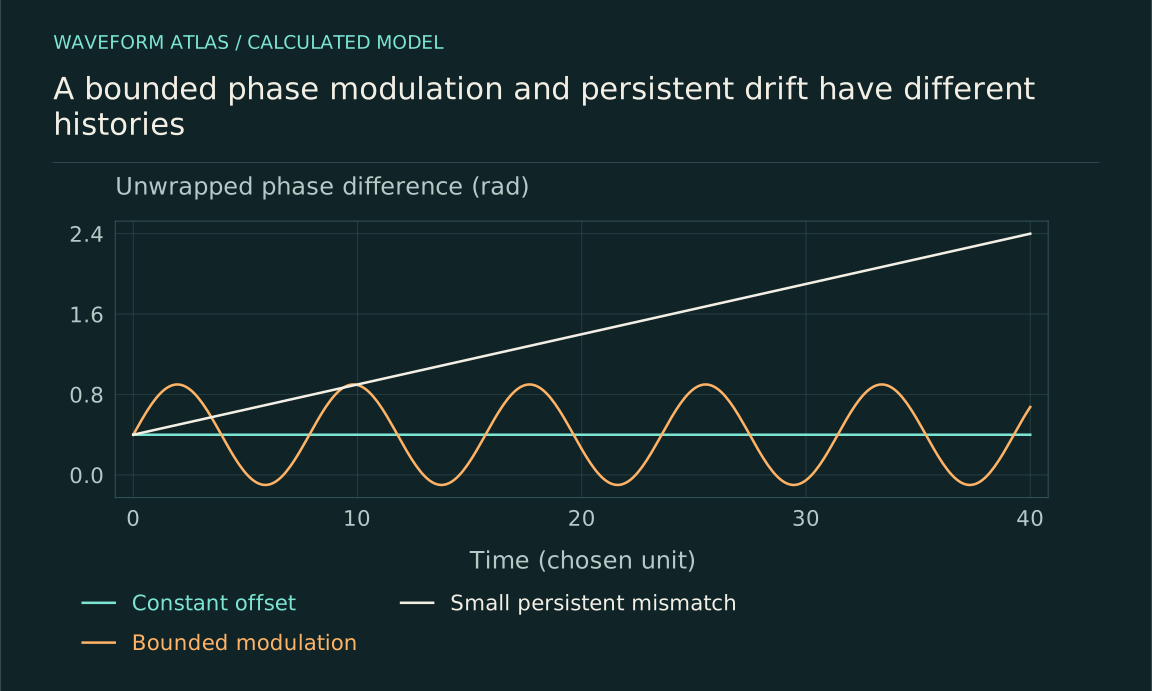
Mean rate and phase history contain different information
An oscillator phase θ(t) increases by approximately 2π each cycle. Its long-time mean angular frequency is the accumulated phase divided by elapsed time after transients are handled. Two oscillators can have equal mean rates even when their relative phase fluctuates strongly. Conversely, a short interval can show nearly equal estimated frequencies while a small persistent mismatch will eventually produce a full phase slip.
Phase locking is therefore a statement about more than two nearby numbers in a frequency table. It concerns the behavior of a defined phase combination over time. Different fields use slightly different operational criteria, especially with noise, so a report should state whether it means a constant offset, bounded modulation, a localized distribution or an acceptably low slip rate.
Constant relative phase implies equal instantaneous rates
For one-to-one locking, define φ(t)=θ₁(t)−θ₂(t). If φ is exactly constant, differentiating gives θ̇₁=θ̇₂ at every instant in the ideal smooth model. The common rate need not itself be constant; both phases could accelerate together while preserving their difference. The condition concerns their relationship, not a requirement that each oscillator trace be a perfect sinusoid.
A stable offset can be zero, π or another angle. In-phase and antiphase motion are both possible forms of coordination. The appropriate value depends on coupling, detuning and waveform definition. A detector that observes only the sum of two signals can mistake antiphase locking for weak activity, so individual phase records are often necessary to identify the timing relation.
Bounded phase modulation allows instantaneous differences
Suppose φ(t)=φ₀+a sinΩmt. This phase difference is bounded, but its derivative is aΩmcosΩmt. The instantaneous frequencies therefore differ periodically even though their long-time means agree. A phase-locking definition that permits bounded modulation can include this behavior; an exact constant-offset definition would be narrower.
The example is useful when an experiment shows a narrow frequency difference distribution but a visibly oscillating relative phase. It need not indicate complete loss of coordination. Determine whether the modulation remains bounded, whether it repeats reproducibly and whether full-cycle slips occur. Report those observations instead of forcing every record into only perfectly locked or completely unrelated categories.
Equal mean rates do not guarantee bounded phase
Consider a relative phase that performs an unbiased random walk. Its mean drift can be zero while its variance grows with time. Long-time average frequencies may agree in an ensemble or operational sense, yet the unwrapped phase does not stay near one offset. This is phase diffusion rather than a strict stable phase lock.
A finite sample can also have zero net phase change by chance even after several positive and negative slips. Reporting only the beginning and ending phases hides that history. Examine the entire unwrapped trace and the distribution of increments. A frequency estimate compresses timing information into one slope; it cannot by itself establish the restoring dynamics or bounded fluctuations required by a stronger synchronization claim.
Rational locking uses a different phase combination
If the mean frequency ratio is ω₁/ω₂=p/q for integers p and q, the relevant combination is ψ=qθ₁−pθ₂. For a two-to-one relation, ψ=θ₁−2θ₂. A bounded ψ means that one oscillator completes approximately two cycles for each of the other's cycles while preserving a defined timing relation. The ordinary difference θ₁−θ₂ would continue growing and is the wrong diagnostic.
This convention must be stated because the labels p:q are sometimes reversed between fields. A frequency ratio close to a simple rational number is not by itself evidence of locking. Coupling dependence, phase localization and stability under perturbation are still needed. Harmonics in one waveform can produce spectral peaks at integer multiples without representing separate oscillators that have synchronized.
A phase equation illustrates the transition
Use φ̇=Δ−Ksinφ for a one-way phase-locking model with K>0. A stable stationary phase exists for |Δ|<K and satisfies sinφ*=Δ/K with cosφ*>0. Outside that interval, the relative phase advances through repeated cycles. The long-time drift rate in the deterministic model is sign(Δ)√(Δ²−K²) for |Δ|>K.
The drift can be very slow near the boundary. A short record just outside the locking region may therefore look almost stationary. Inside the region, small perturbations relax at rate Kcosφ*=√(K²−Δ²), which also becomes slow near the boundary. Both facts make finite-time classification hardest at the edge. Dwell time should be chosen with those dynamical scales in mind.
For K=1 per second and Δ=1.01 per second, the deterministic mean drift is √(1.01²−1)≈0.142 radians per second. One full slip then takes about 44.3 seconds on average. A five-second record can miss the slip entirely. Moreover, the drift is nonuniform: the phase spends a long time near the former locking position and moves faster elsewhere, so its wrapped distribution can look strongly peaked despite the absence of a stationary phase.
This is an important limit of phase-localization statistics in classical records. A peak in a phase histogram can indicate slowing near a locking boundary rather than strict locking. Combine the histogram with the unwrapped winding count and observation duration. The distinction becomes particularly important when comparing deterministic models with noisy data, where both slow drift and rare noise-induced slips can produce similar short records.
Wrapped phase can conceal slips
A plot restricted to angles between −π and π maps every full cycle back into the same interval. A slowly drifting phase then appears as repeated jumps across the plot boundary. A noisy phase near that boundary can appear to jump even when the physical phase changes only slightly. Unwrapping reconstructs accumulated cycles, but it must be done with enough sampling and signal quality to avoid choosing the wrong branch.
Inspect raw cycle timing when an apparent slip occurs. If the signal amplitude passes near zero, phase can become poorly defined and a numerical algorithm may insert a jump. A genuine dynamical slip and an estimation failure are different events. Report the criteria used to identify slips and any intervals excluded because the phase observable was unreliable.
Order parameters need the right symmetry
For many oscillators, R₁=|(1/N)Σexp(iθⱼ)| measures concentration around a common phase. It is one for identical phases and can be small for a broad distribution. However, two equally populated groups separated by π have R₁=0 even if each group is perfectly phase locked and their relative arrangement is stable. The first-harmonic order parameter misses that structured coordination.
A higher harmonic such as R₂=|(1/N)Σexp(2iθⱼ)| detects a two-cluster pattern in that example. Pairwise phase differences or a model-specific order parameter can be more appropriate. Choosing a statistic is therefore part of defining the synchronization being tested. A small R₁ does not universally mean no coordination, and a large value in a short record does not prove the coupling mechanism.
For a two-oscillator antiphase state, θ₂=θ₁+π gives exp(iθ₁)+exp(iθ₂)=0, hence R₁=0. Doubling the phases gives exp(2iθ₂)=exp(2iθ₁), so R₂=1. The arithmetic demonstrates exactly what each statistic sees. Neither number alone describes every possible collective state; the chosen harmonic reflects the symmetry being tested.
If the population sizes of the two groups are unequal, R₁ becomes nonzero even though the same two-cluster geometry remains. A change in R₁ can therefore reflect a change in group membership rather than improved phase precision. Inspect the phase distribution and pairwise relations alongside the scalar order parameter. This prevents an appealing single-number measure from hiding the structure that gives it meaning.
Observation time sets a practical resolution
Two uncoupled oscillators separated by 0.001 hertz accumulate only about 0.063 radians of relative phase over ten seconds, but a full 2π over 1,000 seconds. A ten-second video can make them appear locked even though their phases drift steadily. This calculated example shows why a visual impression needs a time scale and frequency uncertainty.
Longer records improve some distinctions but introduce drift and nonstationarity. Analyze multiple windows and report whether the inferred relation persists. A practical frequency-locking statement may specify a maximum mean mismatch within uncertainty, while a phase-locking statement adds a bound on fluctuations or slips over the same interval. Those operational limits are more honest and useful than claiming permanent exact equality from finite data.
Match the label to the evidence
Use frequency locking when the measured mean rates satisfy the stated relation. Use phase locking only with a defined bounded or localized phase criterion and adequate observation. For rational relations, write the integer-weighted combination explicitly. Include the raw timing evidence, phase-estimation method and controls for common forcing or accidental commensurability.
These distinctions do not make synchronization less real; they make different forms of coordination measurable. A system can share a mean rate while diffusing in phase, maintain bounded phase modulation with unequal instantaneous rates, or lock at a rational ratio. Naming the correct relation prevents a single frequency peak or wrapped phase plot from being asked to establish more than it contains.
What to take forward
- Equal mean frequencies do not by themselves establish bounded relative phase.
- Rational locking requires an integer-weighted phase combination.
- Unwrapped records, suitable order parameters and observation time determine the claim.
Go to the original work.
These links identify the sources behind specific claims. Verification scope varies by source and is stated below.
- 1 / Primary theoryA Study of Locking Phenomena in Oscillators ↗
Robert Adler. Proceedings of the IRE 34(6), 351–357 (1946).
DOI: 10.1109/JRPROC.1946.229930
A reduced phase equation describes injection locking and phase drift under specified oscillator assumptions.
Verification scope: Publisher or author-institution abstract and bibliographic record inspected; full paper not audited.
- 2 / Primary theorySynchronization of clocks and metronomes: A perturbation analysis based on multiple timescales ↗
Guillermo H. Goldsztein; Alice N. Nadeau; Steven H. Strogatz. Chaos 31(2), 023109 (2021).
A model including escapement, amplitude and platform dynamics can have in-phase or antiphase synchronization.
Verification scope: Publisher or author-institution abstract and bibliographic record inspected; full paper not audited.
Found a problem with a claim or calculation? Send the page, the claim and the evidence. Read how these articles were prepared.