Changing a parameter can do work
A mechanical oscillator with a time-dependent spring constant provides a simple picture. Its energy E = m v²/2+k(t)x²/2 changes through both damping and the explicit parameter variation. With no additive drive, dE/dt includes the term k̇x²/2. A controller that changes stiffness can therefore add or remove energy depending on when it acts during the motion.
This is different from applying an ordinary force independent of displacement. The changing parameter modifies how the existing motion stores energy. An optical or microwave parametric device uses an analogous interaction involving a nonlinear response driven by a pump. The analogy does not make all implementations identical, but it highlights the essential bookkeeping: the pump or controller performs work. Growth of the signal is powered by that work rather than by the signal reproducing its energy without an external reservoir.
A periodic modulation selects a resonance condition
For a simple oscillator, a model equation is ẍ+2γẋ+ω0²[1+h cos(2ω0t+φ)]x = 0. A stiffness modulation near twice the natural frequency can couple efficiently to the oscillation. In the weak-modulation, near-resonant approximation, the phase between modulation and motion determines which quadrature grows and which shrinks.
The exact threshold and growth rate depend on damping, detuning, and the normalization of h. For the stated ideal model at exact resonance, the leading growth scale is approximately hω0/4−γ for the favored quadrature. Thus modulation must overcome damping to produce exponential growth from a small seed in that approximation. This is an illustrative analytical model, not a general threshold formula for every parametric amplifier. Nonlinear stiffness, finite pump power, and saturation eventually matter, and the ideal equation cannot predict unlimited physical amplitude.
Interactive model: The noise cost of phase-insensitive gain. Enable JavaScript to adjust its controls.
V_out = (2G − 1)/2; N_added = (1 − 1/G)/2
Ideal quantum-limited phase-insensitive linear amplifier, coherent input, vacuum idler, quadrature vacuum variance 1/2. G is power gain. The pump supplies output energy.
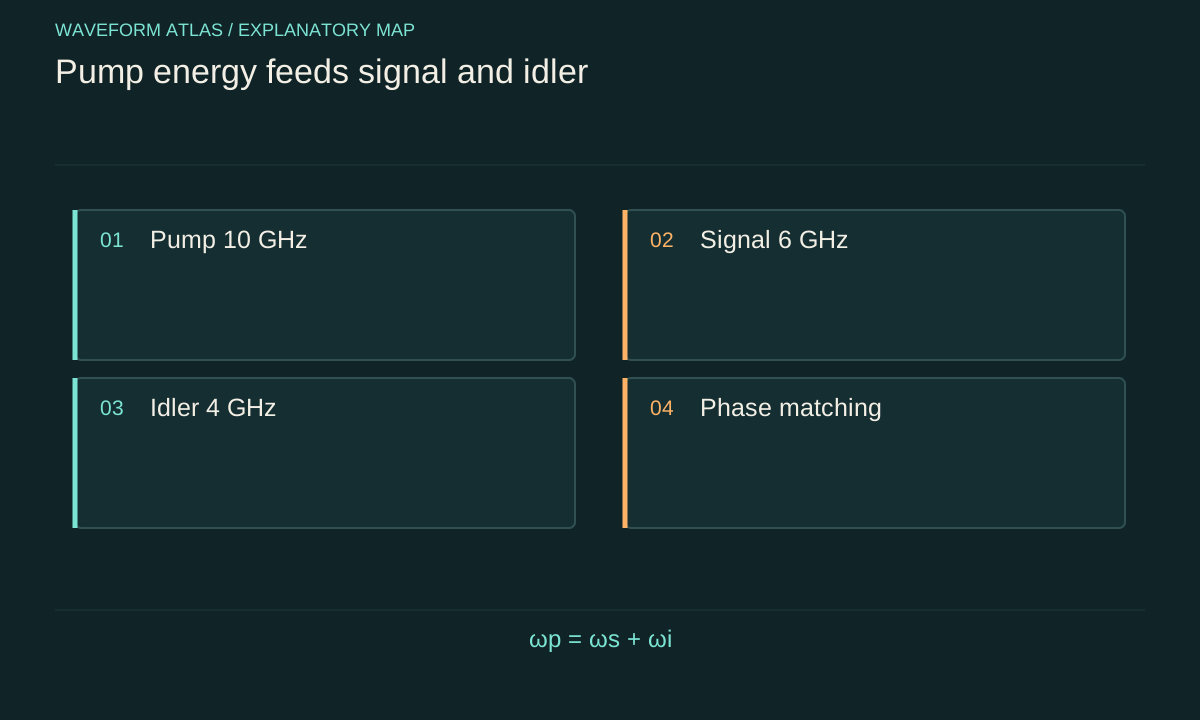
Phase matching lets contributions accumulate
In a traveling-wave device, generated fields from different positions must add with the appropriate relative phase. A mismatch Δk between the relevant wave vectors can make later contributions partly cancel earlier ones. Dispersion engineering or periodic structures can alter that accumulated phase and improve useful interaction over a longer distance.
For a simple undepleted conversion integral, the field contribution is proportional to ∫0L exp(iΔkz)dz, producing a sinc-like dependence on mismatch. Amplification can have more complicated coupled growth than this elementary conversion example, but the phase-accumulation lesson remains: satisfying an energy-frequency relation alone does not ensure efficient transfer. The device must also support the spatial and temporal mode relations. NIST's kinetic-inductance amplifier work uses engineered transmission-line properties in a practical setting, showing that matching and bandwidth are design parameters rather than automatic consequences of a strong pump.
Phase-sensitive gain treats quadratures differently
A single field mode can be described by two conjugate quadratures. An ideal phase-sensitive transformation can enlarge one quadrature and reduce the other, with a chosen phase reference supplied by the pump. In a standard normalization, Xout = eʳXin and Pout = e⁻ʳPin preserves the canonical commutator. The product of the scale factors is one.
The amplified quadrature can avoid the same added-noise penalty required of a phase-insensitive amplifier, but the statement is restricted to that quadrature and a maintained phase relation. An unknown signal with arbitrary phase cannot be assumed to lie entirely in the favored direction. Phase drift mixes the amplified and deamplified components and can degrade the intended measurement. The pump phase is therefore part of the operational specification. Calling this process noiseless without naming the quadrature and task hides the important tradeoff.
A companion mode carries the phase-insensitive requirement
For a nondegenerate ideal amplifier, a representative input-output relation is aout = √G ain+√(G−1) b†in, where b is an independent idler mode. The creation-operator term ensures the output commutator remains correct. Even an idler in its vacuum state contributes fluctuations to the signal output.
The idler is not a disposable mathematical ornament. Its state, loss, and temperature can affect the measured noise. If it is thermally populated or contaminated by pump-related noise, the amplifier can exceed the minimum added-noise limit. NIST's calibrated noise-characterization research specifically emphasizes accounting for the additional idler input and losses. A measurement that models only the signal input can therefore misestimate performance. The full multi-mode description explains both where energy goes and why quantum noise depends on more than the visible signal port.
Pump depletion and compression end the simple growth law
Many analytic models treat the pump as a fixed classical field unaffected by the signal. This undepleted-pump approximation is useful for small signals, but it fails when energy transfer significantly changes the pump or the device response. Gain then depends on input level, and the signal can compress or distort.
A strong signal may also shift the effective resonance or phase-matching condition through the same nonlinearity that enables gain. Additional mixing products can appear. Measure the pump and output spectrum across input power rather than extrapolating weak-signal gain indefinitely. The compression point is an operational measure of the usable range, not a fundamental constant independent of bias and frequency. A finite reservoir guarantees that unbounded exponential growth is not a complete physical prediction, even when the early-time or weak-signal equations contain an exponential.
Conversion and amplification are different operating regimes
A pump-mediated interaction can exchange excitations between two modes without amplifying arbitrary input in the same sense as a phase-insensitive amplifier. An ideal frequency-conversion transformation resembles a mode rotation, while a parametric amplifier couples annihilation and creation operators and can generate correlated signal-idler pairs. The selected pump frequency and interaction determine which regime is realized.
In conversion, an output power increase can reflect higher photon energy rather than increased photon number. In amplification, the signal occupation can increase through pump transfer, accompanied by the appropriate companion-mode dynamics and noise. These distinctions matter when comparing efficiencies and quantum-state preservation. A device called a mixer may operate in either regime depending on configuration. Describe the input-output relation and energy-frequency balance, not only the presence of a strong pump or a new output frequency.
Measure pump, phase, gain, and noise together
A useful characterization maps gain against signal frequency, pump strength, pump phase where relevant, and input level. It measures added noise with calibrated input conditions and accounts for losses before the first gain stage. The idler state and termination should be identified. Pump leakage into the detector must be separated from the desired amplified signal.
Stability matters as well. Reflections and feedback can produce oscillation, and a high-gain device near threshold may be sensitive to small environmental changes. Repeatability across pump settings and temperature helps establish a robust operating region. For a phase-sensitive device, report the response of both quadratures or enough phase-dependent data to identify the preferred axis. One large gain measurement at an optimally chosen phase is insufficient to characterize an arbitrary-phase signal path.
What parametric gain demonstrates
Parametric gain demonstrates controlled energy transfer through a driven interaction. It can provide low-noise amplification, squeezing, correlated outputs, or frequency conversion depending on the configuration. Those are distinct capabilities, and evidence for one should not be silently extended to the others.
The pump supplies energy and a phase reference, while the device's coupling and dispersion determine the allowed transformations. The signal becomes part of a larger dynamical system rather than an isolated wave that grows spontaneously. A complete account identifies that system and its limitations: undepleted-pump approximations, phase stability, loss, compression, and quantum noise. With those conditions stated, parametric amplification is a precise example of how changing a system's response can reshape and strengthen a wave while preserving conservation and the required quantum commutation relations.
A pump-phase scan is a particularly direct control for a degenerate phase-sensitive device. The gain should vary with the relative phase in the manner predicted by the quadrature model. If the apparent gain is phase independent, the setup may instead be averaging over phase drift, measuring total power, or operating in a different regime. Recording both quadratures distinguishes those explanations and checks whether the assumed phase reference is actually maintained during acquisition.
What to take forward
- The pump performs work through a nonlinear or time-dependent coupling.
- Signal, idler, and phase matching belong in the gain model.
- Phase-sensitive gain and phase-insensitive gain have different noise constraints.
Go to the original work.
These links identify the sources behind specific claims. Verification scope varies by source and is stated below.
- 1 / University teachingFundamentals of Photonics: Quantum Electronics — lecture notes ↗
Franz X. Kärtner. Fundamentals of Photonics: Quantum Electronics — lecture notes. 2006.
Population dynamics, absorption/gain, Rabi oscillations and coupled modes
Verification scope: Official author-written course materials and topic mapping inspected
- 2 / University teachingSignals and Systems — Alan V. Oppenheim, lecture notes ↗
Alan V. Oppenheim. Signals and Systems — Alan V. Oppenheim, lecture notes. 2011.
Convolution, linear systems, filtering and feedback
Verification scope: Official course notes and topic records inspected
- 3 / Official researchAmplifiers — NIST research program ↗
Amplifiers — NIST research program.
Josephson and kinetic-inductance parametric amplifiers and the need to balance noise, bandwidth and dynamic range
Verification scope: Official program page inspected; updated April 10, 2025
- 4 / University teachingDamped Oscillations — University Physics Volume 1 ↗
OpenStax. University Physics Volume 1, Section 15.5: Damped Oscillations.
Linear viscous damping and damping regimes
Verification scope: Official textbook section and equation record inspected
- 5 / University teachingQuantum Optical Communication — Jeffrey H. Shapiro, readings and lecture slides ↗
Jeffrey H. Shapiro. Quantum Optical Communication — Jeffrey H. Shapiro, readings and lecture slides. 2016.
Author-written quantum attenuator, amplifier, detection and parametric interaction framework
Verification scope: Official course materials and topic mapping inspected
- 6 / Primary researchQuantum limits on noise in linear amplifiers ↗
C. M. Caves. Physical Review D 26(8), 1817 (1982).
Deterministic linear-amplifier quantum-noise limits, with distinct phase-insensitive and phase-sensitive tasks.
Verification scope: Publisher record and abstract, author-paper first-page excerpt inspected
- 7 / Primary researchLow-noise cryogenic microwave amplifier characterization with a calibrated noise source ↗
M. Malnou; T. F. Q. Larson; J. D. Teufel; F. Lecocq; J. Aumentado. Review of Scientific Instruments 95(3), 034703 (2024). Linked record is the author preprint.
Noise reference planes, attenuation and Friis relations, Y-factor fitting, signal/idler inputs, parametric gain, saturation, and spectral-density units.
Verification scope: Relevant author-preprint full text (§§II.1–II.6 and Appendix D) inspected; published 2024 metadata checked against NIST and PubMed. Experimental sections were not independently replicated.
- 8 / University teachingPhysics 7010, Lecture 20: Parametric Resonance ↗
Michael Fowler. Physics 7010, Lecture 20: Parametric Resonance.
Weak-modulation growth near twice the oscillator frequency: s² = [(hω0/2)²−ε²]/4; at exact resonance the undamped growth scale is hω0/4.
Verification scope: Author-written derivation inspected; the article adds its already defined viscous damping rate γ to obtain the leading net growth rate.
- 9 / University teachingQuantum Optical Communication, Reading 20: Nonlinear Optics of χ(2) Interactions ↗
Jeffrey H. Shapiro (2016). 6.453 Quantum Optical Communication, Reading 20: Nonlinear Optics of χ² Interactions. MIT OpenCourseWare.
Signal–idler frequency balance, nonlinear coupled-mode equations, pump energy and phase matching; course sessions 12–13 and 21 supply the quantum amplifier transformations.
Verification scope: Relevant full-text passages inspected; session list checked for the related quantum treatments.
Found a problem with a claim or calculation? Send the page, the claim and the evidence. Read how these articles were prepared.