Name the signal that is being enlarged
A wave has many measurable features: field amplitude, intensity, pulse energy, spectral power, and occupation of a selected mode. Amplification must refer to one of them under specified conditions. A larger displacement at a resonant point can result from stored-energy buildup, while a larger intensity at a focus can result from spatial concentration. Neither observation alone proves that total transmitted power has increased.
Define an input mode, output mode, frequency range, and reference planes. An amplifier measurement then asks how an input signal maps to a corresponding output signal. The output can also contain noise, pump leakage, and newly generated frequencies that are not part of the intended signal. Separating those components prevents total detector power from being mistaken for useful gain. The definition should remain consistent when comparing devices, because a voltage ratio, a power ratio, and a photon-number ratio answer different questions.
The extra energy has a source
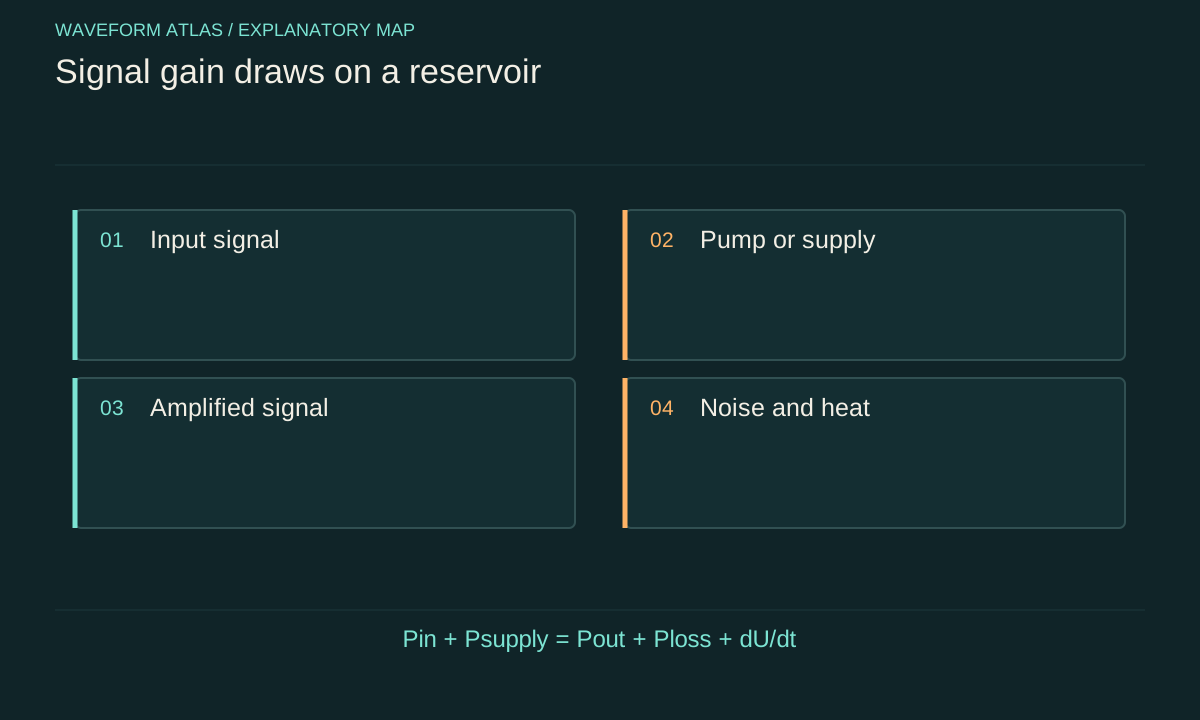
An electronic amplifier draws energy from a power supply. A laser amplifier draws on excited material maintained by pumping. A parametric amplifier transfers energy from a pump through a time-dependent or nonlinear interaction. The signal can control or stimulate that transfer, but it is not the sole energy source for a larger output.
A simple steady energy account is input signal power plus supplied pump or electrical power equals useful output, other radiation or modes, heat, and any change in stored energy. During a transient, the stored-energy term can be important. An output pulse can exceed the instantaneous pump power by releasing energy accumulated earlier. That is a storage effect, not free energy. A credible amplification claim identifies the reservoir and measures enough of the budget to distinguish net energy gain from redistribution, focusing, or a change in detector coupling.
Amplitude and power gains require compatible normalization
If an output amplitude is g times the input amplitude and both modes have the same power normalization, the signal power gain is G = |g|². A tenfold amplitude gain then corresponds to a hundredfold power gain, or 20 decibels. Different impedances or mode areas require additional factors, so the square relation cannot be applied blindly to arbitrary voltage or field readings.
For an illustrative 1-microwatt input and a linear power gain of 100, the corresponding signal output is 100 microwatts. The additional 99 microwatts must come from the amplifier's reservoir, while losses may require substantially more supplied power. If the measured output includes 20 microwatts of noise or pump leakage, calling the entire 120 microwatts amplified signal would overstate performance. A calibrated signal-specific measurement is therefore part of the gain definition, not a separate optional refinement.
Bandwidth connects gain to waveform fidelity
A linear amplifier has a complex frequency response H(ω), not just one gain number. Its magnitude controls how strongly each frequency component is transmitted, and its phase controls relative timing. A narrowband sinusoid can be amplified cleanly while a short pulse is distorted because its spectrum spans a region of varying gain or phase.
A useful bandwidth specification states the gain tolerance and operating conditions. The familiar half-power bandwidth is only one convention. Group-delay variation can matter even when the magnitude response is flat enough. Measure or model the full relevant transfer function before concluding that an output is a scaled copy of the input. A device with high gain at one frequency may be unsuitable for a broad signal. Conversely, a moderate-gain broadband device may preserve the information-bearing waveform more faithfully for a particular application.
Stimulated and parametric gain use different reservoirs
In stimulated emission, an incident optical field interacts with an excited medium and can induce emission into the field's mode. Maintaining useful net gain requires appropriate level populations and competition with absorption and other decay channels. In parametric amplification, a pump couples modes through a nonlinear or time-varying response, transferring energy according to the interaction's frequency and phase relations.
Both mechanisms can amplify a coherent signal, but their noise and saturation properties differ. The pump, idler modes, and material degrees of freedom are part of the complete system. NIST's amplifier program describes Josephson and kinetic-inductance implementations as practical examples of parametric gain, with bandwidth, dynamic range, and low noise treated together. That research context supports the mechanism without implying that every amplifier automatically reaches the same performance or that one gain value captures the whole device.
Quantum noise limits have stated assumptions
A deterministic linear amplifier that amplifies both field quadratures equally cannot simply multiply a quantum annihilation operator by √G and leave everything else unchanged. Additional degrees of freedom are required to preserve the operator commutation relation. In the ideal high-gain phase-insensitive case, the minimum input-referred added noise approaches half a quantum under the usual symmetrized convention.
Caves's amplifier analysis establishes this qualified limit. It is not a claim that every possible operation called amplification adds the same noise. A phase-sensitive amplifier can amplify one quadrature while deamplifying the conjugate quadrature, and probabilistic protocols have different success conditions. The measurement convention, gain regime, and task matter. A claim of noiseless amplification should therefore specify which observable is amplified, whether the process is deterministic, and how noise is referred to the input. Without those details, the phrase is incomplete.
Saturation limits proportional growth
An amplifier's small-signal gain applies only while the signal does not significantly deplete the reservoir or exceed device limits. At higher input, population inversion can be depleted, a pump can be exhausted, or an electronic output stage can approach its voltage and current limits. The output then grows less than the linear prediction, a behavior called gain compression or saturation.
For an illustrative small-signal gain of 100, a 1-milliwatt input would predict 100 milliwatts of signal output. If the available output or reservoir supports only 60 milliwatts under those conditions, the linear model cannot remain valid. Distortion, harmonics, and changed noise can accompany compression. Measure gain across input level rather than extrapolating one weak-signal result. A large output near saturation is not necessarily a faithful amplified copy of the input waveform, even when a power meter reports an impressive number.
Feedback can convert gain into oscillation
An amplifier connected to a return path can feed part of its output back to its input. At frequencies where the loop phase and magnitude support reinforcement, small disturbances can grow. Noise or a switching transient can seed that growth, and nonlinear saturation eventually limits it in a real oscillator.
The resulting output is not necessarily an amplified version of an external signal; it can be self-sustained oscillation powered by the supply or pump. Stability therefore belongs in amplifier characterization. Reflections, cables, cavities, and imperfect isolation can create unintended feedback paths. Changing a cable length or termination may alter the oscillation frequency or threshold. A gain measurement performed near instability can be misleading because the device's own output contaminates the response. The analysis should distinguish stable driven gain, transient growth, and autonomous oscillation.
Stronger does not automatically mean more informative
If an amplifier multiplies both signal and existing noise, their ratio may remain unchanged before additional amplifier noise is considered. Amplification can still be useful because it makes the signal large relative to noise added by later electronics. Its benefit depends on where noise enters the measurement chain, not simply on the final amplitude.
Likewise, a stronger field need not have greater phase coherence or a purer quantum state. Phase noise, amplified spontaneous emission, and coupling to unobserved modes can change those properties independently of mean power. A measurement claim should identify its information metric: signal-to-noise ratio, estimation uncertainty, detection probability, or another operational quantity. No universal rule turns increased amplitude into increased knowledge. Comparing calibrated input and output statistics is the appropriate way to determine whether the amplifier improves the intended task.
Measure gain as part of a complete response
A defensible characterization gives gain versus frequency and input power, phase response where relevant, added noise, stability, and energy supply conditions. It identifies calibration planes and losses before and after the device. Pump leakage and background output should be separated from the intended signal, and compression should be checked at the same operating point used for noise measurements.
The result can then support a precise statement: this device amplifies this mode by a measured factor over this band and range, with a stated noise contribution. That statement is more useful than saying the wave became stronger. Amplification changes a selected subsystem through an energy transfer; it does not by itself constitute quantum collapse, guarantee improved coherence, or create energy. Keeping those distinctions explicit makes gain both an engineering tool and a well-defined physical process.
The distinction between transient and steady gain is also useful. A device can release a previously charged reservoir during one pulse and then require recovery before repeating the result. Comparing pulse energy across a long sequence reveals that limitation. A single impressive output event should therefore be accompanied by the repetition conditions when the claim concerns sustained performance.
What to take forward
- Gain requires an energy reservoir and a defined signal mode.
- Noise, bandwidth, saturation, and stability determine whether amplification is useful.
- Quantum noise limits depend on phase sensitivity, determinism, and measurement convention.
Go to the original work.
These links identify the sources behind specific claims. Verification scope varies by source and is stated below.
- 1 / University teachingSignals and Systems — Alan V. Oppenheim, lecture notes ↗
Convolution, linear systems, filtering and feedback
Verification scope: Official course notes and topic records inspected
- 2 / University teachingFundamentals of Photonics: Quantum Electronics — lecture notes ↗
Population dynamics, absorption/gain, Rabi oscillations and coupled modes
Verification scope: Official author-written course materials and topic mapping inspected
- 3 / Primary experimentLow-noise cryogenic RF/microwave amplifier characterization with a calibrated noise source — Malnou et al. (2023) ↗
Calibrated amplifier noise characterization must include loss, limited power handling and the idler input
Verification scope: Official author abstract inspected; not a claim that the full instrument paper was independently reproduced
- 4 / University teachingElectromagnetics and Applications — lecture notes ↗
Poynting theorem, boundary conditions, material response and polarization
Verification scope: Official author-written course and topic records inspected
- 5 / Official researchAmplifiers — NIST research program ↗
Josephson and kinetic-inductance parametric amplifiers and the need to balance noise, bandwidth and dynamic range
Verification scope: Official program page inspected; updated April 10, 2025
- 6 / University teachingLecture 16: Fourier transform — Signals and Systems ↗
Finite pulse Fourier transforms and time/frequency scaling
Verification scope: Official lecture equations inspected
- 7 / Primary theoryQuantum limits on noise in linear amplifiers — Caves (1982) ↗
Phase-insensitive linear amplification has a high-gain input-referred half-quantum noise bound
Verification scope: Publisher abstract and bibliographic record inspected
- 8 / University teachingQuantum Optical Communication — Jeffrey H. Shapiro, readings and lecture slides ↗
Author-written quantum attenuator, amplifier, detection and parametric interaction framework
Verification scope: Official course materials and topic mapping inspected
Found a problem with a claim or calculation? Send the page, the claim and the evidence. Read how these articles were prepared.