The noise cost of phase-insensitive gain
Adjust the controls, inspect the calculated response and use the reading links to place the model in its physical context.
Interactive model: The noise cost of phase-insensitive gain. Enable JavaScript to adjust its controls.
V_out = (2G − 1)/2; N_added = (1 − 1/G)/2
Ideal quantum-limited phase-insensitive linear amplifier, coherent input, vacuum idler, quadrature vacuum variance 1/2. G is power gain. The pump supplies output energy.
What this model assumes
Ideal quantum-limited phase-insensitive linear amplifier, coherent input, vacuum idler, quadrature vacuum variance 1/2. G is power gain. The pump supplies output energy.
How to explore it
Begin with the default values. Change one control at a time and watch both the graph and the readouts. Then reset the model and change another parameter. This isolates which input produces the effect you are seeing.
The plotted values are generated from the displayed equation. Downloading the calculated data lets you inspect the numerical series or compare it with a calculation of your own. The data are synthetic model outputs, not observations from an apparatus.
Before carrying a prediction into an experiment, match the model’s assumptions to the actual system: the relevant degrees of freedom, boundary conditions, noise, losses and measurement convention. The linked articles explain which comparison is physically meaningful.
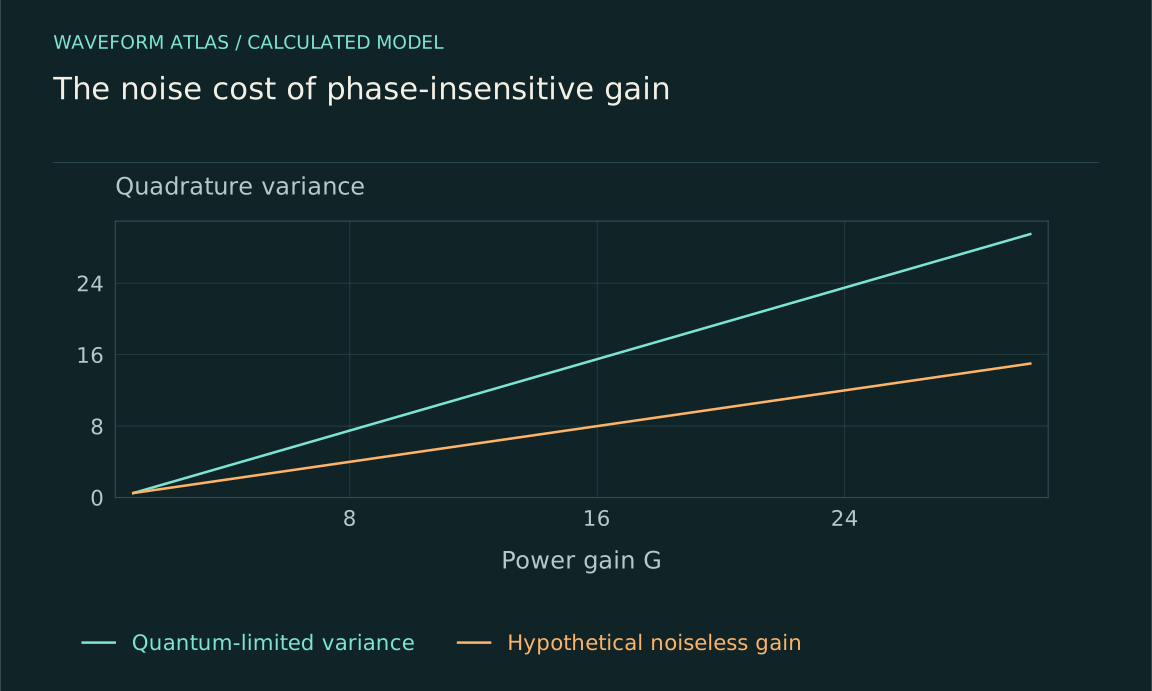
Calculated model curves. Ideal quantum-limited phase-insensitive linear amplifier, coherent input, vacuum idler, quadrature vacuum variance 1/2. G is power gain. The pump supplies output energy. Default control values are used in this fixed figure.
Download SVG ↓Amplification
Making a wave larger requires an energy path
Where does the added wave energy come from?
Amplitude gain, power gain, and bandwidth
Which definition of gain is appropriate for a measurement?
An excited material supplies optical gain
How does stimulated emission contribute to amplification?
Gain from a changing system parameter
How can modulation transfer pump energy into a selected mode?
Why quantum amplification cannot be noiseless in every sense
What tradeoffs distinguish phase-sensitive and phase-insensitive gain?
What happens when gain stops being proportional
Why do real amplifiers depart from small-signal behavior?
When amplification becomes self-oscillation
What role do feedback phase and loop gain play?
Larger motion can lead to nonlinear failure
Under which conditions can a growing wave steepen, break, or excite other modes?
Measure gain without mistaking added noise for signal
Which calibrated measurements identify useful amplification?
Does stronger mean more coherent or more informative?
How can amplitude increase while signal quality degrades?