One investigation.
Many testable paths.
The new findings sharpen the next decisions across the portfolio while preserving its foundational questions and existing investigations.
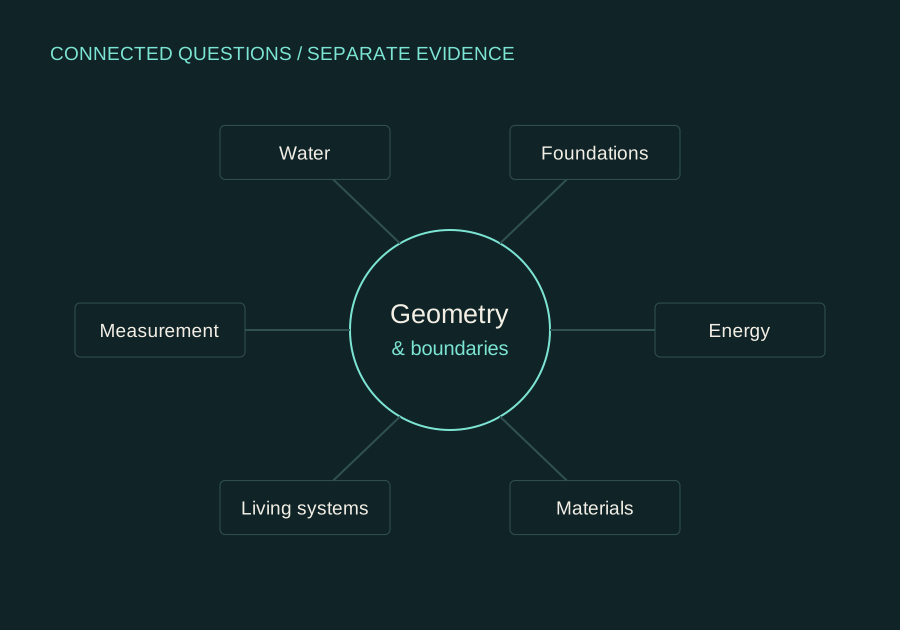
Turn a connection into a question that can fail.
Geometry remains the central investigation. A shared theme becomes useful when each branch can identify its own decisive observation.
Begin with a concrete change: a boundary moves, a preparation changes, a flow encounters a collector, or a readout samples a different region. State what stays fixed. Name the outcome and the comparison. Then decide what result would count against the proposed explanation.
Specify the change
System, state or observation?
Choose the comparator
Same endpoint and operating regime.
Account for costs
Preparation, search, operation and reset.
Let evidence decide
Advance, characterize further or retain the hold.
The C5 result shows how this works in a tractable setting. We know the generator, the preparations and the full probability distribution. We can expose a finite-threshold counterexample without asking an instrument to settle the model first. That success qualifies the illustration. An instrument claim needs its own observation and inference contract.
Keep the fundamental question central
Geometry, boundaries and organization are the common investigation. Foundational questions and application studies continue together, with a separate mechanism, observable and decision for each.
The portfolio review covers 38 programme, workstream and delivery rows. This public map focuses on their research connections; it is not a certification of every company, repository or instrument. Existing holds, parked decisions and programme-specific records remain authoritative.
The next evidence, by workstream
| Workstream | Concrete next result | Condition to advance |
|---|---|---|
| Data and calibration | Recover existing acquisition and calibration records; identify one defensible first dataset. | Independent units, clocks, controls and provenance are established. |
| Statistical methods | Validate representative noise, drift, weak/lagged effects and missing samples; design a transient null only when needed. | Declared assumptions and fresh validation support the intended use. |
| Atlas / NetPhysics | This edition integrates C5 with both criteria, units, attribution and reproducible downloads; next, incorporate further independent review. | The model is communicated within its qualified scope. |
| Weatherhill / Pluvaryn | A regime map and contained collection comparison. | Physical regimes match; useful captured water and power are measured. |
| Helios / Revalith | Separate energy-conversion and extraction ledgers for a complete cycle and a defined feed/product. | The matched baseline survives all input, regeneration and reset costs. |
| MatterVolt / Lattivara | One specimen-specific component comparison. | Measured sensitivity, noise and operating conditions support an advantage. |
| Karam / MINR / First Cell / Death X | Trace intervention, sample identity, function and durability on a specified assay or dataset. | An endpoint is interpreted within its actual biological scope. |
| Control / Metric Flight | A bounded boundary-control or diagnostic comparison when a named bottleneck warrants it. | Improvement includes setup, search and verification costs. |
| Evidence reuse / Synervara | Exercise an existing evidence workflow on permissioned data. | A reproducible extraction or measurement task actually improves. |
| Foundational geometry and motion | Continue existing geometry, field, boundary and frontier questions under their own orders. | Each claim has a model or discriminating observation; no universal mechanism is assumed. |
Seventeen reviewed leads, retained with their limits
These are editorial transfer decisions from the 3 November review. A retained investigation is not a demonstrated device or an endorsement of a headline.
| Reviewed lead | Transfer decision |
|---|---|
| Chemistry-free control of magnetism | Specify material, phase, temperature, readout and noise before a component comparison. |
| Solvable cavity / magnetic-chain theory | Retain as a coupling-theory lead; establish an accessible operating regime before product claims. |
| Acoustic invisible pipe | Compare field shaping with contained demisting. Patent documents are leads, not clearance. |
| Anyon detection theory | Separate a proposed detection route from demonstrated anyons or a working qubit. |
| Nature Reviews Physics interview | Treat the interview as context; follow original papers for physical results. |
| Six-layer graphene | Preserve the cryogenic regime and distinguish superconducting-like evidence from an unqualified zero-resistance claim. |
| WS₂ polariton propagation | Propagation is a component question; it does not by itself establish energy generation. |
| X-ray light collection | Compare brightness alongside resolution, dose, spectrum, manufacturing and the nearest conventional design. |
| Anti-spin ice | Separate a classical colloidal analogue from quantum electronic material behavior. |
| Error-resistant quantum theory | Distinguish an Andreev-state model from proof of a protected qubit or topological phase. |
| Ultrathin kagome material | Distinguish structure and bands from a proposed emergent phase. |
| Relational clocks and time | State the model and observable limits; do not generalize to a claim that time is unreal. |
| Nanoscopic sensor loss | Match charge, separation, dielectric properties, frequency and geometry before transfer. |
| Sabrina Gonzalez Pasterski profile | Follow the original celestial-holography work; a profile is not a hardware or IP result. |
| Quantum battery | Include extraction, retention, matched controls, scaling and a complete cycle. |
| Hula-hoop dynamics | Keep the repaired synthetic-methods result distinct from real data and an intervention or learning benefit. |
| Falling ladder / chain | Distinguish a rigid ladder from a flexible chain; check the original paper and erratum before modeling. |
Research priority and commercial evidence
The Phase 2 charter keeps distinct roles: Lattivara as the first direct physics path, Pluvaryn as the first commercial validation path, Synervara as reusable measurement/data work, and Revalith as a feed-specific feasibility option. Actual demand, capacity and economics remain to be established.
Biological work keeps identity, function and durability separate. A clock shift is not general rejuvenation; supplied-component function is not autonomous life; a preservation result is limited to its material and endpoint. Space and motion programmes retain their own physical and engineering requirements.