Physical geometry
Interfaces, confinement and moving boundaries change the system we are studying.
Follow the evidence ↗A hotter start can reach equilibrium’s neighborhood sooner. The surprise is in the path.
Watch two preparations of one model relax toward the same bath. Then follow Marija Vucelja’s work, test the result yourself, and explore what it changes about our next experiments.
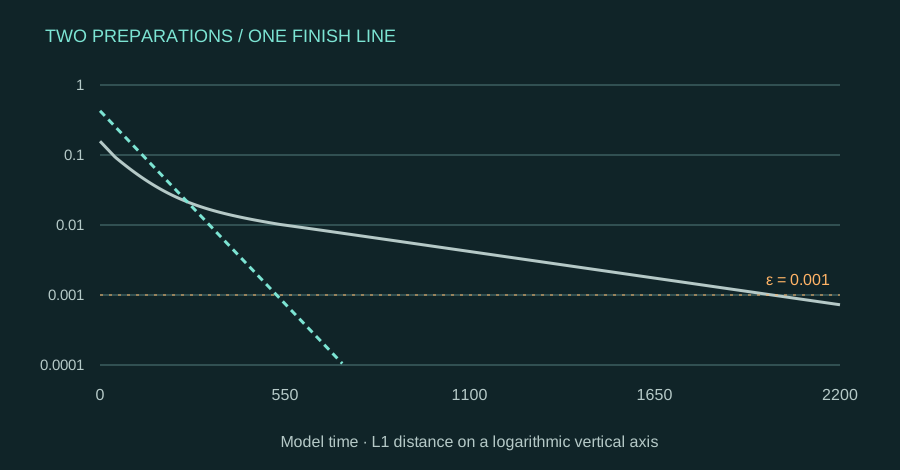
Both copies start out of equilibrium. The hotter preparation begins farther from the common destination.
Our three-state calculation · ε = 0.001 · dimensionless time and temperature · playback speed is a display choice
If two systems are headed for the same destination, should the one that starts closer always arrive first?
In the large-gap model above, the warm preparation starts at L1 distance 0.157230. The hotter strong-root preparation starts at 0.427658. At the finish line ε = 0.001, their arrival times are about 1,998 and 525 model units. To understand that reversal, we need the whole state and the available relaxation modes.
Learn the three-state picture ↗ → Move the finish line ↗ → Check what the evidence supports ↗
The same question—what changed in the system, the preparation or the observation?—organizes the application chapters. Compression changes a boundary. Droplet size changes response to a flow. A material can change signal and noise together. Each example gets its own model, units and comparison.
How do geometry, boundaries and organization change physical behavior? The latest review connects the shape of a physical system, the paths available to its state, and the geometry of its measurement. Each connection needs its own mechanism and comparison.
Interfaces, confinement and moving boundaries change the system we are studying.
Follow the evidence ↗A preparation can avoid a slow relaxation mode. C5 lets you inspect the consequence.
Follow the evidence ↗Coordinates, calibration and a changing line of sight affect the evidence we can collect.
Follow the evidence ↗The papers behind the relaxation question, their coauthors, and the distinction between her research and our data.
Follow the evidence ↗Explore both selected C5 systems. Move the arrival threshold and watch the ordering change.
Follow the evidence ↗The repaired methods, synthetic validation and requirements before instrument use.
Follow the evidence ↗What the General Fusion papers actually measured, and which methods questions transfer.
Follow the evidence ↗Surface clustering, airborne collisions and a bounded collection comparison.
Follow the evidence ↗Why temperature, wavelength, damping, noise and useful output belong in every component comparison.
Follow the evidence ↗The connected programme map, all 17 reviewed topics, and the next evidence needed.
Follow the evidence ↗| Work | Result | Meaning |
|---|---|---|
| Statistical repair | 69/69 checks; 3,700 synthetic replicates; 10/10 declared scenario gates | Qualified for the stated synthetic settings. Instrument transfer remains on hold. |
| C5 model | 11 PASS / 9 INFO in the original rerun; a separate 87/87 implementation check | A reproducible numerical illustration, with finite-threshold and selection limits. |
| Literature review | Mechanisms, apparatus and scope separated | Published results are credited. Their transfer to our programmes is a research question. |
Source checks are dated 3 November 2026. “Full text” describes access and the relevant sections checked; it is not a claim of reproducing every experiment. The linked benchmark files contain our own numerical evidence.
Klich, Raz, Hirschberg & Vucelja · Physical Review X 9, 021060 (2019)
Markovian theory of the strong effect and its geometry; the C5 fixtures on this site are our separate illustrative calculations.
Open the source ↗Israel Klich & Marija Vucelja · arXiv:1812.11962v2 (2019)
The negative control is tied to its specified rates and equilibrium preparations. The result is not a prohibition for every dynamics on a complete graph.
Open the source ↗Israel Klich & Marija Vucelja · Journal of Physics A 59, 255002 (2026)
The publisher’s Crossmark record confirms title, authors and June 2026 publication. Its full text was unavailable in this update; no new numerical claim is based on it.
Open the source ↗Teza, Bechhoefer, Lasanta, Raz & Vucelja · Physics Reports 1164, 1–97 (2026); arXiv:2502.01758
A route into definitions, distance measures, experiments and possible applications. Model classes and experimental systems retain their separate limits.
Open the source ↗Fariss Samarrai / University of Virginia · UVA Today, 21 May 2020
Source of the short direct quotation. This profile supplies context, not validation of a device or cooling protocol.
Open the source ↗Marija Vucelja · Author’s research website
University of Virginia affiliation and nonequilibrium statistical-physics research interests.
Open the source ↗Marija Vucelja & Itzhak Fouxon · Journal of Fluid Mechanics 593, 281–296 (2007)
Floating particles in weak surface waves; sixth-or-higher-order growth is too slow on typical natural timescales. This is not airborne fog scaling.
Open the source ↗G. Falkovich, A. Fouxon & M. G. Stepanov · Nature 419, 151–154 (2002)
Airborne droplet collisions under specified turbulent conditions; a regime match is required before application to FogLab.
Open the source ↗Alex E. Yuan & Wenying Shou · PLOS Biology (2024)
Basis for the truncated time-shift branch and its stationarity assumptions. Dependence is not a causal direction.
Open the source ↗Jesse Hemerik & Jelle Goeman · TEST (2018)
Randomization-test validity depends on the null and transformation structure. Our repair and synthetic results are reported separately.
Open the source ↗P. Carle and colleagues, General Fusion / UKAEA · Preprint dated 6 October 2026
Solid lithium liner, electromagnetic compression and a localized electron-temperature measurement. Diagnostic access changes during compression.
Open the source ↗General Fusion research team · October 2026 preprint
Electron and ion diagnostics, drive history and shot conditions; raw shot data were not independently reproduced.
Open the source ↗Mangione and colleagues · Fusion Engineering and Design 198, 114087 (2024); online December 2023
A scaled water apparatus and shape-control study, distinct from LM26 and from a proposed power plant.
Open the source ↗A. Eichler and colleagues · Nature Nanotechnology 6, 339–342 (2011)
Amplitude-dependent damping is a competing explanation. A non-monotonic ring-down sweep alone does not identify a particular mechanism.
Open the source ↗P. Alex Greaney, Giovanna Lani, Giancarlo Cicero & Jeffrey C. Grossman · Metallurgical and Materials Transactions A (2011)
The parameter scope extends beyond a 5 K example and includes fixed-total-energy comparisons. Transfer to a macroscopic balance remains unestablished.
Open the source ↗Maher Damak & Kripa K. Varanasi · Science Advances (2018)
A distinct collection mechanism to compare at matched flow, input power and captured water.
Open the source ↗Ultrasonic demisting study · Journal of the Acoustical Society of America (2017)
A contained collection comparison; this citation does not establish outdoor clearing performance.
Open the source ↗