Choose the boundary before naming the power
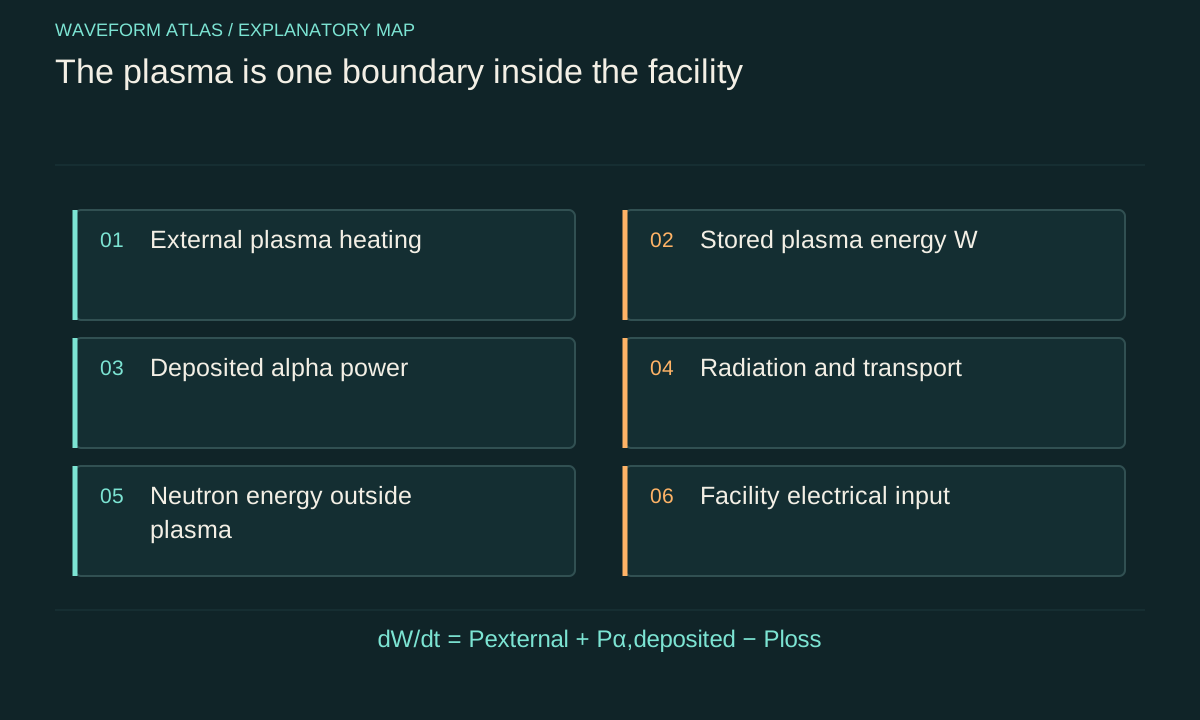
A plasma energy balance describes a specified region and a specified set of particles and fields. For a simple thermal model, write dW/dt = Pexternal + Pα,deposited − Ploss. Stored energy W changes when external heating or deposited alpha energy exceeds losses. The terms must all refer to the same boundary, time interval and energy convention.
This equation does not include every facility expenditure automatically. Electricity used to operate magnets, lasers, pumps, cooling or controls belongs to a broader system boundary. Likewise, energy carried out by neutrons may be useful to a surrounding conversion system without remaining inside the reacting plasma. Mixing these boundaries can turn an ordinary accounting choice into an apparent physical contradiction.
A practical diagram should therefore draw nested regions: reacting plasma, heating and confinement apparatus, and complete facility. Energy crossing one boundary may remain inside another. An experiment can show strong plasma self-heating while still requiring substantial facility power. Neither statement cancels the other; they answer different questions. Defining the boundary first lets the scientific result and the engineering challenge both be stated accurately.
Energy confinement is not merely a particle stopwatch
An energy confinement time is often expressed schematically as τE = W/Ploss, with the loss definition chosen consistently for the operating state. It characterizes how rapidly stored energy would be depleted at the measured loss power. It is not generally the time taken for one representative ion to leave the device, and it need not equal the particle confinement time.
Consider an illustrative plasma storing 2 MJ while losing 4 MW. Its energy confinement time is 0.5 second under this definition. If external heating replaces the loss continuously, the plasma can persist far longer than half a second. The time constant describes energy turnover, not a mandatory discharge duration.
Conversely, retaining particles does not guarantee a favorable reaction rate. A trapped population that cools can remain physically present while its fusion reactivity falls sharply. Measurements of particle inventory, temperature profiles and stored energy therefore serve different purposes. A confinement claim should identify which quantity was measured and how the relevant loss power was obtained, especially in a transient where dW/dt is not negligible.
Charged and neutral products follow different routes
In the familiar D–T reaction, approximately 3.5 MeV goes to the alpha particle and 14.1 MeV to the neutron at low incident energy. Magnetic fields act directly on charged-particle trajectories, making alpha energy a potential plasma-heating source. Neutrons are electrically neutral and generally carry their energy into surrounding structures rather than being magnetically confined with the fuel.
Even the alpha contribution is not identical to deposited heating. Some energetic particles may escape or transfer energy in locations that do not support the desired core conditions. A model needs their slowing and transport, not just the reaction energy partition. Using total fusion power as though all of it reheated the plasma would overestimate the available self-heating.
For a simple illustrative fusion power of 100 MW, the reaction partition suggests about 20 MW in alphas and 80 MW in neutrons. If only 90 percent of the alpha energy deposits within the chosen plasma boundary, deposited alpha heating is about 18 MW. These round numbers demonstrate the ledger; they are not measurements of a particular machine or universal deposition efficiencies.
A loss budget contains several physical mechanisms
Thermal energy can leave a plasma through transport of particles and heat, electromagnetic radiation and escaping energetic products. These mechanisms respond differently to density, temperature, composition and geometry. Combining them into one measured loss power is useful for global accounting, but diagnosing performance requires separating their contributions where possible.
Radiation provides a clear example. A plasma can emit energy even when its particles remain inside the confinement region. Impurities may alter the radiation budget, while changes in temperature modify both emission and fusion reactivity. A denser population can increase reaction opportunities and simultaneously alter loss terms. The phrase “more confinement” does not specify which competition has improved.
A reasonable experimental comparison therefore holds relevant conditions fixed or documents their changes. If a new operating mode produces higher temperature at the same input power, that may indicate reduced effective losses, but one must also check stored energy, density profiles and transient evolution. A temperature increase alone cannot identify the responsible transport mechanism. Multiple diagnostics are needed to distinguish improved retention from changed deposition or redistribution of energy.
The Lawson idea comes from a balance, not a magic threshold
In a simplified equal-temperature D–T plasma with equal fuel densities, the reaction power scales with density squared while thermal stored energy scales with density times temperature. Expressing losses as stored energy divided by τE leads to a requirement involving density and confinement time, with strong temperature dependence through reactivity. This is the logic behind Lawson-type criteria.
The numerical condition depends on the adopted balance: ignition, a specified gain, or another performance target. It also depends on fuel mixture, density convention, electron and ion temperatures, radiation treatment and whether the distributions are thermal. Quoting a single triple-product number without these assumptions obscures the actual physics.
The university derivation cited here uses an idealized pure D–T mixture and explicitly connects alpha heating to thermal losses. It teaches how the criterion arises; it does not certify a real discharge merely because one reported scalar exceeds a remembered benchmark. A credible comparison inserts measured profiles and uncertainties into the appropriate model and states which loss or heating terms have been neglected. The criterion is a structured energy argument, not an independent mechanism that makes fusion occur.
Magnetic and inertial strategies organize time differently
Magnetic confinement aims to maintain favorable conditions while charged particles move within a field configuration. Inertial confinement instead creates a short-lived, dense reacting assembly whose own inertia delays disassembly during the burn. Both approaches must solve an energy and reaction-rate problem, but their geometry, timescales and diagnostics differ substantially.
It is misleading to ask only which approach “holds the plasma longer.” A short interval at very high density can yield many reactions, while a longer interval at lower density can pursue the same basic requirement through a different balance. The relevant comparison combines density, reactivity, volume and time rather than treating duration as an isolated score.
The historical December 2022 NIF experiment is an example of a target-level energy result: LLNL reports approximately 3.15 MJ of fusion yield from 2.05 MJ of laser energy delivered to the target. That ratio concerns a defined target boundary and a particular shot. It does not mean the facility generated net electrical energy, nor does it supply a general confinement-time measurement transferable to a magnetic plasma.
A changing plasma requires a time-resolved ledger
Suppose a heating pulse deposits 10 MW while losses are 7 MW and fusion self-heating is initially negligible. The stored energy rises at 3 MJ per second. If an analysis assumes steady state and equates input directly to loss, it will overestimate the actual instantaneous loss by that amount. The derivative term is measurable physics, not an accounting nuisance.
Later, self-heating may increase while external heating falls. A similar temperature trace can then arise from a different combination of inputs and losses. To distinguish these cases, measurements should align heating waveforms, stored-energy estimates, radiation and product signals on a common clock. Time delays in detectors or transport models must be included.
Spatial information adds another layer. Constant total stored energy can conceal a hotter core and cooler edge, changing the fusion rate even without a large global energy change. Confinement is therefore not fully characterized by one scalar trace. Global balances constrain what is possible, while profile measurements identify how the reacting population is organized and where an apparent improvement actually occurs.
Connect plasma performance to a useful source carefully
A useful energy system must turn outgoing reaction energy into a usable form while supplying its own operating requirements. That introduces conversion efficiency, component lifetime, repetition or uptime, fuel supply and auxiliary power. These engineering quantities are downstream of plasma confinement but cannot be inferred from it automatically.
A simple illustrative ledger makes the point. If a source produces 100 units of recoverable thermal energy and converts 40 percent into electricity, the gross electrical output is 40 units. If operation consumes 45 electrical units, the net is negative five, even though the reaction itself released substantial energy. The chosen numbers are explanatory, not estimates for a specific design.
The appropriate conclusion from a confinement measurement is therefore bounded: it establishes something about maintaining the reacting population and its energy under stated conditions. Combined with product diagnostics and a consistent power ledger, it can support a stronger plasma-performance claim. A complete power-system claim requires the larger boundary to close as well. Keeping these levels distinct makes progress easier to assess without either overstating a milestone or dismissing a real achievement.
What to take forward
- Energy confinement time describes energy turnover, not simply particle residence.
- Use deposited alpha power, rather than all D–T fusion power, for a plasma self-heating balance.
- State whether a gain claim concerns a target, plasma or complete facility.
Go to the original work.
These links identify the sources behind specific claims. Verification scope varies by source and is stated below.
- 1 / University teachingRichard Fitzpatrick: Lawson Criterion ↗
Rate nD nT〈σv〉, energy-confinement time W/Ploss and an explicitly idealized self-heating balance.
Verification scope: University page, assumptions and displayed equations inspected.
- 2 / Official researchITER: The magic cocktail of deuterium and tritium ↗
D–T reaction energy is approximately 17.6 MeV and reactivity depends on the fuel and particle distribution.
Verification scope: Official article and technical context inspected, 1 November 2026.
- 3 / Official researchLLNL’s breakthrough ignition experiment highlighted in Physical Review Letters ↗
The 5 December 2022 experiment reported 3.15 MJ fusion yield from 2.05 MJ laser energy delivered to the target; target gain is a defined boundary.
Verification scope: LLNL's dated 6 February 2024 report of its experiment inspected; not treated as current record or wall-plug gain.
Found a problem with a claim or calculation? Send the page, the claim and the evidence. Read how these articles were prepared.