Translate the headline into a measurable statement
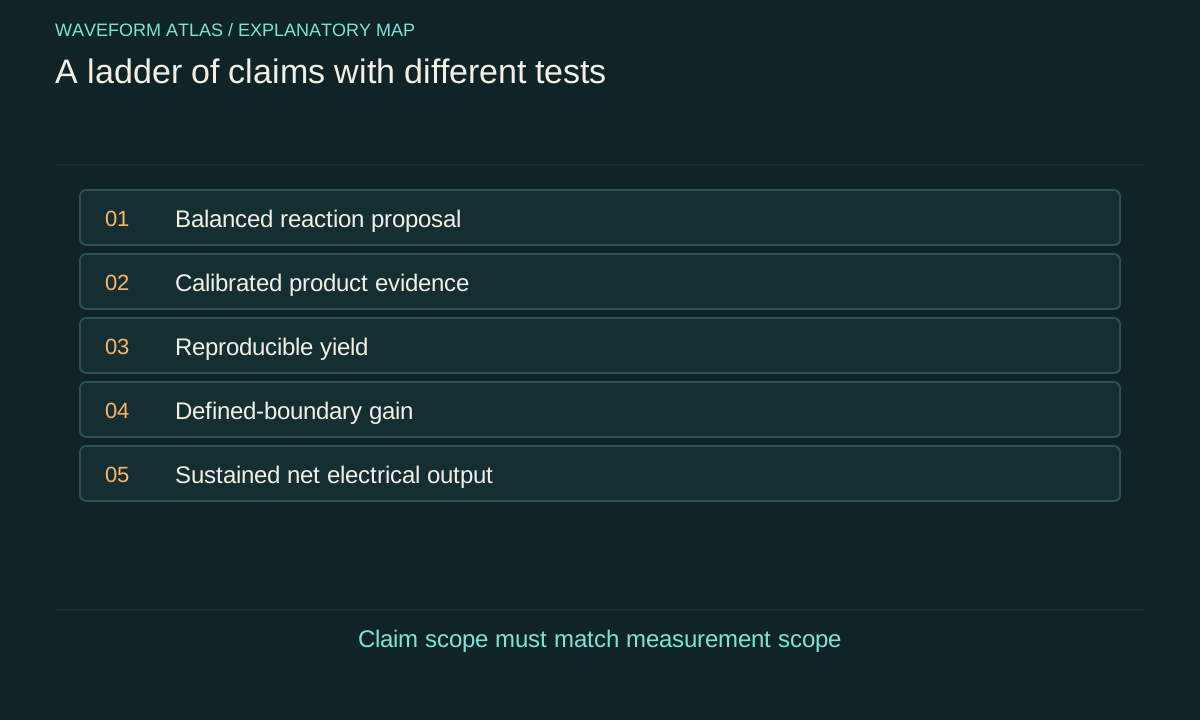
A headline such as “fusion achieved” can refer to several different accomplishments. It may mean that a small number of nuclear reactions were detected, that a plasma became strongly self-heated, that a target produced more fusion energy than the energy delivered to it, or that a complete system exported net electricity. These statements require different evidence.
The first review step is to rewrite the claim as a quantity with a boundary and time interval. For example: a specified fuel produced a measured yield during one shot; or a defined subsystem returned a stated energy ratio over a given operating period. This phrasing reveals what must be measured and what remains outside scope.
Ambiguous terminology should not be treated as proof of bad intent, but it should not survive into the technical conclusion. A useful evaluation separates the strongest statement directly supported by data from extrapolations about future performance. This allows genuine progress to be recognized while keeping speculative engineering promises visible as projections. The aim is a proportionate assessment, not a binary choice between unquestioning acceptance and dismissal.
Check the proposed reaction before the apparatus story
The proposed fuel and products must satisfy charge, energy and momentum conservation and the relevant particle-number bookkeeping. For familiar low-energy fusion channels, isotope labels and Q values can be checked against authoritative nuclear information. A novel apparatus does not suspend those constraints.
Suppose a proposal invokes D–T fusion but attributes all released energy to one charged product and predicts no neutron. That is not the ordinary D–T channel. The proposal would need a different specified reaction and evidence for it, rather than borrowing the familiar reaction’s energy release while discarding its products. A channel diagram makes this inconsistency easier to see than broad claims about unusual conditions.
Conservation alone does not establish a reaction rate. Many possible final states are allowed in principle yet occur with very small probability under particular conditions. The evaluation must therefore distinguish an internally consistent reaction proposal from an experimentally supported mechanism. The former is a necessary foundation; the latter requires cross sections, distributions and measured products. A correct equation can still describe a process too rare to explain the reported effect.
Ask whether the signal identifies a nuclear product
A temperature rise, bright flash or electrical transient does not uniquely identify fusion. A product claim should state the particle type, expected energy distribution and detector response. Background rejection, calibration and timing should be sufficient to connect the recorded signal to the proposed nuclear channel.
The number of observed events matters together with the number expected from alternatives. A few counts in a noisy instrument may have a different evidential value from a resolved spectrum with independent timing and isotope information. Likewise, a large signal can be uninformative if the detector is sensitive to a strong ordinary source that was not controlled.
A practical review asks what change would distinguish the leading explanations. Moving a detector can test propagation timing; changing fuel isotopes can test channel dependence; shielding can test radiation type; a source-off run can test background stability. These controls should be interpreted quantitatively where possible. The strongest evidence is not merely that the signal repeats, but that it changes in the specific way predicted for the claimed product and fails the competing explanations.
Convert yield into an energy budget
Once a reaction yield is inferred, multiply each channel’s event count by its released energy and track deposition. This creates a maximum contribution to measured heat before accounting for escaping products. If the claimed thermal output exceeds that contribution by many orders of magnitude, the detected reactions cannot explain all of it without an additional mechanism.
For illustration, 10¹² D–T reactions release about 2.82 joules in total. A report of 1,000 joules of excess heat would therefore require far more reactions, a different energy source or a mistaken yield or heat estimate. The mismatch cannot be resolved simply by calling the process efficient; efficiency redistributes or converts available energy rather than creating an extra source.
The comparison also runs in the other direction. A proposed large reaction yield predicts associated products that may be detectable even when calorimetry is difficult. Product upper bounds can constrain energetic explanations. A review should show both ledgers, with uncertainties and measurement boundaries, so the claimed mechanism is responsible for all of its expected consequences rather than only the most favorable signal.
Read gain numbers through their denominators
A gain ratio is meaningful only when its numerator and denominator are defined. Fusion yield divided by energy delivered to a target differs from fusion power divided by plasma heating power, and both differ from net electrical output divided by facility electrical input. The same experiment can have different values for these ratios without contradiction.
The December 2022 NIF shot provides a concrete historical example. LLNL reports about 3.15 MJ of fusion energy from about 2.05 MJ of laser energy delivered to the target, giving a target-level ratio near 1.54. The denominator is not the total electrical energy consumed by the facility. The result therefore supports a target-gain statement, not a claim that the facility exported net electricity.
A review should also distinguish energy from power and peak from integrated performance. A brief high-power pulse may have modest total energy, while a low-power steady source may accumulate substantial energy over time. Converting between these quantities requires duration. Clear denominators, boundaries and intervals prevent a technically correct number from acquiring an unsupported meaning as it moves into a headline.
Replication tests more than repeatability in one apparatus
Repeatability means the same group can obtain similar results under similar conditions. Independent replication asks whether another group can reproduce the effect using enough disclosed information to test the mechanism. Both are useful, but they address different sources of uncertainty.
A reproducible protocol should include material preparation, geometry, operating conditions, calibration, analysis choices and failed runs as well as successful ones. If the effect depends strongly on an uncontrolled material property, documenting that dependence is part of the scientific task. Selecting only the best shots can make a variable process look more reliable than it is.
Independent groups need not build identical hardware if the theory predicts a transferable relationship. They can test isotope dependence, energy scaling, product ratios or timing through another apparatus. Agreement across different systematic vulnerabilities is particularly valuable. Conversely, a failed replication should be interpreted against whether the claimed necessary conditions were actually reproduced and whether the measurement had enough sensitivity. Replication becomes informative when both positive and negative outcomes are connected to explicit predictions rather than treated as votes.
Engineering promises need operating data
A demonstrated nuclear reaction does not establish a practical energy source. Engineering claims add requirements such as sustained or repeated operation, component survival, fuel handling, heat extraction, conversion efficiency and auxiliary power. Each introduces measurable costs and constraints that may be absent from a short physics experiment.
Consider an illustrative pulsed source that releases one megajoule per shot. At one shot per hour, its average fusion power is only about 278 watts. At one shot per second, it would average one megawatt, but achieving that repetition rate may demand entirely different cooling, target supply and component durability. A per-shot result cannot determine average output without an operating schedule.
This does not diminish the value of a single-shot breakthrough. It identifies the next questions. A responsible assessment distinguishes measured performance, engineering models and aspirational targets. The model may be plausible and useful, but it should carry assumptions and sensitivity analysis. If an economic or electrical-output claim depends on a future efficiency or lifetime, the reader should be able to see exactly where that assumption enters the projected result.
End with a bounded conclusion and a decisive next test
A good review concludes at the level the evidence supports. It might find credible reaction products but uncertain total yield, a well-supported target-gain result but no complete electrical balance, or an intriguing thermal anomaly without nuclear identification. These are different conclusions with different next experiments.
The most useful next test targets the weakest consequential link. If product identity is uncertain, improve spectroscopy or an independent channel. If gain is uncertain, close the energy boundary with calibrated inputs and storage terms. If reproducibility is uncertain, publish a sufficiently detailed protocol and test across apparatuses. More data of the same ambiguous type may add little.
The framework is deliberately mechanism-focused. It does not require accepting or rejecting a claim based on whether the device looks conventional, whether the team is famous or whether the headline sounds dramatic. It asks for conservation, calibrated observations and a consistent chain from reaction to claimed benefit. That approach makes room for real surprises while ensuring that an extraordinary interpretation remains accountable to ordinary measurable consequences.
What to take forward
- Rewrite a headline as a measurable quantity with a boundary and interval.
- Require nuclear-product evidence and an energy ledger consistent with the inferred yield.
- Separate demonstrated results from projected repetition rate, conversion efficiency and electrical output.
Go to the original work.
These links identify the sources behind specific claims. Verification scope varies by source and is stated below.
- 1 / Official researchIAEA World Fusion Outlook 2023, fusion reaction table ↗
D–T and the two main D–D reaction channels and their approximate Q values; D–D branch fractions are illustrative, not universal constants.
Verification scope: Official publication table retrieved and inspected.
- 2 / Official researchNNDC Q-Value Calculator ↗
Reaction Q values are calculated from evaluated masses; the current page identifies AME 2020 and its covariance limitation.
Verification scope: Official tool description inspected; no claim that a numerical calculation was submitted.
- 3 / Official researchITER: The magic cocktail of deuterium and tritium ↗
ITER: The magic cocktail of deuterium and tritium. https://www.iter.org/node/20687/magic-cocktail-deuterium-and-tritium
The D–T reaction releases approximately 17.6 MeV; the article compares fusion cross sections for different fuels and temperature regimes.
Verification scope: Official ITER explanation inspected; used for total D–T energy and fuel/temperature context, not a derivation of velocity-distribution averaging.
- 4 / Official researchLLNL’s breakthrough ignition experiment highlighted in Physical Review Letters ↗
The 5 December 2022 experiment reported 3.15 MJ fusion yield from 2.05 MJ laser energy delivered to the target; target gain is a defined boundary.
Verification scope: LLNL's dated 6 February 2024 report of its experiment inspected; not treated as current record or wall-plug gain.
- 5 / Official researchDOE Explains… Fusion Reactions ↗
Nuclear fusion changes nuclear species; D–T produces an alpha particle and neutron.
Verification scope: Official explanatory page inspected, 1 November 2026.
Found a problem with a claim or calculation? Send the page, the claim and the evidence. Read how these articles were prepared.