A single peak is an observation, not yet a mechanism
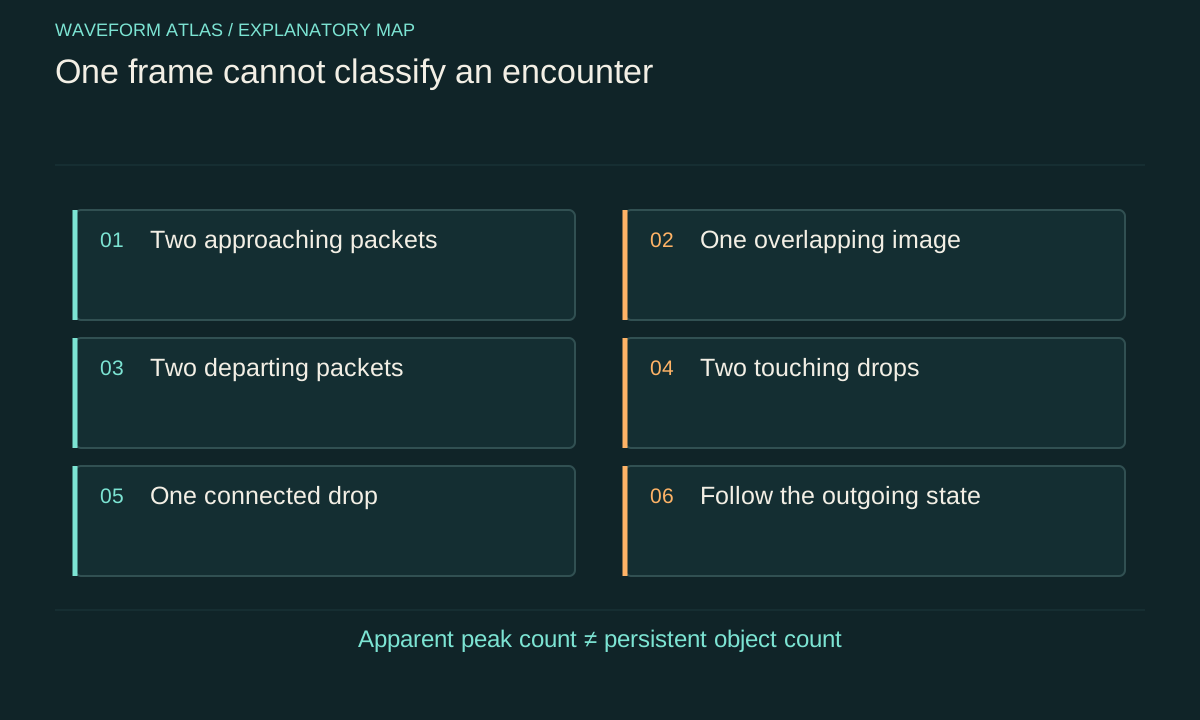
Suppose a camera sees two bright spots approach, become one spot and later separates them again. The middle frame contains one maximum, but the full sequence describes overlap. If the camera stops at that frame, the same data could be misclassified as merging. The missing information is temporal, not merely a better word for the image.
A merger claim should identify what counts as a structure and what makes the final organization persistent. For liquid drops, connectivity of the liquid region is useful. For localized waves, one may track stable peaks, modes or coherent structures. For orbiting objects, a remnant and outgoing radiation may be relevant. These definitions are system-dependent because the dynamics are different.
The broad word merging is therefore a classification to be earned by observation. It does not supply a universal equation or guarantee that all original information disappears. A combined object can retain internal structure, composition gradients or correlations with its environment. The first task is to say which separate identities are no longer useful at the chosen scale and how that change will be measured.
Linear waves provide the cleanest counterexample
For a linear wave equation, if u₁ and u₂ are solutions, their sum is also a solution. Two packets can therefore occupy the same region while continuing to evolve as the components predicted by the equation. Their amplitudes may reinforce or cancel locally, producing a striking temporary shape without a new interaction between the packets.
Take two identical positive Gaussian pulses traveling in opposite directions on an ideal string. At complete overlap, the displacement can be twice that of either pulse. Later, the two original profiles separate. A photograph at the maximum would suggest one larger object, but the propagation sequence shows no persistent joining.
Opposite signs make the warning even clearer: the instantaneous displacement can vanish at overlap while the motion and stored energy remain nontrivial. A zero picture is not annihilation, just as a doubled picture is not fusion. The relevant model tracks the full field and its time derivative, not only one intensity or displacement image. Recoverability of the original components is a direct test of the linear-overlap interpretation.
A changing interface gives a different physical criterion
Two drops that coalesce develop a liquid bridge and become one connected fluid region. The interface geometry changes, and surface energy can drive flow as the shape relaxes. This is more than adding two independent images: the material boundary itself evolves through a joining event.
For equal incompressible spherical drops, volume conservation gives a final spherical radius larger by a factor 2¹ᐟ³. The total area falls to 2⁻¹ᐟ³ of its initial value, about 79.4 percent, if the final drop is spherical and no liquid is lost. The decrease provides an energy source proportional to surface tension, while viscosity and inertia govern how the fluid responds.
The endpoint calculation does not determine every early-time detail. Experiments and simulations by Paulsen and colleagues show that inertia can matter even in the initial regime commonly described too simply as purely viscous. The outer medium can also affect the process. A droplet merger is consequently a concrete example with measurable connectivity, flow and energy redistribution, not a universal template that every wave or particle encounter must follow.
Nonlinear localized structures require their own model
In a nonlinear equation, adding two solutions generally does not produce another solution. The presence of one structure can change the evolution of the other. Depending on the equation, parameters and relative phase, an encounter may produce scattering, binding, radiation, breakup or a persistent combined structure.
Research on driven dissipative solitons supplies examples where coalescence occurs in specific parametrically driven systems. Clerc and colleagues studied a coalescence cascade across models and an oscillated fluid layer. That evidence supports a model-specific phenomenon. It does not establish that all solitons merge or that any pair of intense optical pulses will behave the same way.
A good explanatory simulation names its equation, initial conditions, boundary conditions and numerical resolution. It also tests whether the apparent remnant survives beyond the collision interval. If the output is a transient pulse that later spreads, calling it permanently stable would overstate the result. Nonlinearity makes new outcomes possible, but only the specified dynamics determine which outcome actually occurs. The word nonlinear is an invitation to calculate, not an explanation by itself.
Binding preserves a distinction that merging may remove
Two structures can remain associated while retaining separate centers. A molecule, an orbiting pair or a pair of localized pulses can have a stable or oscillating separation. This is binding under an appropriate definition, even if a low-resolution image shows one combined envelope.
A simple observable is the separation d(t). Scattering produces a separation that grows after the encounter. Binding produces a bounded separation over the observation window. Coalescence of two resolved material regions can remove the intervening boundary, making the original two-center description inappropriate. These categories can overlap in loose language, so an experiment should state its chosen distinction.
Optical research has demonstrated bound soliton pairs in a specific dispersion-managed fiber setting. The existence of such pairs is a useful reminder that persistent association need not mean one pulse. A spectral modulation can reveal an internal delay even when direct imaging cannot resolve both components. The measurement should therefore test internal structure as well as overall lifetime. A remnant that looks single at one resolution may still contain a well-defined pair at another.
Energy and momentum constrain every proposed outcome
Persistent joining often requires relative-motion energy to be redistributed into internal excitation, radiation, fluid motion or the environment. Conservation does not demand that the energy disappear; it demands that the ledger include where it goes. A dissipative model describes transfer into degrees of freedom that are not explicitly resolved.
Consider two equal masses approaching with velocities +v and −v. Their total momentum is zero, but their total kinetic energy is mv². If they form a stationary composite, that kinetic energy must become another form. Zero total momentum is therefore not a zero-energy condition. An image showing a stationary remnant cannot explain the missing kinetic energy by itself.
Angular momentum adds another constraint for off-center encounters. A remnant may rotate, deform, eject material or transfer angular momentum elsewhere. The exact channels depend on the system, but the accounting principle is shared. A merger model that removes relative motion without providing an energy or momentum route is incomplete, even if its before-and-after pictures are visually plausible.
Observation time and resolution define the strength of the claim
Persistence is always assessed over a finite interval. An experiment should compare that interval with relevant crossing, oscillation and relaxation times. Watching a system for one exposure time is insufficient if the expected separation would occur ten exposures later. Conversely, requiring infinite observation would make every physical classification unusable.
Spatial resolution also matters. If two objects approach closer than the instrument’s resolving distance, a single observed peak may reflect blur rather than joining. A useful analysis passes a two-object model through the measured point-spread function and asks whether the data can distinguish it from a single-object model. Additional spectral or phase measurements can break the ambiguity.
A practical report states both the observed persistence and the unresolved alternatives. For example, it may establish one connected liquid region but leave internal mixing incomplete, or establish a long-lived optical pair without proving a single-mode state. These are informative bounded results. The goal is to classify the physical change at the scale actually measured, not to claim that every possible distinction between the inputs has been erased.
For example, an unresolved pair can remain hidden even in a perfectly stable image; stability and spatial resolution constrain different alternatives.
Use a sequence of questions to identify the mechanism
Start with the incoming structures: what variable makes each one identifiable? Then follow the encounter through a sufficiently long observation window. Ask whether the outputs separate, remain bound, form a connected material region or settle into a different mode. Measure the energy and momentum channels needed by that interpretation.
Next compare at least one competing model. Linear propagation may explain a temporary bright spot; limited resolution may explain a single peak; a bound pair may explain a persistent envelope. A merger becomes persuasive when the observations reject these alternatives under stated conditions. The distinguishing measurement depends on the system, so a universal visual slogan cannot replace it.
Finally, keep the conclusion at the appropriate physical level. Droplet coalescence does not establish nuclear fusion, coherent optical combining does not fuse photons, and a new macroscopic organization does not automatically demonstrate quantum state reduction. Merging is useful when it names a measured structural outcome and a specified mechanism. It becomes misleading when the same word is asked to explain every way that two patterns can appear as one.
What to take forward
- Follow the system after overlap; one frame cannot establish a merger.
- Connectivity, bounded separation and a single stable mode are different criteria.
- Require an energy and momentum route for the observed combined state.
Go to the original work.
These links identify the sources behind specific claims. Verification scope varies by source and is stated below.
- 1 / University teachingUniversity Physics Volume 1, 16.6: Standing Waves and Resonance ↗
Superposition of counterpropagating waves and the location of nodes and antinodes.
Verification scope: Publisher-hosted textbook equations and explanations inspected.
- 2 / Primary experimentPaulsen et al. (2012): The inexorable resistance of inertia determines the initial regime of drop coalescence ↗
Early coalescence regimes require inertia as well as capillary and viscous effects under the study's drop conditions.
Verification scope: Accessible primary-paper abstract and selected results/conclusion inspected; not claimed a complete reanalysis.
- 3 / Primary experimentPaulsen et al. (2014): Coalescence of bubbles and drops in an outer fluid ↗
The surrounding fluid changes the coalescence problem; exterior and interior fluid dynamics must be distinguished.
Verification scope: Publisher abstract inspected; no universal neck-growth exponent inferred.
- 4 / Primary experimentClerc et al. (2011): Coalescence cascade of dissipative solitons in parametrically driven systems ↗
Model-specific coalescence of dissipative localized structures, with theoretical, numerical and driven-fluid experimental components.
Verification scope: Publisher abstract and bibliographic record inspected; no unseen numerical parameters or figures reproduced.
- 5 / Primary experimentStratmann, Pagel and Mitschke (2005): Experimental Observation of Temporal Soliton Molecules ↗
A bound pair of temporal solitons in a specific dispersion-managed-fiber system, distinct from one merged pulse.
Verification scope: Publisher abstract and bibliographic record inspected; details limited to reported abstract scope.
Found a problem with a claim or calculation? Send the page, the claim and the evidence. Read how these articles were prepared.