Linearity is a statement about the equation
A system is linear when adding two allowed inputs produces the sum of their corresponding responses, with the relevant homogeneous boundary conditions treated consistently. For an ideal one-dimensional wave equation, u₁ and u₂ can be added to obtain another solution. This mathematical property is the foundation of superposition.
It does not mean that measured intensity is linear in amplitude. An optical detector may record a quantity proportional to the squared field, producing cross terms when fields overlap. Those cross terms create interference without requiring a nonlinear propagation law. Confusing nonlinear detection with nonlinear wave dynamics is a common route to misclassifying overlap as interaction.
The test is therefore not whether a graph changes dramatically during overlap. It is whether the total field follows the sum predicted from the separately propagated components. If it does, no additional packet-to-packet coupling is needed to explain the observation. If it does not, one must examine nonlinear material response, boundary changes, losses or errors in the assumed input states before naming a merger mechanism.
Follow an explicit pair of Gaussian pulses
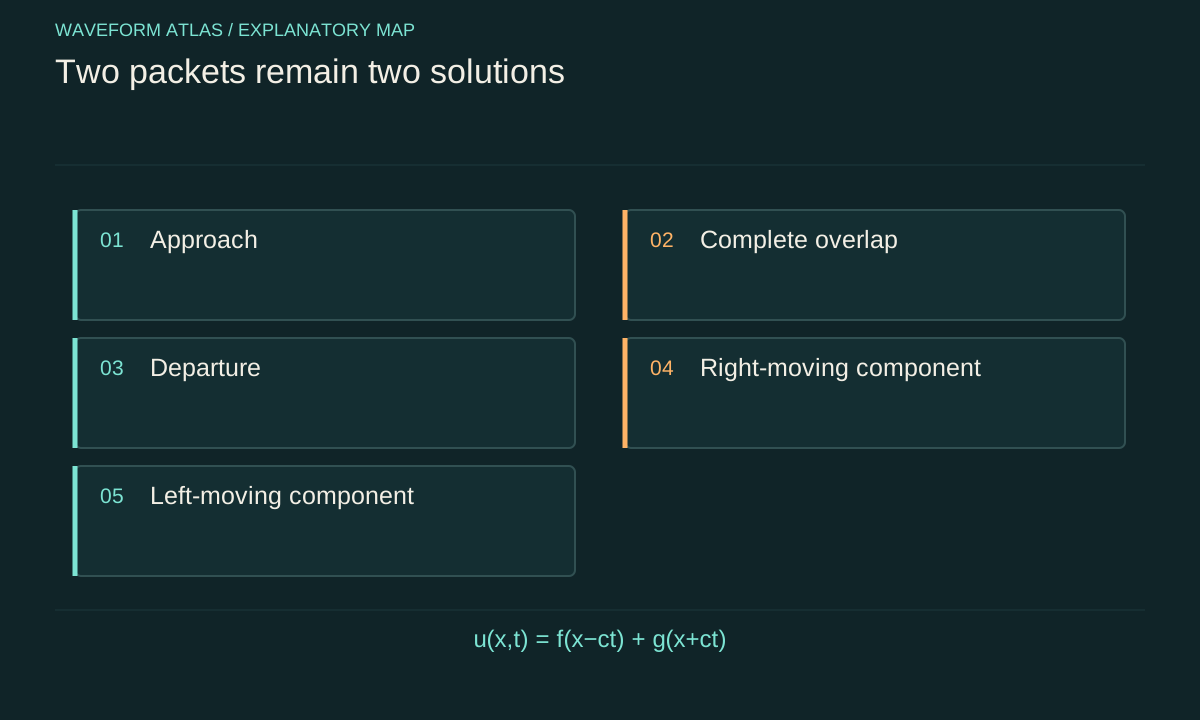
Consider u(x,t) = f(x−ct) + g(x+ct) on an ideal string. Choose f to be a positive Gaussian initially centered to the left and g an identical Gaussian initially centered to the right. Their centers approach at relative speed 2c, overlap and then continue past each other.
At exact alignment, the displacement profile is twice either individual profile. Its shape may resemble one larger pulse, but the equation still predicts two outgoing components. The enlarged peak is not evidence that a stable new pulse has formed. Watching the system for another crossing time resolves the ambiguity directly.
A concrete scale choice makes the timing clear. If the initial center separation is 20 cm and each pulse travels at 1 m/s, their centers coincide after 0.1 second. A camera exposure centered on that moment can hide the approach and departure if its time resolution is poor. The numbers are illustrative, but the lesson is general: spatial overlap is an event in the propagation history, not automatically a change in the number of independently evolving solutions.
Zero displacement can coexist with stored energy
Now reverse the sign of one Gaussian. At exact overlap, the two displacements can cancel everywhere in the overlapping profile. It is tempting to say the waves have disappeared, but a string’s dynamical state includes both displacement and velocity. The two time derivatives need not cancel.
For equal opposing profiles at the cancellation instant, the spatial displacement gradient can vanish while the time derivative remains nonzero. Energy can then reside in motion of the string elements. At another instant, it resides partly in elastic deformation. The wave equation transports this energy through the overlap and produces outgoing pulses.
This example exposes the limitation of measuring only one field snapshot. A zero value of one observable does not imply a zero state. In optical interference, the relevant field and flux accounting is different in detail, but the same caution applies: local darkness does not establish destruction of all energy or of the source excitations. A full account follows the other output channels, boundaries and time dependence instead of treating a canceled amplitude as a universal annihilation mechanism.
Interactive model: A freely spreading quantum packet. Enable JavaScript to adjust its controls.
σₓ(t) = √[σ₀² + t²/(4σ₀²)]
One-dimensional free particle, initial unchirped minimum-uncertainty Gaussian. Dimensionless units: ℏ = m = 1. The plotted position density broadens under unitary evolution.
Intensity cross terms reveal coherence rather than fusion
For scalar complex fields E₁ and E₂ in the same detected mode, intensity is proportional to |E₁ + E₂|². Expanding gives |E₁|² + |E₂|² + 2 Re(E₁*E₂). The last term depends on relative phase and overlap. It can increase or decrease the measured intensity at a particular location.
Take equal intensities I in an ideal two-input combination. The local expression becomes 2I(1 + cos φ) when the fields share polarization, frequency and spatial mode. It ranges from zero to 4I as the phase φ changes. This is a local or mode-specific statement; a complete optical arrangement must account for other ports and source conditions.
A bright output does not mean two photons fused into a higher-energy photon. Ordinary linear combining redistributes amplitudes among modes without that frequency-changing reaction. A dark output likewise does not mean all incoming energy was erased. Measuring both outputs while scanning phase makes the redistribution visible and distinguishes coherent interference from a claim that the underlying particles have changed identity.
Dispersion changes shape without requiring merging
In a dispersive linear medium, different frequency components propagate with different phase or group behavior. An individual packet can broaden, chirp or develop a more complicated profile. Two packets may then overlap for longer or become difficult to distinguish by eye even though superposition remains valid.
The appropriate comparison propagates each initial packet through the same linear transfer function and adds the results. Comparing the output with unchanged copies of the input would incorrectly attribute ordinary dispersion to an interaction between packets. Recoverability may require compensating the known dispersion or measuring phase as well as intensity.
A simple frequency-domain description writes the output spectrum as H(ω) times the input spectrum. For two inputs, H(ω)[A(ω) + B(ω)] equals H(ω)A(ω) + H(ω)B(ω). The equality is the useful test. If the transfer function is invertible over the measured band, information can in principle be recovered, though noise and finite bandwidth may make inversion difficult. Practical loss of resolution is therefore distinct from a fundamental merger of the two solutions.
If the transfer function has an exact zero at a frequency, that channel cannot be reconstructed from the measured output alone. The missing information has a specific spectral location rather than an unexplained merger label.
Decomposition needs physical constraints
Any measured function can be written as a sum in many artificial ways. The claim that original packets remain recoverable is stronger than the trivial algebraic statement that a curve can be decomposed. It relies on known initial conditions, a governing linear equation and sufficiently informative measurements.
For the ideal string, specifying both initial displacement and velocity determines the right-moving and left-moving components. A single displacement snapshot generally does not. For optical fields, phase-sensitive measurements or known preparation can provide information absent from intensity alone. Without those constraints, several different input combinations may fit the same observed image.
This is why a convincing overlap experiment measures the components separately or predicts them from a validated model. It then tests the combined run without freely adjusting every parameter. Agreement across time, position and phase offers a meaningful check of superposition. A post hoc decomposition with arbitrary functions offers little evidence either for or against merging. The physical question is whether the independently specified components continue to explain the observed evolution within experimental uncertainty.
What would count as evidence against simple overlap?
A systematic departure from the linear sum can motivate a different model. Examples include an intensity-dependent phase shift, energy transfer to new frequencies, persistent trapping of the packets or radiation that cannot be explained by the independently propagated inputs. The relevant signature depends on the medium and measurement.
Even then, a merger is only one possible outcome. Nonlinear scattering can alter packet shapes without producing a single remnant. Absorption can remove one packet while leaving the other. A detector can saturate and make two bright inputs appear as one flattened peak. These alternatives should be tested before selecting the most dramatic interpretation.
A useful control varies input amplitude. In a genuinely linear regime, scaling an input scales its field response proportionally. Departure from that scaling can reveal a nonlinear material response or instrumental saturation, but those must be distinguished by calibration. Additional time-resolved measurements can test whether a new localized state persists. The evidence should connect the failure of superposition to a specified dynamical mechanism, rather than treating any mismatch as proof of irreversible joining.
Recoverability is a practical and conceptual test
An ideal reversible overlap can be undone by reversing the appropriate propagation or recombining the measured modes. In practice, finite aperture, bandwidth and noise limit recovery. A failed reconstruction may therefore reflect missing measurement channels rather than a fundamental loss of information.
The most informative report states what was recovered and under which model. Reappearance of two outgoing packets supports a particularly direct conclusion. Successful phase-sensitive reconstruction supports another. Neither requires asserting that every microscopic degree of freedom was controlled. The claim should match the measured field variables.
Linear overlap remains a useful baseline because it predicts a dramatic visual encounter with no persistent merger at all. It shows why a peak count, a dark instant or a shared region cannot settle the mechanism. Once that baseline is established, genuinely nonlinear or dissipative changes become easier to identify. The decisive question is whether the later evolution requires a new coupled state, or whether the original independently evolving solutions still account for the record.
What to take forward
- A nonlinear intensity pattern can arise from linear field propagation.
- The full wave state includes phase or velocity information absent from a snapshot.
- Test independently predicted component evolution before interpreting overlap as merger.
Go to the original work.
These links identify the sources behind specific claims. Verification scope varies by source and is stated below.
- 1 / University teachingUniversity Physics Volume 1, 16.6: Standing Waves and Resonance ↗
University Physics Volume 1, 16.6: Standing Waves and Resonance. https://openstax.org/books/university-physics-volume-1/pages/16-6-standing-waves-and-resonance
Superposition of counterpropagating waves and the location of nodes and antinodes.
Verification scope: Publisher-hosted textbook equations and explanations inspected.
- 2 / University teachingBarton Zwiebach, MIT 8.04: Chapter 2, Experiments with photons ↗
Barton Zwiebach (2016). Chapter 2: Experiments with photons. MIT 8.04 Quantum Physics I, lecture notes, 9 February 2016, pp. 1–8.
Beam-splitter phase conventions, two-path amplitude transformations and Mach–Zehnder recombination.
Verification scope: MIT-hosted lecture-note text and beam-splitter equations inspected.
- 3 / University teachingOpenStax University Physics Volume 1: Interference of Waves ↗
OpenStax. University Physics Volume 1, Section 16.5: Interference of Waves.
Linear superposition and boundary reflection/transmission.
Verification scope: Publisher-hosted Section 16.5, especially superposition and passage of overlapping pulses, inspected.
- 4 / University teachingQuantum Physics I, Lecture 7: Wavepackets and uncertainty ↗
Barton Zwiebach (2016). 8.04 Lecture Note 7. https://ocw.mit.edu/courses/8-04-quantum-physics-i-spring-2016/6ca5bd79a2121967796f7c0b8f6f48c9_MIT8_04S16_LecNotes7.pdf
Linear wave-packet evolution and dispersion-induced shape changes; a free Gaussian packet is a concrete example.
Verification scope: Sections 2–3 inspected, including the dispersion expansion and free-packet Fourier propagation. The merging article makes a qualitative dispersion claim rather than quoting a Gaussian-width formula.
Found a problem with a claim or calculation? Send the page, the claim and the evidence. Read how these articles were prepared.