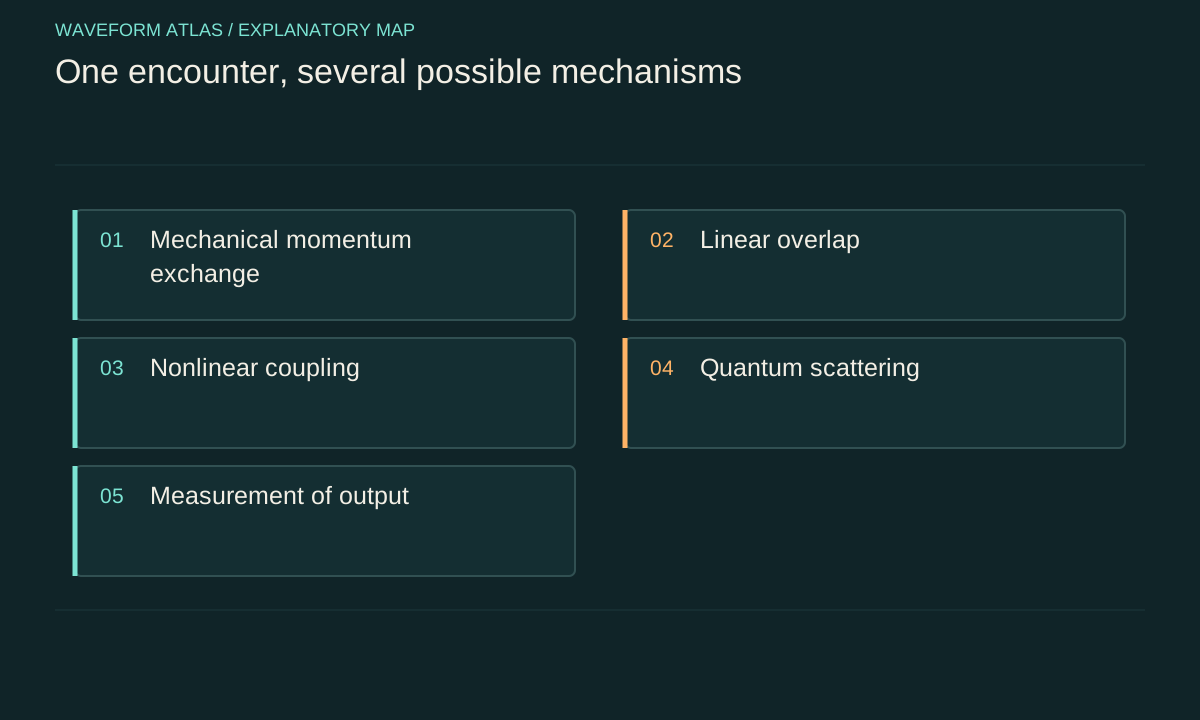
Define the participants and the interaction
The word collision can describe two moving bodies making contact, particles interacting through a potential, localized nonlinear waves meeting, or a disturbance reaching a boundary. These situations share an encounter but not necessarily a mechanism. The first task is to identify the participating systems and the coupling between them. Physical contact is not required for an interaction mediated by a field.
Also specify the system boundary. If two bodies exchange momentum while isolated from external impulses, their total momentum is conserved. If one is attached to a support, the support can receive momentum. If an optical field interacts with a pumped medium, the pump can supply energy. An apparent failure of a conservation law often reflects an incomplete inventory of participants rather than a failure of the law itself.
Classical collisions begin with momentum
For an isolated pair, total momentum before and after the encounter is equal. In one dimension, m₁u₁ + m₂u₂ = m₁v₁ + m₂v₂. In several dimensions this is a vector equation, so each component must be accounted for. Momentum conservation alone does not determine every final velocity; additional information about energy, internal states or the interaction is required.
An elastic collision also preserves the pair's total translational kinetic energy under the chosen idealization. An inelastic collision transfers some of that energy into internal excitation, deformation, heat or other channels. Total energy remains conserved for the complete isolated system. Calling kinetic energy lost is shorthand for leaving the measured translational degrees of freedom, not disappearing from physics.
Relative motion supplies the available energy
The kinetic energy of two bodies separates into center-of-mass motion and relative motion. The latter uses the reduced mass μ = m₁m₂/(m₁ + m₂). For an isolated pair, the center-of-mass velocity remains constant, while the relative-motion energy can be redistributed into internal channels. This separation prevents frame-dependent misunderstandings about how much energy is available for excitation.
A moving laboratory observer assigns a different total kinetic energy to the same event, but the internal excitation threshold depends on the relative motion. A fast-moving pair with almost equal velocities may have little energy available for a violent encounter. Conversely, two bodies moving oppositely can have substantial relative energy even if their total momentum is zero. Relative speed is therefore a more useful collision variable than one participant's speed alone.
Linear wave overlap is a different category
In a linear wave equation, the sum of two solutions is also a solution. Two pulses can overlap, produce a larger or smaller local field through interference, and then continue with their original shapes in an ideal nondispersive model. The temporary combined shape does not imply that the pulses exerted a persistent nonlinear influence on one another.
Energy density can vary during overlap because it is often quadratic in the total field. Cross terms matter locally. Yet the field evolution still follows the linear sum. A striking cancellation at one instant does not mean both pulses were destroyed. To test for an interaction beyond superposition, compare the later output with the independently propagated inputs, including any ordinary dispersion or boundaries.
Nonlinear waves can exchange more than appearance
When the governing equation contains nonlinear terms, the combined field can alter its own propagation. Two pulses may shift each other's phase, transfer energy, radiate new waves, merge or break apart. The outcome depends on the equation, amplitudes, relative phases and velocities. The label nonlinear does not specify one universal collision behavior.
Some integrable models support solitons that emerge from encounters with preserved shapes but shifted positions or phases. Other nonlinear systems produce substantial radiation or irreversible changes. A solitary-looking pulse is not automatically a soliton, and a shape-preserving encounter in one model does not establish universal indestructibility. The governing dynamics and measured before-and-after parameters must accompany the claim.
Quantum scattering predicts outgoing probabilities
In quantum mechanics, an encounter can be described by an incoming state evolving under an interaction Hamiltonian. The outgoing state contains amplitudes for allowed channels. Cross sections and transition probabilities connect those amplitudes to measured event distributions. The calculation includes conservation constraints and, where relevant, internal excitation or particle identity.
An interaction can entangle the participants because different outgoing states of one become correlated with different states of the other. That joint evolution need not invoke an additional collapse law. Measurement of an outgoing channel is a further operational step, and ignoring unobserved degrees of freedom can produce a mixed reduced description. Keeping evolution, entanglement and detection separate avoids treating every encounter as the same kind of quantum measurement.
Geometry changes the result
An impact parameter describes the transverse offset of an incoming trajectory relative to a target in a suitable classical or semiclassical description. Different offsets can produce different deflections, transferred angular momentum or probabilities of close interaction. The relative speed and orientation also matter. A head-on event is one special geometry, not a representative picture of every collision.
For extended or structured objects, contact shape and internal orientation add variables. For quantum wave packets, finite transverse width and coherence can limit a simple trajectory interpretation. A measured angular distribution averages over the actual incoming preparation and target distribution. Reconstructing the interaction requires knowing those distributions rather than assuming every event began with the same ideal geometry.
An impact has a source and a duration
A mechanical strike applies a force over time. Its impulse is the integral of force and equals the momentum change of the selected system when all relevant forces are included. The duration and spatial pattern determine which modes are excited. A short local strike can launch a broad spectrum of waves even if the visible point of contact becomes temporarily flat.
This connects collision mechanics to wave response without making them identical. The striker's loss of kinetic energy can become target motion, deformation, sound or heat. The target may already carry a wave, so the strike can add or remove energy from a chosen mode depending on timing. Measuring the target alone misses the work and momentum supplied by the intervention.
Classify the observed change before naming its cause
A reduced forward signal might mean reflection, scattering, absorption, mode conversion or destructive interference. A changed velocity might mean elastic momentum exchange or internal excitation. A lost interference fringe might mean phase averaging, path imbalance or environment correlations. Similar outputs can arise from different mechanisms, so the classification should follow measurements rather than visual analogy.
Use complementary observables: outgoing directions and speeds for momentum, spectra and internal states for energy, phase-sensitive tests for coherence, and force-time records for impact. The goal is not to measure everything, but to constrain the alternatives that would explain the same initial observation. A successful account links a specific interaction to a specific set of changes.
Keep the categories connected but distinct
One event can involve several categories. A projectile strikes a plate, excites elastic waves, produces nonlinear deformation and eventually dissipates energy as heat. A gas particle scatters from an interferometer molecule and becomes correlated with its path. A nonlinear pulse encounter can radiate small linear waves. These are layered descriptions of coupled processes, not competing slogans.
The useful question is what changed, through which interaction, in which degrees of freedom. Momentum and energy accounts organize the classical part; state evolution and correlations organize the quantum part; the governing field equation determines whether wave overlap is linear or interactive. With those distinctions, collision becomes a precise description of an encounter rather than a synonym for every disappearance, disturbance or collapse of a wave pattern.
One encounter can have several legitimate boundaries
Consider a ball striking a vibrating plate. If the selected system is the ball alone, the contact force supplies an external impulse and changes its energy. If the system is ball plus plate, contact forces are internal, but the plate supports can still supply external impulse. If the supports and surrounding air are included, sound and support motion become explicit channels. Each description can be correct if its boundary and omitted exchanges are stated.
The choice should match the question. To predict rebound speed, a contact model and plate response may suffice. To determine whether an existing plate mode was suppressed, measure that mode before and after and include the work done by the ball. To assess total dissipation, track residual vibration, deformation and heat over a longer interval. These are different analyses of the same event, not contradictory answers.
Timing also changes the inventory. Immediately after contact, energy may remain in organized vibration; much later, internal friction can convert it into heat. Calling the whole event dissipative from the final thermal state conceals the intermediate mode conversion. Conversely, observing a coherent ringdown does not establish that no energy was lost during contact. A useful report follows the sequence with enough temporal resolution to distinguish injection, redistribution and dissipation. That sequence provides a concrete bridge between collision mechanics and wave dynamics while avoiding the claim that one momentary visual change explains the entire encounter.
What to take forward
- Define the participants and system boundary before applying conservation laws.
- Linear overlap need not change the later waves.
- Quantum scattering, entanglement and measurement are distinct steps.
Go to the original work.
These links identify the sources behind specific claims. Verification scope varies by source and is stated below.
- 1 / University teachingOpenStax University Physics Volume 1: Types of Collisions ↗
Classical elastic and inelastic collision definitions and conservation-law setup.
Verification scope: Open textbook section inspected. Worked numbers here are independently calculated illustrative examples.
- 2 / University teachingOpenStax University Physics Volume 1: Collisions in Multiple Dimensions ↗
Vector momentum conservation and reconstruction in multiple dimensions.
Verification scope: Open textbook section inspected; examples in this article are original.
- 3 / University teachingOpenStax University Physics Volume 1: Interference of Waves ↗
Linear superposition and boundary reflection/transmission.
Verification scope: Open textbook section inspected; no textbook passage or diagram is reproduced.
- 4 / University teachingQuantum Physics III: Scattering and Identical Particles ↗
Scattering states, differential cross sections, phase shifts and their assumptions.
Verification scope: MIT course page and lecture topic descriptions inspected; this is a teaching reference, not a new experiment.
- 5 / Primary theoryZabusky and Kruskal, Interaction of Solitons in a Collisionless Plasma and the Recurrence of Initial States ↗
Original model-dependent soliton interaction study.
Verification scope: Publisher title, authors, date and citation record inspected; no uninspected numerical simulation result is reproduced.
- 6 / University teachingOpenStax University Physics Volume 1: Impulse and Collisions ↗
Impulse as the integral of force and the change of momentum.
Verification scope: Open textbook section inspected. The oscillator calculations are derived independently.
Found a problem with a claim or calculation? Send the page, the claim and the evidence. Read how these articles were prepared.