An interaction is not automatically a measurement record
Quantum systems can interact coherently. A controlled Hamiltonian can change momentum, phase or internal state while preserving a pure joint state. Calling every such interaction a collapse obscures the distinction between dynamical evolution and the production of an experimentally accessible record. The relevant question is what information becomes correlated with what degrees of freedom.
A measurement is also a physical interaction, but its operational description includes an observable, an apparatus and outcomes. An uncontrolled environmental encounter can act like a measurement of some system property when it leaves distinguishable records in the environment. That does not mean every collision measures every observable or that a human observer must read the record for reduced interference to occur.
A two-path model identifies the mechanism
Let a system initially occupy a coherent superposition a|L⟩ + b|R⟩, with an environment in state |e₀⟩. An interaction can correlate the paths with environmental states, giving a|L⟩|e_L⟩ + b|R⟩|e_R⟩. The total state can remain pure under unitary evolution. The system alone is described by tracing over the environment.
Its off-diagonal coherence is multiplied by γ = ⟨e_R|e_L⟩. If the environmental states are identical, the overlap is one and this mechanism does not reduce path coherence. If they are orthogonal, the reduced path coherence vanishes. Intermediate distinguishability gives partial suppression. The model makes the relevant criterion explicit: path-dependent environmental records, not the mere occurrence of an encounter.
Scattering can carry path information away
A scattered particle or photon can have an outgoing state that depends on where the system was. If those outgoing states are distinguishable enough, the environment contains which-path information. Ignoring the scattered object reduces interference in the system's observed statistics. The amount depends on wavelength, geometry, momentum transfer and the separation between the alternatives.
A collision too insensitive to the path separation may produce little distinguishability even if it transfers some momentum. Conversely, a modest energy exchange can still carry substantial spatial information. Energy loss and decoherence are therefore not interchangeable measures. The relevant calculation uses the overlap of environmental states or an appropriate master equation, with the physical scattering process specified.
The experimental source supports a bounded example
Hornberger and colleagues reported pressure-dependent loss of fullerene interference associated with background-gas collisions. The verified primary publication record supports that collisional-decoherence interpretation in the studied matter-wave interferometer. It does not establish a universal numerical decoherence rate for every object or gas, and no such rate is imported here.
The useful conceptual lesson is that ordinary scattering can quantitatively affect interference. Gas pressure, collision cross sections, path geometry and detection all belong in the baseline model. A claim of an additional collapse mechanism must be compared with that baseline rather than treating every pressure-dependent fringe loss as unexplained. Source-specific experimental scope matters because apparatus geometry determines how scattering and loss enter the recorded signal.
Loss of particles can mimic loss of contrast
A detector may reject particles that scatter outside its acceptance. The surviving ensemble can have altered intensity balance or a selected momentum distribution. A reduction in total count rate is not the same observable as a reduction in normalized fringe visibility. Both can change in one experiment, but they need separate analysis.
Measure single-path intensities and detector acceptance alongside interference. Unequal path amplitudes reduce maximum visibility even with perfect coherence. Phase drift during averaging can also wash out fringes. These ordinary explanations must be constrained before assigning the entire visibility change to environmental which-path information, much less to a new fundamental collapse law.
Reduced mixedness does not identify one interpretation
Tracing over an environment gives a mixed reduced density matrix when the system is entangled with unobserved degrees of freedom. This is a standard prediction about local measurements. It does not by itself select among all interpretations of quantum mechanics or demonstrate a particular physical collapse dynamics. The operational predictions must be separated from broader interpretive language.
An objective-collapse model, when proposed, modifies the dynamics and should supply quantitative differences from the conventional account. Those differences may involve mass, geometry, time, noise or another parameter. Testing the model requires its actual equations and a region where its predictions are distinguishable from known interactions. A generic observation that a macroscopic pattern disappeared is not enough.
Conditional recovery is a different experiment
If environmental records remain accessible, one can sometimes condition on a measurement of them or apply a controlled reversal. Conditional subsets may show interference that is absent in the unsorted ensemble. This reveals correlations in the joint state. It does not mean the unconditional signal was restored on every run, nor that inaccessible environmental information can always be recovered.
Report the selection rule, success probability and operations used. A state reconstructed after postselection is different from deterministic recovery. A fresh coherent preparation is different from reversing the original interaction. These distinctions matter when phrases such as erased measurement or restored wave are used to interpret an encounter. The data should identify which operation actually occurred.
A coherent kick offers a counterexample
A spatially uniform, controlled impulsive force can shift momentum through a unitary operation. If the control does not acquire distinguishable information about alternative system states and its noise is negligible in the model, the operation need not destroy coherence. It changes the state, but changing a state is not synonymous with measuring it.
An uncontrolled random kick can instead produce ensemble dephasing or momentum broadening after averaging. A path-dependent kick can entangle system and controller. These outcomes depend on the force's statistics and correlations. The counterexample shows why the words collision, disturbance and collapse cannot be treated as equivalent without specifying the interaction and what is observed.
Design a test around a distinctive prediction
To investigate unexplained coherence loss, characterize environmental pressure, temperature, electromagnetic noise, source stability and detector response as relevant to the apparatus. Vary a parameter that the candidate models predict differently. A controlled scaling curve is more informative than one residual visibility value. Keep the ordinary model parameters constrained by independent measurements when possible.
If a proposed collapse model predicts an additional rate, compare that rate with uncertainty in conventional decoherence and technical averaging. A null result may constrain the model within a parameter range; a nonzero residual may still have several explanations. State the statistical and physical assumptions behind any bound. Do not infer a universal conclusion from a model-specific exclusion or an unresolved excess.
Use precise language for the observed level
An experiment can establish scattering, reduced interference, entanglement under a suitable witness, or a detector outcome distribution. Each is a meaningful result. The language should match the strongest claim actually supported. Saying that a collision occurred is weaker than showing it carried path information; showing decoherence is different from proving an additional collapse dynamics.
The disciplined account follows the joint interaction, the accessible records and the reduced observations in that order. It preserves the possibility of testing new physics while recognizing how much ordinary quantum scattering already predicts. An encounter can change motion and correlations profoundly without requiring the assertion that every wave has undergone the same kind of collapse.
Independent collisions can yield an exponential coherence factor
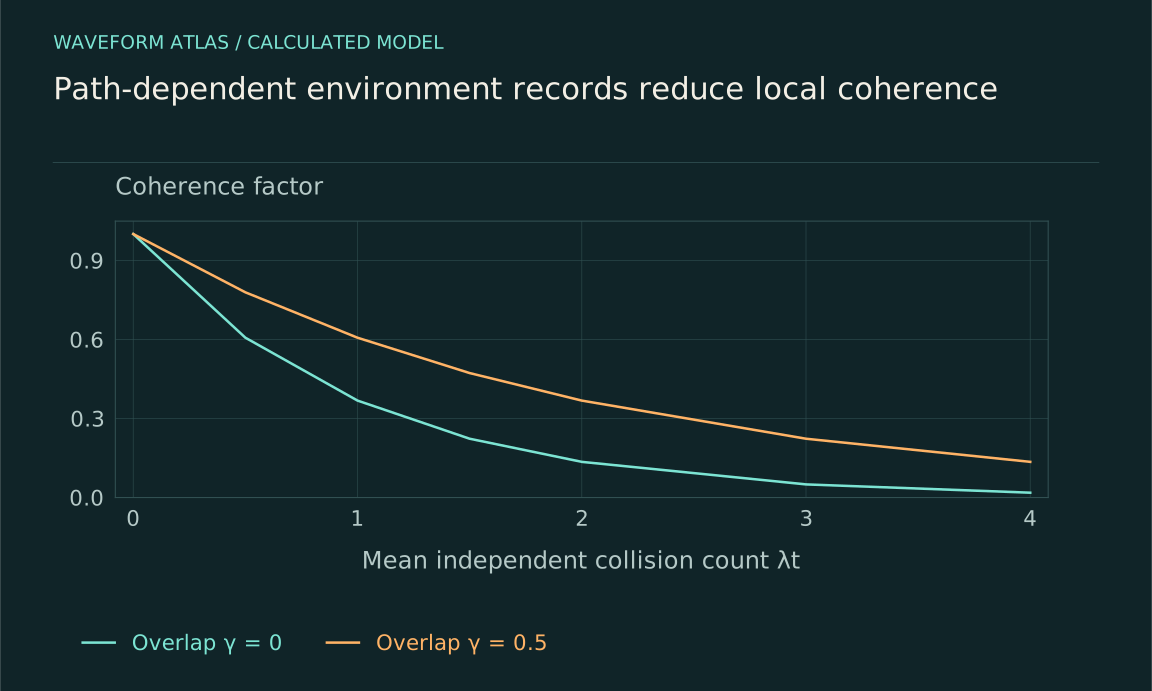
In a deliberately simplified model, suppose every collision multiplies the same path coherence by a factor γ, and the number of independent collisions in time t is Poisson distributed with mean λt. Averaging γ to the power n over that distribution gives exp[λt(γ − 1)]. If each event completely resolves the paths so that γ = 0, the coherence factor becomes exp(−λt). If γ = 1, collisions produce no suppression through this channel.
This derivation is an original ideal-model calculation. It assumes independent events, a fixed per-event overlap and no additional changes in the system that alter later collisions. Real gases have momentum distributions, scattering-angle dependence and detector selection, so a proper model averages the relevant overlaps rather than assigning one universal γ. The formula is useful because it separates collision rate from information gained per collision.
For γ = 0.5 and λt = 2, the factor is exp(−1), approximately 0.368. Merely knowing that the mean number of collisions is two does not determine the coherence unless the path sensitivity of each event is also known. This directly refutes the shortcut that any collision necessarily causes complete loss of interference.
If γ is complex, the same average can include a phase shift as well as contrast reduction. A phase-sensitive measurement can distinguish those effects. Reporting only visibility can miss coherent phase accumulation, while reporting only phase can miss ensemble suppression. The joint interpretation follows the interaction's state-dependent records and the measured observable, keeping ordinary collisional dynamics separate from any proposed additional collapse process.
The same distinction applies to a null result: no observed additional decoherence constrains only effects large enough to be resolved under the tested conditions. It does not establish that every conceivable collapse model is excluded. Report the parameter range and the ordinary-noise floor that define the sensitivity.
What to take forward
- Path-dependent environmental records can reduce local interference.
- Count loss, amplitude imbalance and phase averaging need separate controls.
- Decoherence from an encounter does not by itself establish an additional collapse law.
Go to the original work.
These links identify the sources behind specific claims. Verification scope varies by source and is stated below.
- 1 / Primary experimentCollisional Decoherence Observed in Matter Wave Interferometry ↗
K. Hornberger, S. Uttenthaler, B. Brezger, L. Hackermüller, M. Arndt, and A. Zeilinger. Physical Review Letters 90, 160401 (2003).
DOI: 10.1103/PhysRevLett.90.160401
Pressure-dependent loss of fullerene interference attributed to background-gas collisions.
Verification scope: Publisher abstract and bibliographic record inspected; no new numerical bound is inferred.
- 2 / University teachingQuantum Physics III: Scattering and Identical Particles ↗
Quantum Physics III: Scattering and Identical Particles.
Scattering states, differential cross sections, phase shifts and their assumptions.
Verification scope: MIT course page and lecture topic descriptions inspected; this is a teaching reference, not a new experiment.
- 3 / University teachingIntroduction to Decoherence Theory ↗
K. Hornberger, Introduction to Decoherence Theory, in Entanglement and Decoherence, Lecture Notes in Physics 768, 221–276 (2009). Author manuscript: arXiv:quant-ph/0612118.
DOI: 10.1007/978-3-540-88169-8_5
Reduced-state coherences are multiplied by overlaps of scattered environmental states; ordinary decoherence is distinct from an added collapse law.
Verification scope: Section 5.1.1, especially equations (5.5)–(5.7), and the discussion of collisional overlaps inspected. The Poisson example in this atlas is its own stated ideal-model calculation.
Found a problem with a claim or calculation? Send the page, the claim and the evidence. Read how these articles were prepared.