Follow the outgoing possibilities
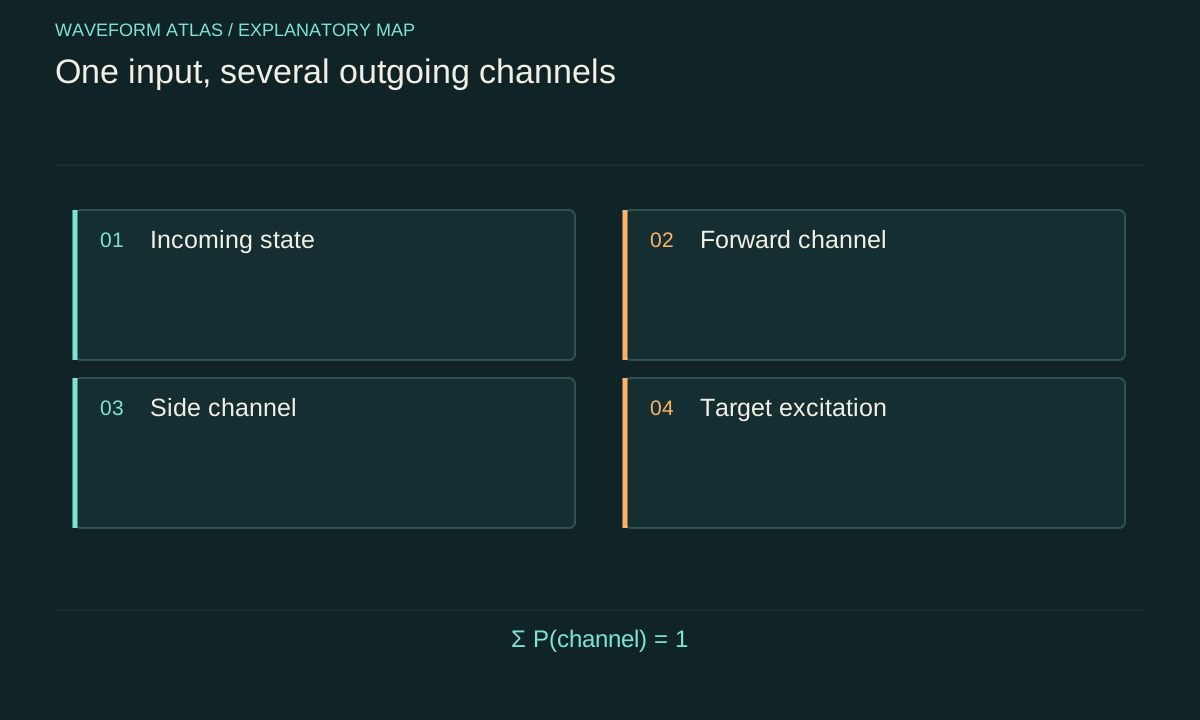
A narrow beam meets a small object. Downstream, the bright spot becomes weaker, while other detectors register light to the side. The useful description begins by identifying an incoming state and the possible outgoing states. Direction is one label, but frequency, polarization, spatial mode and the target's internal state can also distinguish the outputs. Scattering is the interaction that redistributes amplitude or probability among those possibilities.
This picture covers very different instruments. An acoustic pulse can scatter from a cavity. Neutrons can exchange momentum with a crystal. An electron can leave an atom excited. The same word does not make their microscopic coupling identical. In every case, specify the incident excitation, the target and the quantities measured after the encounter. That specification turns a dramatic image into a physical question. A dark patch behind an obstacle is an observation; scattering is one possible explanation that needs an outgoing-channel account.
Separate the wave from the material response
For a weak classical field, the incident wave drives a material response that radiates a secondary field. The detected field is the sum of the incident and scattered fields. The secondary field is not generally an independent energy supply: the incoming source and the responding object belong to one energy account. Their relative phase matters, especially near the forward direction where both fields reach the same detector.
For quantum scattering, an incoming state evolves under an interaction Hamiltonian. The outgoing state may remain a coherent superposition of several directions. A detector later records one event, while many repetitions reveal a distribution. Describing that distribution with a scattering amplitude does not require treating the wavefunction as a literal fluid that hits an obstacle. Classical and quantum calculations share useful mathematics, but the physical interpretation of their amplitudes differs. Field amplitude can represent a measurable oscillating quantity; quantum probability amplitude determines probabilities for specified measurement outcomes.
Energy identifies a channel
An elastic channel preserves the relevant total kinetic energy of the asymptotic participants when their internal states are unchanged. A target may nevertheless recoil, so the projectile's own energy can change in the laboratory frame. An inelastic channel changes internal excitation or creates different accessible products, with the energy balance including those changes. Always state whose energy is being compared and in which frame.
Consider an ideal heavy target that redirects a monochromatic optical beam without measurable frequency shift. The output can occupy a broad angular range while retaining the incident frequency. Now imagine a scattering process that leaves a material vibration excited. The outgoing light can have a different frequency because energy was exchanged with that vibration. These examples distinguish redirection from spectral conversion. They also show why a detector that measures intensity alone cannot establish that an interaction was elastic: it must either resolve the energy change or justify an approximation that makes it negligible.
Interactive model: Small-particle Rayleigh scattering. Enable JavaScript to adjust its controls.
Cross-section scaling ∝ λ⁻⁴; angular shape ∝ 1 + cos²θ
Unpolarized light, a fixed isolated particle much smaller than every selected wavelength, and fixed optical properties. The curves show relative differential cross section in the Rayleigh limit; multiple scattering and Mie corrections are omitted.
A simple two-channel calculation
Suppose a normalized incoming quantum state has two allowed outgoing channels. In an ideal lossless model its state can be written as a|forward⟩ + b|side⟩, with |a|² + |b|² = 1. Choosing a probability of 0.70 for the forward channel leaves 0.30 for the side channel. Among 1,000 identically prepared detections, the expected counts are 700 and 300, with ordinary counting fluctuations around those values. These are illustrative probabilities, not observations from an experiment.
A forward detector alone would report a thirty-percent reduction. Calling that reduction absorption would be wrong in this specified model because the missing events appear in the side channel. If instead a third channel transfers excitation to an unmeasured target, two visible detectors no longer close the account. The lesson is operational: a completeness claim depends on the set of channels the apparatus can actually measure. Increasing detector coverage can change the interpretation without changing the interaction itself.
Geometry controls the pattern
A scatterer's size and shape affect the phase differences between contributions from different locations. The wavelength sets the spatial scale on which those differences matter. A feature much smaller than the wavelength often produces a different pattern from a large structure with many resolvable paths. The target's material response supplies another scale through resonance, absorption or directional susceptibility.
Geometry therefore influences energy flow, but it does so through a specified wave equation and boundary or constitutive conditions. A change in shape can redirect energy, alter resonant coupling or suppress a chosen output mode. It does not remove the need to account for the input and every other output. An engineer can use this dependence to design an acoustic diffuser or an optical antenna. A researcher uses the same dependence in reverse, inferring aspects of a target from measured patterns while remembering that different structures can produce similar limited observations.
Coherence survives some complicated paths
Multiple deflections can produce an irregular speckle pattern without destroying the phase relations in an individual stable realization. If the paths and material response remain stable, the outgoing field is related to the input through a deterministic transformation. A complicated appearance is not equivalent to random evolution. Wavefront-control experiments exploit this distinction by adjusting the input phases so selected transmitted contributions add at a chosen location.
Vellekoop and Mosk's original experiment demonstrated focusing through a strongly scattering material by controlling the incident wavefront. That is evidence for usable coherent structure in that apparatus, not a promise that every opaque object can be reversed perfectly. Absorption, limited controlled channels, motion and measurement noise all constrain recovery. The important question is whether the relevant transformation can be measured with adequate stability and access. The answer depends on the experiment, not on whether the output looks visually disordered.
When scattering carries a record
An outgoing particle can become correlated with which alternative the system followed. Write a simple joint state as a|left⟩|eL⟩ + b|right⟩|eR⟩. When the environmental states are indistinguishable, their overlap can preserve the interference term available in the system. When they are distinguishable and the environment is ignored, the locally observed interference can be suppressed. The correlation, rather than the mere existence of a deflection, is the essential element.
The fullerene experiment reported by Hornberger and colleagues studied the reduction of interference with increasing background-gas pressure and compared it with collisional decoherence theory. Its interpretation concerns a specific environment and interferometer. It illustrates why pressure, collision rate and path information matter. It does not mean that every scattering event destroys coherence or demonstrates a new objective-collapse law. That stronger conclusion would require a prediction that distinguishes the proposed additional dynamics from the ordinary interaction and the apparatus response.
Build an observation that distinguishes explanations
Start with a reference measurement of the incident spectrum, power or particle flux. Record the forward output and a deliberate set of angular channels. Characterize detector acceptance, polarization sensitivity and background. If an energy change is central, resolve the output spectrum and, where feasible, the target recoil or excitation. If coherence is central, add a phase-sensitive comparison or recombination test; intensity redistribution alone cannot answer that question.
Then vary one meaningful control, such as wavelength, target orientation, thickness or environmental pressure, while monitoring the incoming beam. A scattering model should predict how the pattern changes across those controls, not simply reproduce one image. Save raw measurements and the normalization used to compare them. The strongest conclusion is the narrowest one that explains all measured channels consistently: redirection, inelastic exchange, coherent transport, environmental recording or a mixture. From there, the atlas's elastic, angular-pattern and recovery chapters show how to turn that classification into a quantitative experiment.
Choose the surface before counting
A scattering balance needs a geometrical boundary as well as a time window. Imagine surrounding a small sample with a closed sphere of detectors. In a lossless steady state, the net outward energy flux, after separating the incident contribution correctly, accounts for the incoming power. A detector on one small patch of that sphere answers a different question: how much power entered its acceptance cone? The first is a conservation statement; the second is a property of a particular collection system.
Real instruments rarely enclose the entire sample. A support obscures one direction, the source blocks another, and a camera misses wavelengths outside its response. Those gaps belong in the uncertainty budget. Calling the unobserved fraction absorbed silently assumes that the missing channels are negligible. A calorimetric measurement or a calibrated integrating enclosure can test that assumption, but neither is automatically perfect.
Time matters for the same reason. Multiple scattering can lengthen paths, so some transmitted energy arrives after the nominal direct pulse. An early gate can label this delayed light as lost even when a longer gate recovers it. Plotting the collected fraction against both collection angle and gate duration is therefore a powerful diagnostic: sensitivity to angle suggests directional redistribution, while sensitivity to duration identifies delayed transport or storage. A sample may exhibit both. These are experimentally different explanations of a dim image, and both can occur without any claim about a fundamental alteration of quantum dynamics.
What to take forward
- A weaker forward beam does not identify the fate of the missing signal.
- Coherent, elastic and inelastic describe different properties of scattering.
- Measure angular, spectral and correlation information to distinguish the channels.
Go to the original work.
These links identify the sources behind specific claims. Verification scope varies by source and is stated below.
- 1 / University teachingQuantum Physics III: Scattering and Identical Particles ↗
Scattering states, differential cross sections, phase shifts and their assumptions.
Verification scope: MIT course page and lecture topic descriptions inspected; this is a teaching reference, not a new experiment.
- 2 / Primary experimentVellekoop and Mosk, Focusing coherent light through opaque strongly scattering media ↗
The reported control of incident wavefronts to focus transmitted multiply scattered light.
Verification scope: University author-repository abstract and publication metadata inspected; no claim of a full-paper methods audit.
- 3 / Primary experimentHornberger et al., Collisional Decoherence Observed in Matter Wave Interferometry ↗
Pressure-dependent loss of fullerene interference attributed to background-gas collisions.
Verification scope: Publisher abstract and bibliographic record inspected; no new numerical bound is inferred.
Found a problem with a claim or calculation? Send the page, the claim and the evidence. Read how these articles were prepared.