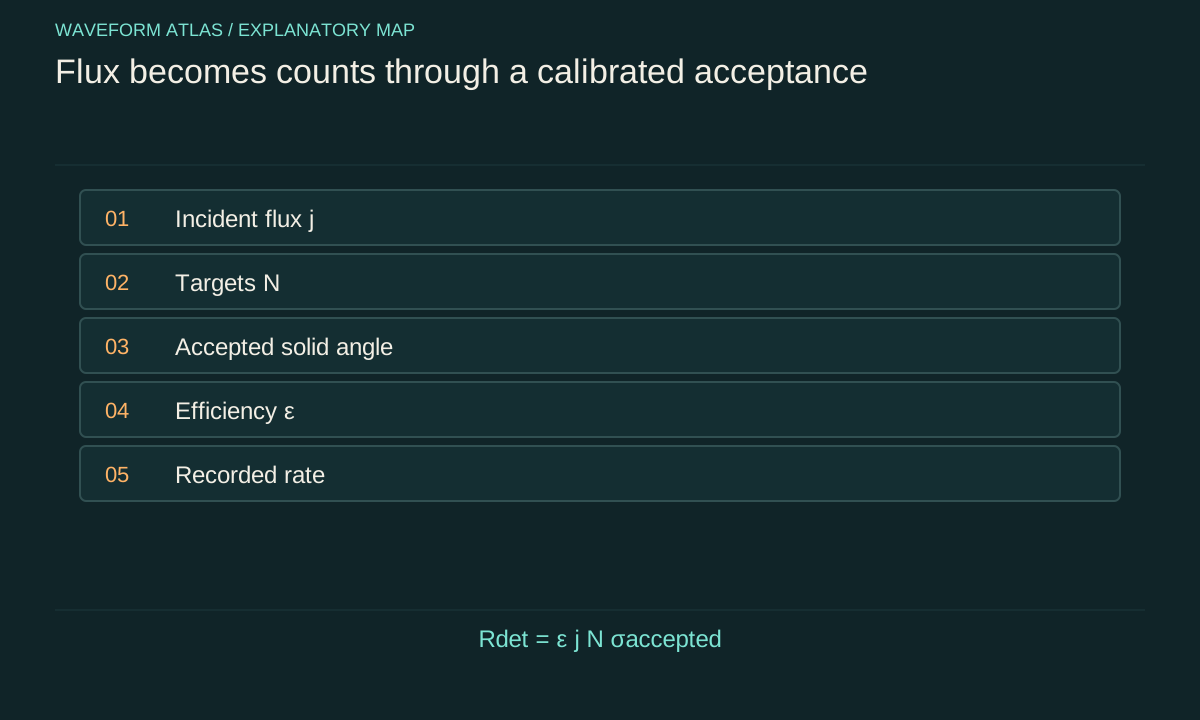
An area that predicts an event rate
Imagine a dilute beam crossing a thin target. The incident flux j counts incoming particles per unit area per unit time. If N independent target particles are illuminated and each has cross section σ for a specified process, the ideal event rate is R = jNσ. The units explain the name: multiplying flux by an area produces a rate for one target. The cross section is an effective interaction measure, not automatically a photograph of the target's size.
This definition requires a specified incident preparation and outcome. Elastic scattering, excitation, absorption and a reaction channel can each have their own cross section. Changing incident energy or polarization can change the result even when the target's geometry stays fixed. In a quantum problem, interference among amplitudes and resonant coupling can make the effective interaction area very different from a simple silhouette. The word area remains useful dimensionally, but the dynamics determine its value.
Differential cross sections retain direction
The total cross section sums over the outgoing directions included in the process. The differential cross section dσ/dΩ describes how that effective area is distributed over solid angle Ω. Integrating it over a detector's acceptance gives the cross section sampled by that detector, before accounting for efficiency. Integrating over all relevant directions gives the total for the specified channel.
For a detector that sees only a narrow cone, the measured count rate should not be divided by the full sphere's solid angle unless the scattering is known to be isotropic. Strongly forward-directed scattering makes that shortcut particularly misleading. The acceptance can also depend on energy and polarization. A careful analysis uses the actual response function, perhaps integrating a model over each detector element. This is why two instruments can report different raw rates for the same target while remaining consistent after the same physical cross section is folded through their different geometries.
A worked counting example
Suppose a toy experiment has incident flux 2 × 10⁸ particles per square metre per second and N = 5 × 10⁶ independent targets in the illuminated volume. A selected angular channel has integrated cross section 3 × 10⁻¹⁴ square metres per target. The ideal rate is then 30 events per second. If the detection efficiency for that channel is 0.60, the expected recorded signal is 18 counts per second before background.
Over 100 seconds, the expected signal count is 1,800. A background of 200 counts must be measured and subtracted with its own uncertainty. Dividing the background-subtracted rate by jN without correcting the efficiency would underestimate the channel cross section by forty percent. The chosen numbers are illustrative and deliberately independent of a particular apparatus. They demonstrate a general point: calibration factors can be as important as the event count. A precise integer count does not imply a precise physical cross section when target number or beam flux is poorly known.
Thin-target assumptions can fail
The simple rate law assumes that one target particle's encounter does not significantly alter the beam reaching another. In a thick medium, attenuation and repeated scattering change the local incident flux. Targets may be shadowed by upstream interactions, while particles redirected once can scatter again into the detector. Counting every detected event as a single independent encounter can then bias the inferred cross section.
For a uniform dilute medium, an elementary model introduces number density n and mean free path ℓ = 1/(nσ). The dimensionless optical depth over thickness L is τ = nσL. When τ is much smaller than one, single-scattering reasoning is often a useful starting point. As τ grows, transport and multiple-event probabilities become important. The model still requires independent scatterers and an appropriate definition of σ. Correlated structures, coherent propagation and strong near-field coupling can invalidate a naive application even when the sample appears physically thin.
A resonance can enlarge the effective response
A target can respond especially strongly when the incoming energy matches an available resonant process. The resulting cross section is controlled by coupling strengths, linewidths and allowed channels as well as geometry. A resonant optical element can interact with a beam over an effective area that is not equal to its material cross section. This does not imply energy creation: the increased response draws from the incident field and redistributes or dissipates that energy.
The useful measurement is a spectrum rather than one isolated value. Determine how the interaction rate changes with incident frequency or energy, and compare the observed line shape with the instrument response. A narrow resonance can be broadened by target motion, environmental variation or limited source coherence. Avoid interpreting every width as an intrinsic lifetime. If several channels compete, their branching fractions also matter. A large total interaction cross section does not guarantee a large cross section for the particular output an application needs.
Uncertainty belongs in every factor
The inferred cross section depends on flux, target number, acceptance, efficiency and background subtraction. Each factor can have statistical and systematic uncertainty. Increasing the acquisition time reduces counting noise but does not automatically repair a miscalibrated detector or an uncertain target concentration. Correlations among calibration factors also matter: treating shared errors as independent can either exaggerate or understate the final uncertainty.
For a simple product-and-quotient estimate with small independent uncertainties, relative variances approximately add. That approximation is useful for planning, but a low-count experiment or a large background may require a more careful likelihood model. State the estimator and the confidence or uncertainty convention rather than presenting an unexplained plus-minus number. Repeat calibration measurements across the parameter range where the cross section is claimed. A detector calibrated at one wavelength cannot be assumed to have the same efficiency across a broad spectrum without supporting characterization.
Cross section and probability are related but distinct
A cross section is not itself a probability because it carries units. A probability emerges when it is combined with a target density and path length or a specified overlap geometry. In the independent-event attenuation model, the probability of no interaction through thickness L is exp(−nσL). The probability of at least one interaction is one minus that quantity. For small optical depth, it is approximately nσL.
Confusing these quantities can produce impossible results. A cross section larger than a target's geometric area is not automatically a probability above one. Conversely, extending the thin-target approximation P ≈ nσL into a regime where nσL exceeds one is mathematically inappropriate. The exponential model remains bounded, although its physical assumptions may still need scrutiny. Keeping dimensions visible is an efficient error check. It also helps readers transfer a reported cross section into their own apparatus without assuming that an event rate from one beam or sample automatically applies to another.
Make the reported number portable
A useful cross-section result includes the incident species or field, energy distribution, target state, reference frame when relevant, channel definition and angular integration range. It states how flux and target number were determined, which efficiency corrections were applied and whether multiple scattering was modeled. Raw counts and acquisition times help others examine the statistical part of the result.
The next measurement should challenge the dominant assumption. Vary thickness to check the thin-target regime, change acceptance to test the angular model, or compare a reference interaction with a known response. If the inferred cross section changes unexpectedly with these controls, the discrepancy may reveal useful physics or an incomplete calibration. Either outcome is more informative than treating σ as a fixed material label detached from preparation and measurement. A cross section earns its value by connecting a specified interaction to a reproducible rate under clearly stated conditions.
A cross section is not an area seen in a photograph
A useful consistency check compares the predicted scattering probability with the thin-target assumption. For a target containing an areal density η of independent scatterers, the single-pass probability is approximately ησ only when that product is much smaller than one. If the product becomes appreciable, upstream scatterers attenuate the beam reaching downstream ones; simply multiplying the unattenuated flux by every target particle overestimates the signal.
In a basic independent-event model the probability of at least one event becomes 1 − exp(−ησ). For ησ = 0.02, this gives approximately 0.01980, close to the linear estimate 0.02. At ησ = 2, the exact model probability is about 0.8647, while the linear expression incorrectly predicts two events per incident particle if interpreted as a probability. A mean event count and the probability of any event are different quantities.
Coherent correlations and dependent scattering can invalidate even the exponential model. The relevant cross section may also vary across a beam's energy distribution. An instrument then measures a flux-weighted average unless it resolves energy. Reporting a single fitted value without these qualifications can conceal both energy dependence and target effects. The dimensional unit remains area, but its physical meaning is a precisely specified interaction probability per incident flux, not necessarily the projected silhouette of an object.
What to take forward
- A cross section has units of area and depends on the selected process.
- Detector acceptance and efficiency must be removed from raw rates.
- Thickness scans test whether a single-scattering interpretation is valid.
Go to the original work.
These links identify the sources behind specific claims. Verification scope varies by source and is stated below.
- 1 / University teachingQuantum Physics III: Scattering and Identical Particles ↗
Scattering states, differential cross sections, phase shifts and their assumptions.
Verification scope: MIT course page and lecture topic descriptions inspected; this is a teaching reference, not a new experiment.
- 2 / University teachingOpenStax University Physics Volume 1: Collisions in Multiple Dimensions ↗
Vector momentum conservation and reconstruction in multiple dimensions.
Verification scope: Open textbook section inspected; examples in this article are original.
Found a problem with a claim or calculation? Send the page, the claim and the evidence. Read how these articles were prepared.