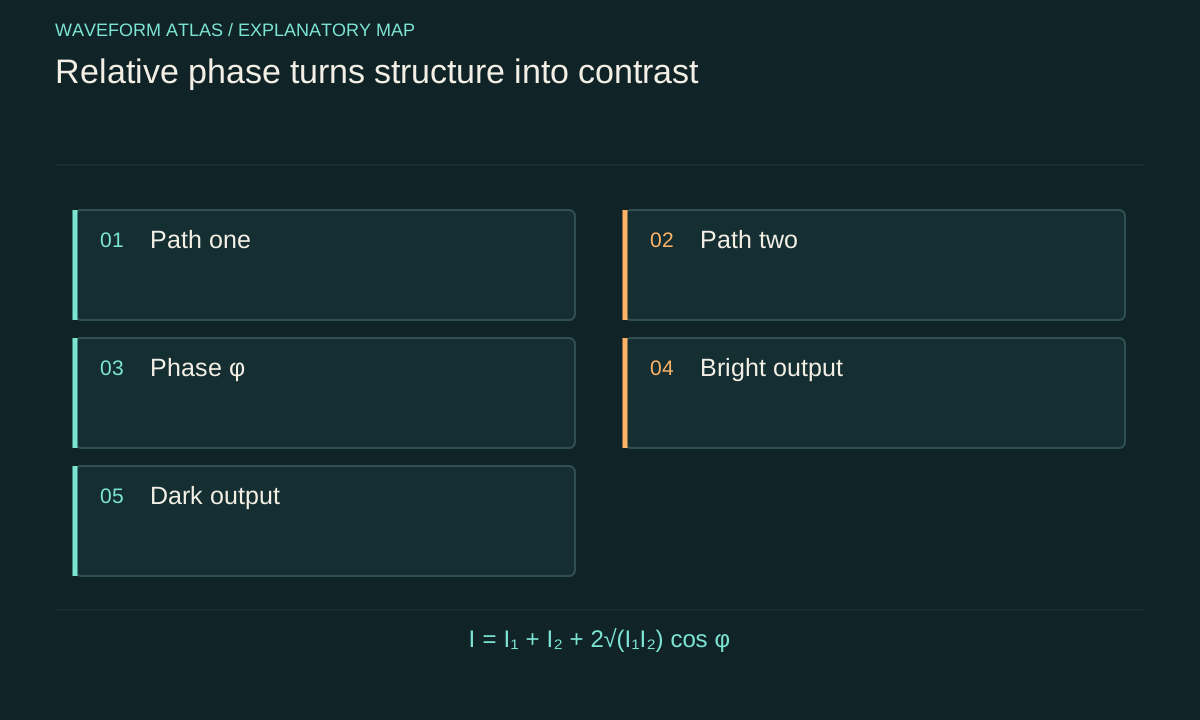
Begin with amplitudes, then calculate intensity
Two scattered fields that reach the same detector do not generally contribute independent intensities. Their complex amplitudes add first. If the fields are E₁ and E₂, the detected intensity is proportional to |E₁ + E₂|². Expanding this expression produces the separate intensities and a cross term that depends on their relative phase. That cross term is the part that makes coherent scattering sensitive to arrangement and path differences.
The rule applies only to contributions that the measurement can combine coherently. Distinguishable frequencies averaged for a long time, orthogonal polarizations at an insensitive detector, or fluctuating relative phases can suppress the observed cross term. Calling a source coherent is therefore not enough. Specify the temporal and spatial separations being compared and the duration of the measurement. Coherence is a relationship between field samples under stated conditions, not a permanent badge that makes all possible paths interfere in every apparatus.
A stable phase produces a repeatable fringe
For equal intensities I₀ and a relative phase φ, the combined intensity is 2I₀(1 + cos φ). It ranges from zero to 4I₀ as φ changes. The peak exceeds the sum of the separate intensities at that one point because the full interference pattern redistributes energy. A complete accounting includes other positions or output ports and the source's interaction with the optical arrangement.
Choose three illustrative phases: zero, π/2 and π. The corresponding point intensities are 4I₀, 2I₀ and zero. This elementary calculation provides a useful detector test. Move a controlled phase element and ask whether the output follows the predicted variation. A single dark reading can have several causes, including a blocked path or detector failure. A reproducible phase-dependent modulation is much stronger evidence that the contributions remain mutually coherent. It also provides a direct way to quantify contrast rather than classifying a pattern by eye.
Visibility separates contrast from total brightness
For a measured fringe, visibility is V = (Imax − Imin)/(Imax + Imin), after appropriate treatment of background. Equal perfectly coherent contributions can reach unit visibility in an ideal detector. Unequal intensities reduce the maximum possible visibility even if their mutual coherence is perfect. For intensities I₁ and I₂, the ideal maximum is 2√(I₁I₂)/(I₁ + I₂).
If one contribution is four times the other, this upper limit is 4/5, or 0.80. A visibility of 0.80 in that setup does not by itself indicate environmental decoherence. It can follow entirely from unequal amplitudes. Conversely, a bright fringe is not necessarily a high-visibility fringe if a large background raises both maximum and minimum. Report input balance, background and detector response with the contrast. This keeps a useful quantitative observable from becoming an ambiguous shorthand for all aspects of coherence.
Structure appears in relative phases
For an array of scatterers, the total amplitude includes a sum of phase factors associated with their positions. In a simple equal-scatterer approximation, that sum has the form Σj exp(iq·rj). The wavevector transfer q selects which spatial arrangements add constructively in a particular direction. The resulting angular intensity can therefore encode separations and symmetry.
The individual scatterer's response still matters. A structural interference factor does not remove the material envelope, polarization dependence or possible repeated interactions. This is why a measured diffraction-like feature cannot be interpreted solely from its spacing without checking the scattering regime. A controlled change of wavelength or orientation helps distinguish geometry from a material resonance. If an inferred spacing predicts the movement of several features across those controls, the structural interpretation becomes more persuasive than a fit to one isolated pattern. The result remains conditional on the model used to connect arrangement with amplitude.
Speckle can be coherent rather than featureless noise
A rough surface or disordered sample can produce a mottled speckle pattern. Many paths arrive with different phases, and their sum varies sharply across position. The pattern looks irregular, but it can be reproducible for a fixed sample, illumination and detector geometry. A deterministic complex field can therefore look visually random. Random appearance alone is not evidence that phase information has been destroyed.
Change the wavelength slightly or move the sample and the relative phases change, often producing a different pattern. This sensitivity can be useful for sensing, but it also makes calibration demanding. A speckle image recorded after the sample moved may no longer describe the transformation relevant to the next measurement. When reporting a recovery or imaging result, state the time interval over which the medium was stable. That practical timescale can determine whether a mathematically reversible model leads to useful experimental control.
Averaging removes a cross term in a specific way
Suppose the relative phase fluctuates between repeated measurements. The averaged intensity contains the average of exp(iφ), not simply the phase evaluated at its mean. A broad distribution of phases can drive that complex average toward zero. Each shot may show coherent addition, while the combined record loses fringe contrast. This distinction between a realization and an ensemble is central to interpreting phase scrambling.
An illustrative Gaussian phase distribution with variance s² gives |⟨exp(iφ)⟩| = exp(−s²/2). A phase standard deviation of one radian yields a coherence factor about 0.607 in that model. The relation assumes Gaussian fluctuations and suitable averaging; it is not a universal conversion between noise and decoherence. Measure the phase statistics or compare different exposure durations before using it. If a fast detector reveals moving fringes that a slow detector averages away, the two instruments are describing different temporal resolutions of the same evolving field.
An environment may retain distinguishing information
Quantum coherent scattering requires attention to the target and environment as well as the detected particle. Two projectile paths can become correlated with different target states. If those states are ignored, the projectile's reduced interference term is weighted by their overlap. A distinguishable target record can therefore suppress local interference even if the combined state evolves coherently.
This is different from a fixed phase offset that can be calibrated and reversed. It is also different from simple loss of particles from the detected ensemble. An experiment should determine whether contrast changes are accompanied by changes in transmitted count, target excitation or uncontrolled environmental coupling. A visibility curve without those supporting measurements can leave several explanations open. The distinction is especially important when using scattered particles to infer which path a quantum object followed. The information available in principle and the information actually extracted by a detector are related but not identical questions.
Coherent control shows what remained accessible
Wavefront shaping offers an operational test of useful phase structure. Adjust the input phases and observe whether a chosen output changes reproducibly. If contributions can be aligned at a target position, the experiment demonstrates controllable coherence across the addressed channels. Vellekoop and Mosk's reported optical focusing through a scattering sample is an important example of this principle.
The result should be evaluated with the available input power, number of controlled modes, sample stability and reference output. Concentrating transmitted light into a focus is not equivalent to reversing every path or recovering all information. Uncontrolled channels and absorption remain outside the correction. A strong report compares the controlled output with a clearly defined baseline and measures performance on data not used for calibration. Those checks establish what the procedure accomplished physically, rather than allowing the dramatic appearance of a bright focus to stand in for a complete transfer measurement.
Choose a coherence test that answers the question
For a two-path experiment, scan a controlled phase and measure visibility with input balance and background calibrated. For a structured target, vary wavelength and orientation to test predicted interference features. For a disordered medium, characterize the stability of the complex transformation and demonstrate repeatable response to input-phase changes. These measurements address different kinds of accessible coherence.
The essential discipline is to keep the observable and the inference together. A stable intensity pattern is weaker evidence than a phase-sensitive response. A successful correction proves control over the measured channels, not the absence of every unobserved interaction. A lost fringe may reflect phase noise, unequal amplitudes, target records or finite resolution. Once those alternatives are separated, coherent scattering becomes a precise tool for examining geometry and information. It shows how a wave can be strongly redirected while retaining relations that a suitable experiment can still use.
Phase scans distinguish coherence from a bright point
A single bright output spot is not sufficient evidence of interference between two specified paths. Either path alone may already concentrate energy there. A controlled phase scan supplies the stronger test: block each path in turn to measure its intensity, reopen both, and vary their relative phase without changing their amplitudes. The oscillating cross term can then be compared with the separately measured baseline.
Drift during that scan is a systematic error. If one path slowly dims while the phase is swept, an apparent fringe can combine interference with source variation. Alternating phase settings, monitoring incident power and repeating the scan in both directions help expose this coupling. The resulting visibility still belongs to the selected polarization, bandwidth, spatial mode and observation time; it should not be assigned indiscriminately to every component of the outgoing field.
What to take forward
- Add amplitudes before intensities when paths remain mutually coherent.
- Unequal brightness can limit visibility without destroying coherence.
- Phase-sensitive control distinguishes stable structure from a merely bright pattern.
Go to the original work.
These links identify the sources behind specific claims. Verification scope varies by source and is stated below.
- 1 / University teachingQuantum Physics III: Scattering and Identical Particles ↗
Scattering states, differential cross sections, phase shifts and their assumptions.
Verification scope: MIT course page and lecture topic descriptions inspected; this is a teaching reference, not a new experiment.
- 2 / Primary experimentVellekoop and Mosk, Focusing coherent light through opaque strongly scattering media ↗
The reported control of incident wavefronts to focus transmitted multiply scattered light.
Verification scope: University author-repository abstract and publication metadata inspected; no claim of a full-paper methods audit.
- 3 / Primary experimentHornberger et al., Collisional Decoherence Observed in Matter Wave Interferometry ↗
Pressure-dependent loss of fullerene interference attributed to background-gas collisions.
Verification scope: Publisher abstract and bibliographic record inspected; no new numerical bound is inferred.
Found a problem with a claim or calculation? Send the page, the claim and the evidence. Read how these articles were prepared.