Start from the claim the instrument can support
A detector behind a sample measures less power after the sample is inserted. That observation establishes reduced power in the detector's accepted channel. It does not yet establish absorption. Light may have been reflected, scattered sideways, shifted outside the detector's spectral response or redirected into a different polarization. The experiment should be designed to separate the alternatives that matter for the claim.
Begin with a defined system boundary and a list of possible outputs. For an optical sample, the list may include forward transmission, diffuse transmission, reflection, side scattering and material heating. For an acoustic sample, it may include transmitted pressure waves, reflected waves, structural vibration and dissipation. The detector choices follow from this list. An experiment that measures only one output can still be useful, but its conclusion must remain a statement about that channel rather than the fate of all incident energy.
Establish an incident reference
Measure the incoming power or flux with the same source settings used for the sample measurement. A monitor channel can track drift during acquisition. Check detector linearity across the signal range and record dark or background readings with the source blocked. If the source has a broad spectrum, characterize the spectral distribution rather than assuming a single nominal wavelength represents every photon or mode.
The reference plane matters. Power measured before a lossy mount or window differs from power that actually reaches the sample. Include those elements in the baseline or characterize them separately. Alignment changes during sample insertion can also alter the detected beam. A blank holder measured in the same mechanical configuration is often more informative than an unobstructed source measurement alone. These controls are ordinary metrology, but they can determine whether a small apparent loss is a property of the material or an artifact of how the sample was introduced.
Collect the directions that a forward detector misses
Add angular detectors, a scanning detector or a calibrated collection system to measure redistributed power. Document the solid angle covered and the regions blocked by mounts, ports or the incident beam. A collection system with a large acceptance is not automatically complete. Its response can vary with wavelength, polarization and the point at which scattered light enters.
An integrating sphere is one possible optical instrument for collecting diffuse radiation, but its use still requires calibration and an appropriate sample geometry. Do not treat the word integrating as proof that every outgoing channel was measured. Specular reflection can escape through a port, and fluorescence or thermal emission can fall outside the calibrated band. The measurement plan should state which outputs are counted as transmitted, reflected or converted. That definition allows another laboratory to reproduce the energy account instead of comparing numbers that integrate different parts of the physical process.
Use a numerical ledger with an uncertainty line
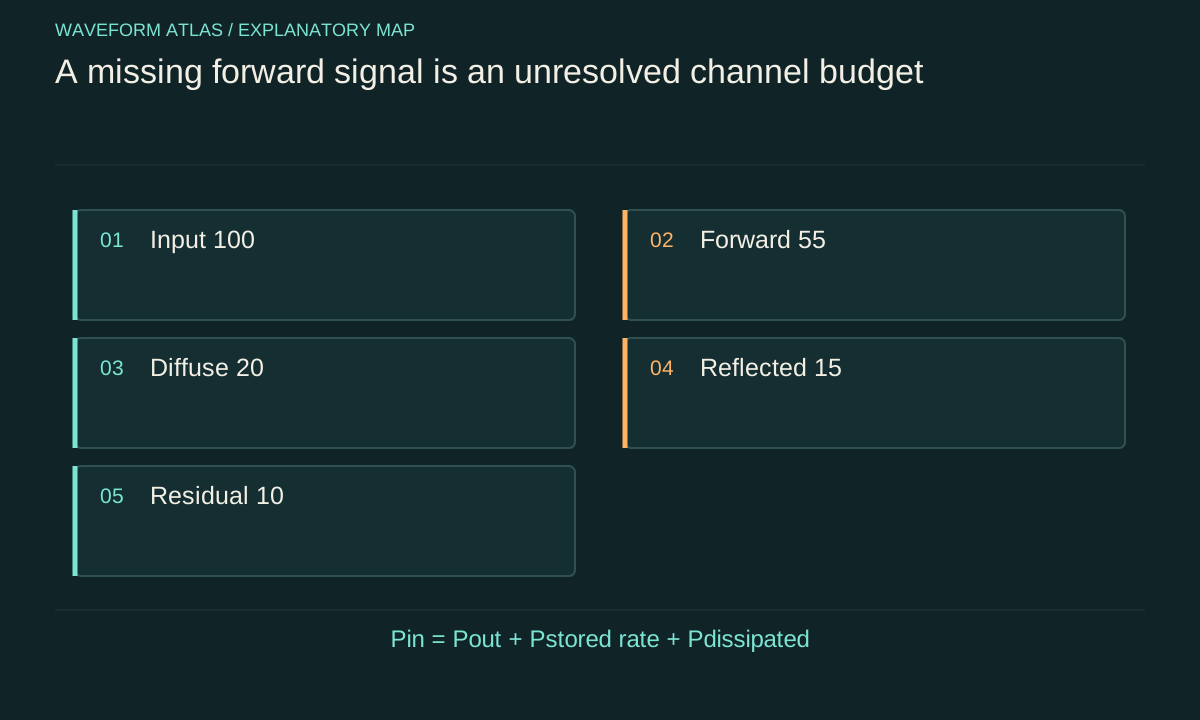
Consider an illustrative steady-state optical experiment with 100 units of incident power. Suppose calibrated measurements find 55 units of forward transmission, 20 of diffuse transmission and 15 of reflection. The measured optical outputs sum to 90. The remaining 10 units are a residual, not automatically a proven absorption value. Uncovered angles, spectral conversion, detector uncertainty and material storage can all affect the interpretation.
If an independent thermal measurement and a complete optical model support 8 units of dissipation with a 3-unit uncertainty, the experiment can test whether the residual is consistent with absorption. It should not claim a precise ten-percent value simply by subtracting three uncertain channels from 100. Correlated calibration errors must also be considered. For example, a shared incident-power calibration affects several normalized outputs together. Writing the ledger explicitly makes the missing information visible and prevents a narrow measurement from being promoted into a stronger physical conclusion than the data support.
Time resolution can expose hidden storage
A pulsed experiment can distinguish prompt outputs from delayed release. Energy temporarily stored in a resonant mode may emerge after the direct pulse has passed. A detector gate that closes too early can misclassify that delayed energy as permanent loss. Conversely, a long integration can combine a desired coherent output with unrelated delayed luminescence or background.
Choose the acquisition window from the possible response times and demonstrate that extending it no longer changes the relevant integral within uncertainty. Monitor the sample between pulses if heating or metastable excitation could accumulate. A steady-state input does not eliminate storage questions during startup or shutdown. For a resonant structure, recording both turn-on and ringdown can help separate coupling, storage and dissipation. The correct time window depends on the claim: an application may care about energy arriving within a communication slot even when later energy is physically conserved elsewhere.
Spectrum and polarization identify converted channels
If the sample changes frequency or polarization, a detector calibrated only for the incident state can miss part of the output. Measure a spectrum when inelastic scattering, fluorescence or modulation is plausible. Add polarization analysis when the material is anisotropic or the geometry can rotate the field. These measurements can reveal a change of mode that would otherwise look like simple attenuation.
Keep conversion separate from a claim of lossless performance. A frequency-converted output may require energy from an external pump, and a polarization change can occur alongside absorption. The full account includes the pump and any other controlled energy source. Report the measured conversion efficiency with its definition: photon-number conversion, optical power ratio and useful receiver power are different quantities. A transparent definition allows the same experiment to inform both basic physics and engineering decisions without hiding an energy contribution in the normalization.
Coherence needs an additional observable
Collecting nearly all outgoing power does not establish that a desired phase relation survived. An intensity-based energy ledger and a coherence test answer different questions. If the claim involves reversible wavefront control or preserved quantum interference, add an appropriate reference, recombination measurement or correlation benchmark. The energy balance alone cannot distinguish a stable scrambled field from an ensemble with fluctuating phases.
Conversely, a surviving high-visibility interference pattern in a selected output does not prove that no energy was lost elsewhere. A postselected subset can remain coherent while throughput decreases substantially. Record both visibility and accepted count or power. The resulting two-dimensional assessment is more useful than a single success label. It tells an engineer whether the system preserves useful phase relations, transmits enough signal, or trades one property for the other. It also prevents a conventional loss mechanism from being confused with a fundamental change in quantum dynamics.
Build controls that target the likely artifacts
Measure the empty holder, a reference sample and repeated insertions of the same sample. Rotate the sample while monitoring whether the apparent effect follows the material or the apparatus. Vary detector aperture to test whether forward redistribution is being mistaken for absorption. Change the acquisition duration to look for delayed output. These controls should be selected from the physical alternatives, not added as an arbitrary checklist after a surprising result appears.
Randomizing the order of settings can reduce confusion with slow drift. Record temperature, source power and alignment indicators with the primary data. A modest discrepancy may be explained by one of these measured variables; an unexplained discrepancy should remain explicitly unexplained rather than immediately named as a new mechanism. A good control is one whose possible outcomes would change the interpretation. Repeating the same insufficient observation more times improves precision but does not resolve a missing channel.
Report the residual without overclaiming
Present the measured inputs and outputs, calibration uncertainty, angular and spectral coverage, time window and any model used to infer unmeasured components. Distinguish directly measured absorption from an absorption estimate obtained by subtraction. If the latter is used, show why the neglected channels are smaller than the claimed uncertainty. Preserve the raw data needed to revise that account when new information becomes available.
The next step follows from the largest unresolved contribution. Add angular coverage if side scattering dominates the uncertainty, extend the time window if storage is plausible, or improve spectral calibration if conversion is suspected. This approach makes a simple beam experiment scientifically valuable. It turns the disappearance of a familiar pattern into a quantitative map of where the excitation went, and it makes clear which additional observation would support a stronger conclusion.
Use uncertainty to decide whether the ledger closes
Energy-balance terms often share calibration errors. If every optical channel is normalized by the same incident-power sensor, uncertainty in that sensor moves several fractions together. Adding all quoted percentage errors as if they were independent can therefore give an incorrect uncertainty for the residual. Preserve the shared calibration factor or include its covariance when propagating errors.
A residual consistent with zero within uncertainty is evidence that the measured channels account for the input at the stated precision. It does not prove that every microscopic pathway has been identified. Conversely, a positive residual may be scientifically useful without establishing absorption: it identifies where additional angular coverage, longer recording or thermal measurements would most improve the experiment. The next measurement should be selected by that uncertainty budget, rather than by the most dramatic interpretation of the missing signal.
What to take forward
- A forward detector measures removal from its accepted channel.
- Angular, spectral and timing coverage determine the energy-accounting claim.
- Report an unresolved residual until measurements or a validated model explain it.
Go to the original work.
These links identify the sources behind specific claims. Verification scope varies by source and is stated below.
- 1 / University teachingQuantum Physics III: Scattering and Identical Particles ↗
Quantum Physics III: Scattering and Identical Particles.
Scattering states, differential cross sections, phase shifts and their assumptions.
Verification scope: MIT course page and lecture topic descriptions inspected; this is a teaching reference, not a new experiment.
- 2 / Primary researchFocusing coherent light through opaque strongly scattering media ↗
I. M. Vellekoop; A. P. Mosk. Optics Letters 32(16), 2309–2311 (2007).
Experiment demonstrating coherent focusing through multiple scattering by control of the incident wavefront.
Verification scope: Author-institution record and abstract inspected
- 3 / University teachingMIT Physics III: Vibrations and Waves ↗
Yen-Jie Lee. MIT Physics III: Vibrations and Waves. 2016.
Wave equations, interfaces, optics and propagation in media.
Verification scope: MIT course outline inspected; article derivations are independent textbook-level explanations.
- 4 / Primary researchMeasurement of Absorption and Scattering With an Integrating Sphere Detector: Application to Microalgae ↗
A. K. Gaigalas; H.-J. He; L. Wang. Journal of Research of the National Institute of Standards and Technology 114(2), 69–81 (2009).
Two collection geometries separate scattering from molecular absorption, with finite angular collection and systematic-bias limitations.
Verification scope: Title page and relevant measurement-model/results passages inspected; not all numerical data reanalyzed.
Found a problem with a claim or calculation? Send the page, the claim and the evidence. Read how these articles were prepared.