Binding measures the cost of taking a nucleus apart
A bound nucleus has less rest energy than the collection of separated protons and neutrons from which it can be assembled. The binding energy is the energy required to reverse that assembly under a stated convention, leaving the separated constituents at rest and far enough apart that their mutual interactions no longer contribute appreciably.
This definition is easy to confuse with a stockpile of usable energy. A stable nucleus does not release its entire binding energy just because it is present in a device. Extracting energy requires a transition to an allowed final state with a lower total energy. The transition may involve combining nuclei, breaking a nucleus apart, changing nuclear species or emitting radiation, depending on the starting system.
It is also important to distinguish nuclear binding from the electronic binding that holds atoms and molecules together. The particles being bound, characteristic length scales and available states are different. Both obey energy conservation, but a measurement of chemical heat does not identify a nuclear transition. A calculation should name which constituents and which energy levels are included before attaching a numerical value.
Write the reaction before subtracting masses
For a reaction with several inputs and outputs, write a balanced particle equation first. Check electric charge and the relevant conserved quantum numbers. At the introductory nuclear level, balancing total nucleon number is often a useful first check, although it is not a substitute for the full conservation analysis in more general particle reactions.
Then sum the rest masses of every incoming particle and subtract the rest masses of every outgoing particle. The difference multiplied by c² is Q. An emitted neutron is not a minor correction that can be omitted because the word fusion suggests a single final nucleus. An omitted product changes the energy account and may make an impossible interpretation look plausible.
There is a bookkeeping choice between atomic masses and nuclear masses. Atomic mass tables include electrons. For reactions where the total number of atomic electrons balances consistently, electron rest masses can cancel in a convenient atomic-mass calculation. If beta particles, ionization changes or unequal electron counts are involved, that cancellation needs explicit treatment. Mixing atomic and bare-nucleus masses without adjustment is a common way to manufacture a misleading Q value.
Read the sign of Q without adding a new law
A positive Q means that the final rest-energy sum is smaller. The difference can appear in kinetic energy, photons or excitation of the products, subject to the permitted channel. A negative Q means the rest-energy sum increases, so the incoming system must provide the difference as well as satisfy momentum conservation.
The word exothermic does not mean easy to initiate. A reaction can have a favorable endpoint energy balance while remaining extremely unlikely because the incoming particles seldom reach the relevant interaction region or because the transition amplitude is small. The difference between an energy ledger and a reaction rate is central to fusion physics.
Conversely, an unfavorable rest-energy change is not automatically impossible at all incident energies. Sufficient kinetic energy can open an endothermic channel. For a projectile striking a stationary target, the required laboratory energy generally exceeds the magnitude of the negative Q because some energy must remain in center-of-mass motion. Threshold calculations therefore need masses and geometry of the initial motion, not only an endpoint energy difference. This is one reason that a reaction table is more useful than a slogan about light and heavy elements.
A numerical example with transparent rounding
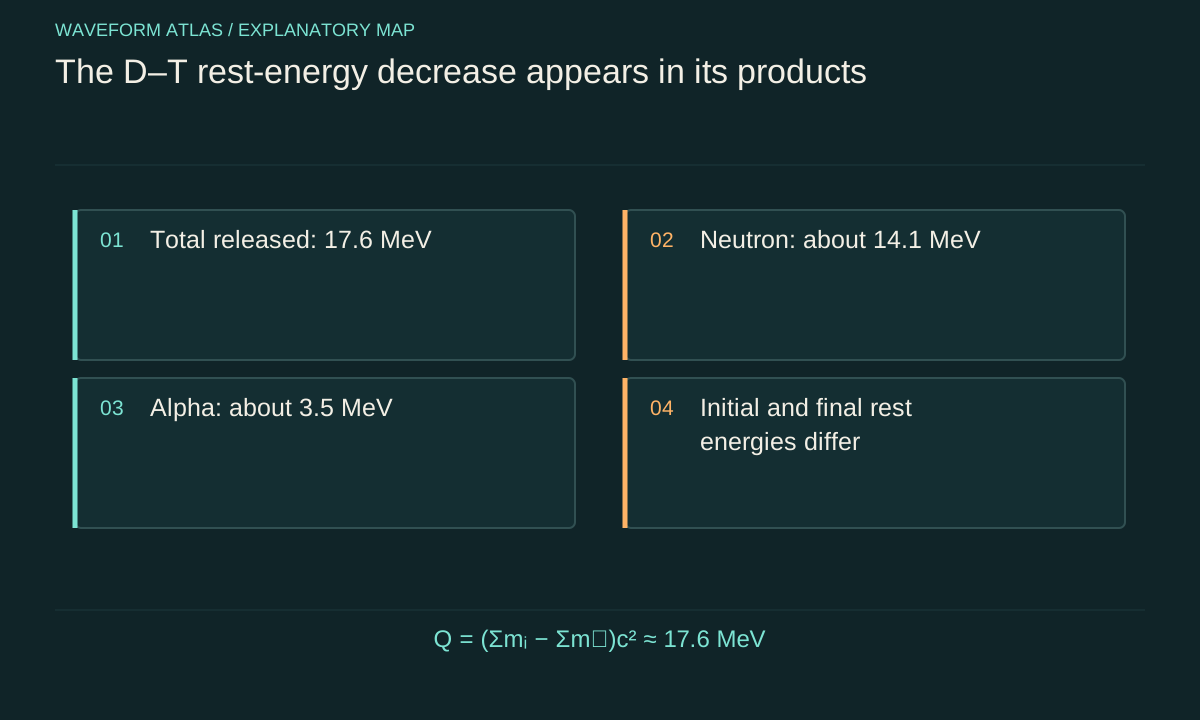
For the common D–T channel, a rounded release of 17.6 MeV corresponds to 17.6 × 10⁶ electronvolts. Using the exact electronvolt-to-joule conversion gives approximately 2.82 × 10⁻¹² J per reaction. This is a small amount for an individual event but a large amount compared with typical energy changes per particle in ordinary chemical processes.
The corresponding rest-mass decrease is Q/c², about 3.14 × 10⁻²⁹ kg. Expressed in atomic mass units, it is approximately 0.0189 u. These numbers are calculated here from the rounded reaction energy, so their displayed precision should not be mistaken for a new measurement or an evaluated mass-table result.
Suppose a calibrated diagnostic implied 10¹² reactions during a pulse. Multiplying by the same per-reaction energy would give about 2.82 J of total fusion yield. If the apparatus consumed much more energy while preparing the pulse, the reaction yield could still be real while the whole experiment remained a net energy consumer. A clear calculation keeps those two statements compatible rather than forcing one to stand in for the other.
Why the broad binding curve is not a reaction table
Binding energy per nucleon divides a nucleus's total binding energy by its nucleon count. The familiar broad trend rises from very light nuclei toward the iron–nickel region and then changes more gradually for heavier nuclei. That trend helps explain why some combinations of light nuclei and some splits of heavy nuclei can release energy.
However, an average per-nucleon value does not identify a specific reaction channel. Isotopes with the same element name can have different nuclear masses, spins and allowed decays. The products may include neutrons, protons, gamma rays or excited states. A reaction that looks promising on a schematic curve can have an unfavorable Q for the actual products being proposed.
A careful graphic therefore distinguishes a contextual trend from a calculation. If the chart is qualitative, it should not display invented isotope values. If it displays measured masses or evaluated binding energies, it should cite the data source and identify the isotope set. For a research decision, the key quantity is the difference between complete specified states. The curve gives a useful map of the landscape, but the balanced reaction determines the route.
Product motion carries the released energy
Consider an ideal two-body final state in its center-of-mass frame. The momenta are equal in magnitude and opposite in direction. At nonrelativistic speeds, the kinetic energies are p²/(2m₁) and p²/(2m₂), so their ratio is m₂/m₁. The lighter product receives the larger kinetic-energy share even though both products have the same momentum magnitude.
For the D–T example, this produces the well-known approximate division of 14.1 MeV to the neutron and 3.5 MeV to the alpha particle. These rounded values are adequate for explaining the energy channels. A precise diagnostic model needs the incident-energy distribution, reaction kinematics, instrument resolution and any relevant relativistic corrections.
The division matters operationally. Charged products can exchange energy with a plasma and respond to electromagnetic fields; neutrons require different detection and energy-capture arrangements. Counting only one channel without a calibrated conversion can underestimate or misinterpret the total yield. Likewise, depositing some product energy in a surrounding material does not establish the efficiency with which that heat could ultimately become useful electricity. Each conversion step has its own boundary and losses.
Uncertainty enters before the final multiplication
A calculated Q value can be very precise when evaluated rest masses are accurately known. An experimentally inferred energy yield can be much less certain because it depends on detector response, calibration, geometry, backgrounds and the number of events. These are separate uncertainty problems and should not be merged into a single impressive-looking number.
For an illustrative count-based estimate, let the detected signal be S and the efficiency be ε. A simplified reaction-count estimate is N = S/ε after appropriate background subtraction. If independent relative uncertainties in S and ε are five and ten percent, the combined relative uncertainty is approximately the square root of 0.05² + 0.10², or 11.2 percent. Correlated errors require a different covariance calculation.
Multiplying N by Q does not remove that uncertainty. Nor does a high-precision value of the electronvolt conversion compensate for an uncertain efficiency. Reporting many digits after an uncalibrated measurement creates apparent precision without information. A useful ledger records the measured quantity, the model connecting it to reaction count, and the uncertainty of each conversion. This gives readers enough structure to reproduce the inference or challenge its weakest assumption.
Use the ledger to ask the next question
Once the energy balance is explicit, several productive questions become available. Is the proposed channel allowed? Is its Q positive? What must the detector collect? How many reactions are needed for the claimed yield? Does the reaction rate make that count plausible during the stated observation window? Which inputs and losses remain outside the quoted boundary?
These questions prevent two opposite mistakes. A real small nuclear yield should not be dismissed merely because it does not power the apparatus. Equally, a favorable per-reaction energy should not be advertised as evidence that a system already produces net useful energy. The physics result and the engineering result can be evaluated separately and then connected through an honest system model.
The December 2022 NIF example is useful precisely because its reported comparison specifies laser energy delivered to a target and fusion energy released. It demonstrates a particular target-gain result; it does not erase the rest of the facility's energy ledger. That way of naming boundaries is transferable to any fusion claim, from a published laboratory experiment to an early concept that has not yet produced a measurable reaction signature.
What to take forward
- Calculate Q from the full balanced reaction, including every outgoing particle.
- Positive reaction energy does not establish a sufficient reaction rate.
- Propagate diagnostic uncertainty separately from precise nuclear mass data.
Go to the original work.
These links identify the sources behind specific claims. Verification scope varies by source and is stated below.
- 1 / University teachingUniversity Physics Volume 3, 10.2: Nuclear Binding Energy ↗
Rest-mass differences, binding energy and the distinction between total binding and binding per nucleon.
Verification scope: Publisher-hosted textbook section and its scope verified.
- 2 / University teachingRichard Fitzpatrick: Nuclear Fusion Reactions ↗
D–T reaction kinematics, product energy partition and distinct charged-particle/neutron energy channels.
Verification scope: University teaching page and displayed equations inspected; broad introductory approximations retained only with explicit limits.
- 3 / Official researchITER: The magic cocktail of deuterium and tritium ↗
ITER: The magic cocktail of deuterium and tritium. https://www.iter.org/node/20687/magic-cocktail-deuterium-and-tritium
The D–T reaction releases approximately 17.6 MeV; the article compares fusion cross sections for different fuels and temperature regimes.
Verification scope: Official ITER explanation inspected; used for total D–T energy and fuel/temperature context, not a derivation of velocity-distribution averaging.
- 4 / Official researchLLNL’s breakthrough ignition experiment highlighted in Physical Review Letters ↗
The 5 December 2022 experiment reported 3.15 MJ fusion yield from 2.05 MJ laser energy delivered to the target; target gain is a defined boundary.
Verification scope: LLNL's dated 6 February 2024 report of its experiment inspected; not treated as current record or wall-plug gain.
- 5 / University teachingChapter 15: Collision Theory ↗
P. Dourmashkin. Classical Mechanics, Chapter 15: Collision Theory. MIT OpenCourseWare 8.01SC, textbook corrected 2022.
Center-of-mass kinetic energy, relative motion, restitution, and elastic, inelastic and superelastic collision limits.
Verification scope: MIT textbook sections 15.2–15.4 and 15.6 inspected; illustrative atlas numbers are independently calculated.
Found a problem with a claim or calculation? Send the page, the claim and the evidence. Read how these articles were prepared.