What the word removes from the inventory
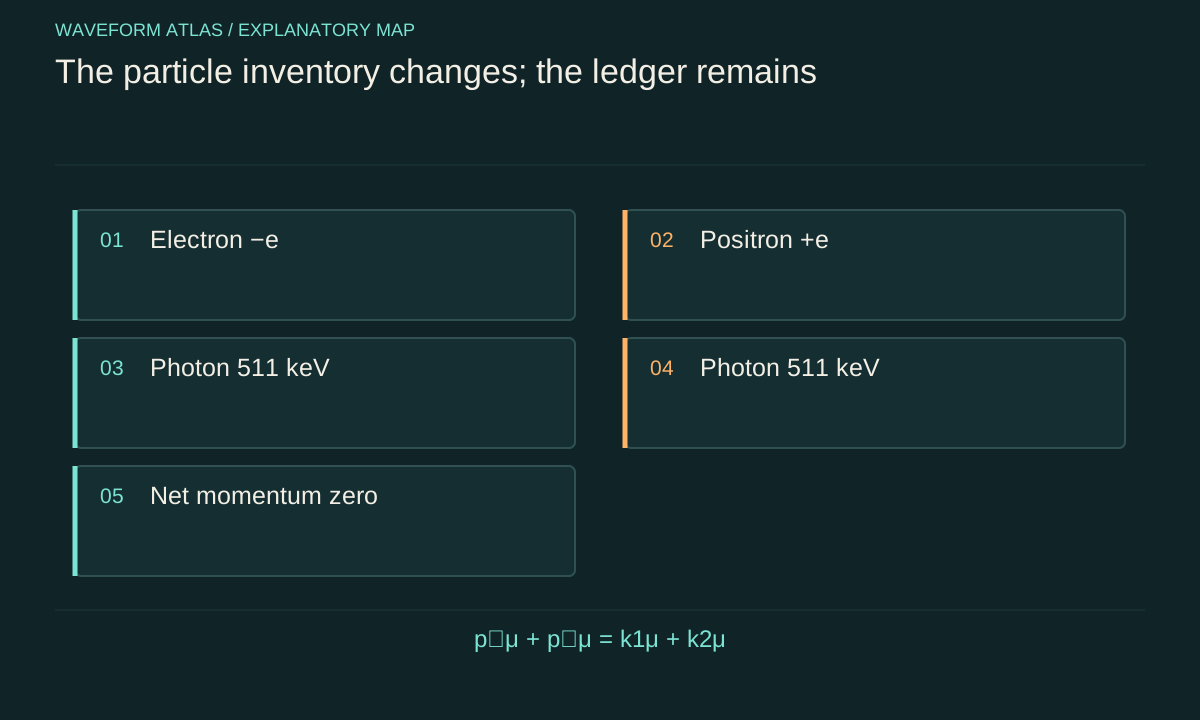
An electron and positron can enter a reaction whose outgoing particles are photons. In that event, the final particle inventory no longer contains the original electron–positron pair. Calling this annihilation is useful shorthand for that change. It is misleading if the word is taken to mean that the entire physical state or its energy has vanished.
The reaction should be written with both sides visible, such as e⁻+e⁺ → γ+γ for a specified two-photon channel. Other channels can occur under different conditions. The arrow represents a transition governed by an interaction, with probabilities and conservation constraints. It is not an instruction to subtract two opposite numbers and replace the whole system with zero. A complete description names the incoming state, the allowed products, and the measurements that identify those products. The label alone does not supply the dynamics.
Antiparticles are not negative-energy particles
A positron has the electron's mass and opposite electric charge. In the physical particle description, both have positive energy. The opposite charge allows the total charge of a pair to be zero, but it does not make their energies cancel. Other particle–antiparticle pairs have corresponding relationships among the relevant quantum numbers.
The distinction is important because informal diagrams sometimes place a plus sign on matter and a minus sign on antimatter without saying which quantity is signed. Electric charge is signed; energy of ordinary incoming particle states is not negated merely because a particle is an antiparticle. An electron at rest contributes approximately 511 kiloelectronvolts of rest energy, and a positron at rest contributes approximately the same amount. Their combined energy is about 1.022 megaelectronvolts before including motion or binding corrections. The products must account for that positive total.
The two-photon example closes the simplest budget
For a free electron–positron pair with negligible kinetic energy in its center-of-momentum frame, a two-photon final state has photons traveling in opposite directions with approximately 511 kiloelectronvolts each. The photon momenta have equal magnitude Eγ/c and cancel as vectors, while their energies add to the initial total.
A single real photon cannot be the only product of this isolated reaction. The initial pair has a timelike total four-momentum with nonzero invariant mass, while one real photon has zero invariant mass. Equivalently, in the pair's center-of-momentum frame the initial momentum is zero, but a photon with nonzero energy necessarily has nonzero momentum. A surrounding body or additional product can change the kinematic possibilities by taking recoil, so the isolated-system assumption belongs in the statement. Conservation is enforced for the complete participating system, not for a convenient subset.
Mass is one form of the energy account
The relation E² = p²c²+m²c⁴ connects a particle's energy, momentum, and invariant mass. A reaction can replace massive incoming particles with massless photons without violating conservation because rest energy becomes outgoing radiation energy. The invariant mass of the complete two-photon system can remain nonzero even though each photon individually has zero rest mass.
For two opposite photons of equal energy Eγ, their total momentum is zero and the system's invariant mass is 2Eγ/c². This is a useful correction to the claim that mass simply disappears. The sum of individual rest masses is not generally conserved in reactions, but total four-momentum is conserved in the isolated laboratory process under discussion. Energy can also appear as kinetic energy of massive products. The bookkeeping should therefore use the full relativistic relation rather than demand that every final particle have the same mass as an incoming one.
Allowed does not mean inevitable
Conservation laws restrict possible final states, but they do not determine every probability. The interaction strength, available phase space, initial spins, relative motion, and quantum amplitudes determine rates and branching fractions. An electron and positron can scatter rather than annihilate, and they can form a temporary bound system under suitable conditions.
At sufficient collision energy, annihilation can produce heavier particle pairs instead of only photons. The familiar two-photon low-energy example is therefore not a universal script for every matter–antimatter encounter. A reaction diagram should state the regime and channel it illustrates. This matters experimentally because selecting a particular final state selects only part of the total event sample. A detector that sees two photons is testing that channel with finite acceptance, not directly counting every possible interaction that occurred in the source region.
Positronium makes the timing distinction concrete
An electron and positron can form positronium, a bound state with atom-like energy levels. Its spin configuration affects its dominant annihilation channels and lifetime. The 2025 Particle Data Group positronium table gives approximate vacuum ground-state lifetimes of 125 picoseconds for the singlet state and 142 nanoseconds for the triplet state, associated predominantly with two- and three-photon decay respectively.
Those very different times show why annihilation should not be described as an unconditional instantaneous event whenever opposite particles are nearby. Formation, internal evolution, and decay are separate stages. Material interactions can alter observed lifetimes and channel populations, so vacuum values cannot be transplanted without qualification into every sample. The bound state's mass also includes binding energy. A precision energy account distinguishes free-pair rest energy from the slightly smaller rest energy of a bound positronium state.
Products provide positive evidence
Annihilation is identified through observed products and their correlations. Energy spectra, coincidence timing, angular relationships, and known source conditions can jointly support a reaction interpretation. Merely failing to detect an incoming particle is weaker evidence because it could have scattered, escaped the acceptance, or fallen below a detector threshold.
For the simple near-rest two-photon case, two approximately opposite detections with energies near 511 kiloelectronvolts are consistent with the expected channel. Real detectors have finite energy and timing resolution, incomplete efficiency, and backgrounds. Scattering before detection can shift measured energy and direction. A strong analysis models those effects and estimates accidental coincidences rather than treating every pair of clicks as one annihilation. More elaborate positronium experiments use correlations in decay products to test specified symmetry properties; those tests depend on a defined observable and apparatus response.
A quantum description includes different particle sectors
Quantum field theory provides a state space containing sectors with different particle content. Interactions can connect an electron–positron sector to photon sectors and other allowed channels. Particle number of a selected species need not remain fixed, while the larger quantum evolution can preserve total probability and the relevant conserved quantities.
A schematic outgoing state can be a superposition over different photon directions, polarizations, and allowed channels. The reaction does not require the universal state to become the zero vector. In fact, the zero vector is not a normalized physical state. A detector record selects information about one observed outcome, and ignoring unobserved products produces a reduced description. Those operations should be distinguished from the reaction dynamics themselves. The formalism accommodates particle conversion without equating it with a fundamental objective-reduction law.
Destructive interference answers a different question
Two coherent fields can interfere so that a selected output port is dark. In a lossless interferometer, energy is redistributed among the available outputs rather than eliminated. The field amplitude at one location can vanish even though the global field state and total energy remain nonzero. No particle–antiparticle reaction is implied by that local cancellation.
Annihilation, by contrast, changes the particle inventory through an interaction and produces a characteristic outgoing state. Both phenomena involve quantum or wave amplitudes at a theoretical level, but that shared mathematical language does not make their mechanisms identical. Even interference between alternative reaction amplitudes affects probabilities of products, not a simple subtraction of positive and negative particle energies. The discriminating measurements differ: an interferometer needs port-resolved power and phase tests, while annihilation needs reaction-product identification and conservation checks.
The useful conclusion is a transformed system
Annihilation establishes that particular incoming excitations can be converted into different outgoing excitations. It provides a vivid example of why particle content and conserved energy are separate ideas. It does not establish absolute nothingness, free energy, a universal disappearance of quantum states, or a solution to the cosmic matter–antimatter asymmetry problem.
A reliable account follows three steps: specify the initial state, calculate or constrain the allowed products, and compare those predictions with calibrated observations. The interpretation remains strongest when the system boundary includes recoil, radiation, and unobserved channels that could matter. A missing track becomes scientifically meaningful when accompanied by the appropriate outgoing evidence. Keeping the products visible turns an evocative word into a precise reaction statement and makes comparisons with damping, interference, decay, and quantum measurement much clearer.
The number of recorded events also depends on the observation window. A short window can miss delayed positronium decay, while a narrow angular window misses products traveling elsewhere. Changing either window can alter the apparent disappearance rate without changing the underlying interaction. A reaction claim should therefore distinguish a physical rate from the acceptance of the apparatus used to count it.
What to take forward
- The incoming pair disappears from a selected final particle inventory, not from the energy budget.
- Two opposite 511-keV photons are a near-rest two-photon example, not a universal channel.
- Particle conversion, destructive interference, and objective collapse are distinct claims.
Go to the original work.
These links identify the sources behind specific claims. Verification scope varies by source and is stated below.
- 1 / University teachingDavid Tong — Quantum Field Theory, section 6: Quantum Electrodynamics ↗
Electron-positron annihilation into photons and other allowed QED channels
Verification scope: Author-hosted indexed section text inspected; direct page fetch intermittently failed
- 2 / Official researchKinematics — Particle Data Group 2026, Jackson; reviewed by Miller and Tovey ↗
Four-momentum, Lorentz transformations, center-of-momentum energy and two-body kinematics
Verification scope: Official 2026 PDF inspected, particularly sections 49.1, 49.2 and 49.4; review text itself reviewed August 2021
- 3 / Official researchParticle Data Group 2026: Particle Properties ↗
Current particle-property reference and electron listing
Verification scope: Official 2026 index inspected; no invented precision values
- 4 / Official researchAntimatter — CERN ↗
Matter-antimatter reactions and distinction from the cosmic abundance problem
Verification scope: Official institutional overview inspected
- 5 / Official researchParticle Data Group: Atomic and nuclear properties of positronium ↗
Approximate vacuum singlet/triplet lifetimes and predominant photon channels
Verification scope: Official property table inspected; 2025 table explicitly identified
- 6 / Primary experimentPrecise measurement of positronium — Progress of Theoretical and Experimental Physics (2012) ↗
Experimental positronium lifetimes and spin-dependent photon multiplicity
Verification scope: Author research account and lifetime section inspected
- 7 / Official researchParticle Detectors at Accelerators — Particle Data Group 2026 ↗
Scintillation, semiconductor response, timing, energy calibration and finite detector resolution
Verification scope: Official PDF detector sections and timing/calibration passages inspected; not a claim to have read all 128 pages
- 8 / Primary experimentDiscrete symmetries tested at 10−4 precision using linear polarization of photons from positronium annihilations ↗
Polarization-sensitive positronium decay products can test specified symmetry correlations
Verification scope: Primary article abstract inspected; no reinterpretation as universal symmetry proof
- 9 / University teachingDavid Tong — Quantum Field Theory, section 2: Free Fields ↗
Fock space includes sectors with different particle numbers; interactions connect sectors
Verification scope: Author-hosted indexed section text inspected; scope limited to Fock-space construction
- 10 / University teachingDavid Tong — Quantum Field Theory, section 3: Interacting Fields ↗
Unitary scattering operator and four-momentum conservation in scattering amplitudes
Verification scope: Author-hosted indexed scattering passages inspected; direct page fetch intermittently failed
- 11 / University teachingQuantum Optical Communication — Jeffrey H. Shapiro, readings and lecture slides ↗
Author-written quantum attenuator, amplifier, detection and parametric interaction framework
Verification scope: Official course materials and topic mapping inspected
- 12 / Official researchBig-Bang Cosmology — Olive and Peacock, Particle Data Group 2026 ↗
Baryon asymmetry is a separate cosmological problem; standard baryogenesis ingredients and abundance inference
Verification scope: Official PDF section 22.3.6 and nearby abundance discussion inspected; not every cosmological section verified
Found a problem with a claim or calculation? Send the page, the claim and the evidence. Read how these articles were prepared.