List the complete initial and final systems
A conservation test begins with a boundary. Are the incoming particles isolated, bound in a material, interacting with an external field, or accompanied by a recoil partner? The answer determines which objects can exchange energy and momentum. Omitting a participating body can make an allowed process appear impossible or an impossible sketch appear plausible.
Write the proposed reaction with every relevant external particle or body included. Internal lines in a theoretical diagram are not additional detected products and should not be counted as independent reservoirs. The final list must include radiation, massive products, and any material recoil relevant at the precision of interest. For a simple free electron–positron pair, the boundary is straightforward. For annihilation in a solid, the surrounding material can carry small but measurable energy and momentum. The same conservation principles apply, but the ledger has more entries.
Four-momentum combines energy and momentum
For each particle, define four-momentum pμ = (E/c,p), with invariant E²/c²−|p|² = m²c². An isolated reaction satisfies the vector equation Σpinμ = Σpoutμ. This contains energy conservation and three momentum components simultaneously, and it remains valid under a Lorentz transformation.
Checking energy alone is insufficient. Two photons traveling in the same direction could carry the correct total energy for a near-rest electron–positron pair but would also carry nonzero total momentum. Without a recoil partner, that final state would fail the momentum part of the ledger. Conversely, equal opposite photon momenta imply equal photon energies, which then fixes each energy from the total. Four-momentum is efficient because it prevents separate, inconsistent choices of energies and directions. The invariant mass of the whole system provides another frame-independent check of the same account.
An explicit allowed and forbidden comparison
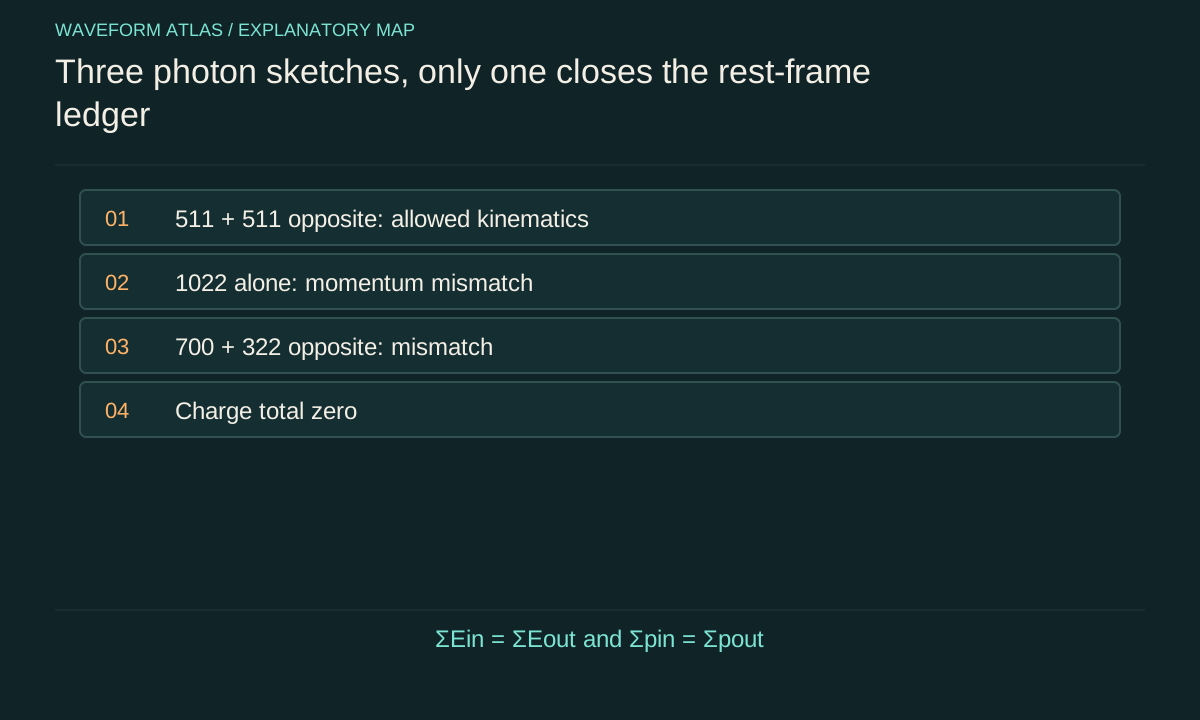
Take an isolated pair at rest with total energy approximately 1.022 megaelectronvolts and zero momentum. Two opposite photons of 0.511 megaelectronvolt each satisfy both energy and momentum. One photon of 1.022 megaelectronvolts satisfies the energy total but fails momentum conservation because its momentum magnitude is 1.022 MeV/c.
A second incorrect proposal is two opposite photons with energies 0.700 and 0.322 megaelectronvolt. Their energies add correctly, but their momentum magnitudes differ, leaving a net 0.378 MeV/c. The mismatch is not repaired by calling one photon antimatter or by giving it negative energy. Photons have positive energy in this description. A third product or a different moving initial state could change the analysis, but then it is a different specified reaction. These examples show why a numerical energy sum is only one part of a valid reaction sketch.
Electric charge is a separate constraint
The electron and positron have charges −e and +e, giving zero total charge. Photons are electrically neutral, so a photon-only final state is compatible with charge conservation. A proposed final state containing one electron and otherwise only neutral particles would have net charge −e and would not conserve charge for the isolated neutral pair.
Charge cancellation is not energy cancellation. The two quantities have different signs, units, and conservation equations. A neutral initial state can carry large positive energy and nonzero angular momentum. Other conserved quantum numbers may also constrain channels, depending on the interaction and theory. Avoid a vague statement that all opposite properties cancel: only specified quantities can be added, and their conservation must be checked independently. The correct final state can have different individual particles while matching the required total charges and other relevant quantum numbers.
Angular momentum constrains more than directions
Total angular momentum includes spin and orbital contributions. A proposed reaction must allow the outgoing state to carry the initial total angular momentum under the relevant symmetry conditions. Photon polarization and relative orbital motion are therefore part of the state, not optional decorative details.
Positronium provides a concrete example. Its singlet and triplet ground states have different total spin and different dominant photon multiplicities in vacuum. The selection involves discrete symmetries as well as angular momentum, so reducing it to a simple count of photon spins can be misleading. A multi-photon state has correlated polarizations and angular dependence, and the particles are identical bosons. The full quantum state must satisfy those constraints. An energy-momentum sketch can establish kinematic possibility without proving that a particular spin-prepared initial state has a nonzero amplitude for that channel.
Thresholds depend on center-of-momentum energy
Producing heavier particles requires enough invariant center-of-momentum energy to supply their rest masses and any necessary kinetic energy. In units with c = 1, the squared collision energy is s = (p1+p2)². A two-particle final state with masses m3 and m4 requires √s at least m3+m4, subject to other constraints.
A high laboratory beam energy does not all become available for new rest mass if much of it remains in overall center-of-momentum motion. For a beam particle of mass m incident on an identical stationary target, s = 2m²+2mEbeam, where Ebeam is total beam energy in those units. Head-on equal-energy colliders use energy differently because their total momentum can cancel. This distinction explains why threshold statements should use invariant energy rather than merely quote one particle's laboratory kinetic energy. The same relation applies when evaluating possible electron–positron annihilation products.
Symmetry rules have a stated domain
Some quantities are exactly conserved in the theory being applied, while others are approximate or violated by particular interactions. Electric charge and four-momentum conservation in the isolated relativistic reaction are not interchangeable with every discrete-symmetry selection rule. Charge conjugation, parity, and their combinations require attention to the interaction and initial state.
For electromagnetic positronium decay, these symmetries help organize allowed photon channels. Weak interactions and environmental perturbations can introduce effects outside that simplified account. A claim that a process violates a symmetry should define the observable, standard prediction, and experimental sensitivity. Primary positronium tests using decay-product correlations illustrate this procedure: they constrain specified combinations rather than announce that all conservation laws have been tested at once. Keeping the domain explicit prevents a rule valid for one idealized state from being applied indiscriminately to a different reaction or material environment.
Conservation does not calculate the branching fraction
Many final states can satisfy the same conservation constraints. Their probabilities depend on matrix elements and the available phase space. A channel can be allowed yet extremely rare, or kinematically open but suppressed by a small coupling or unfavorable state overlap. Conservation laws therefore eliminate possibilities but do not replace dynamics.
The differential probability or cross section involves the squared magnitude of an amplitude with interference among contributions, integrated over the relevant final-state variables. Detector acceptance then selects part of that distribution. A measured fraction is not automatically the underlying branching fraction unless efficiencies and selection effects are corrected. The distinction between allowed and likely is practical: it guides which products should be searched for and how much data are needed, while avoiding the false claim that one energy-momentum diagram uniquely determines what every event must produce.
Missing energy first tests the measurement boundary
An apparent mismatch between measured incoming and outgoing energy can arise from unobserved particles, incomplete angular coverage, energy deposited in inactive material, calibration errors, or radiation below threshold. These possibilities do not prove conservation in advance, but they are necessary parts of a quantitative test. A genuine discrepancy must exceed the modeled response and uncertainty.
For a two-photon event, one photon can leave the apparatus or scatter before reaching a detector. The recorded energy sum can then be much smaller than the reaction energy even though the complete process conserves it. Momentum reconstruction also depends on position and angle resolution. Report the missing-energy observable and its uncertainty rather than claiming energy vanished from a low detector total. A strong conservation test uses redundancy: independent calibrations, multiple measured channels, and control samples that expose the most plausible instrumental explanations.
A reusable reaction ledger
For any proposed annihilation event, first check species and total charge. Next compute total initial four-momentum and compare it with the full final state. Then check thresholds, angular momentum, and interaction-specific selection rules. Only after those checks should a rate or branching prediction be interpreted, because it depends on the dynamics of an already allowed channel.
This sequence also clarifies what annihilation does not conserve: the number of electrons, positrons, or photons need not remain individually fixed, and the sum of individual rest masses can change. The complete conserved quantities persist through different carriers. A reaction can therefore be dramatic in particle content while ordinary in its energy and momentum account. The ledger is not a rhetorical reassurance; it is a set of equations and measured correlations that can be tested with stated precision and a clearly defined system boundary.
Experimental conservation tests always have finite resolution. A reconstructed total momentum consistent with zero means the uncertainty region includes zero under the stated response model, not that every component was measured with infinite precision. Reporting residual distributions across many events is more informative than displaying only one perfectly balanced schematic event.
What to take forward
- Energy and momentum must be checked together as four-momentum.
- Conservation permits channels; interaction amplitudes determine their probabilities.
- Recoil, unobserved products, and detector response belong in any missing-energy claim.
Go to the original work.
These links identify the sources behind specific claims. Verification scope varies by source and is stated below.
- 1 / Official researchKinematics — Particle Data Group 2026, Jackson; reviewed by Miller and Tovey ↗
Four-momentum, Lorentz transformations, center-of-momentum energy and two-body kinematics
Verification scope: Official 2026 PDF inspected, particularly sections 49.1, 49.2 and 49.4; review text itself reviewed August 2021
- 2 / University teachingDavid Tong — Quantum Field Theory, section 6: Quantum Electrodynamics ↗
Electron-positron annihilation into photons and other allowed QED channels
Verification scope: Author-hosted indexed section text inspected; direct page fetch intermittently failed
- 3 / Official researchParticle Data Group 2026: Particle Properties ↗
Current particle-property reference and electron listing
Verification scope: Official 2026 index inspected; no invented precision values
- 4 / Official researchParticle Data Group: Atomic and nuclear properties of positronium ↗
Approximate vacuum singlet/triplet lifetimes and predominant photon channels
Verification scope: Official property table inspected; 2025 table explicitly identified
- 5 / ReviewPrecise measurement of positronium ↗
T. Namba. Progress of Theoretical and Experimental Physics 2012(1), 04D003 (2012).
Experimental positronium lifetimes and spin-dependent photon multiplicity
Verification scope: Publisher review article and its positronium lifetime discussion inspected; classified as a review rather than a single primary experiment.
- 6 / Primary experimentDiscrete symmetries tested at 10−4 precision using linear polarization of photons from positronium annihilations ↗
P. Moskal et al.. Nature Communications 15, 78 (2024).
DOI: 10.1038/s41467-023-44340-6
Polarization-sensitive positronium decay products can test specified symmetry correlations
Verification scope: Primary article abstract inspected; no reinterpretation as universal symmetry proof
- 7 / University teachingDavid Tong — Quantum Field Theory, section 3: Interacting Fields ↗
Unitary scattering operator and four-momentum conservation in scattering amplitudes
Verification scope: Author-hosted indexed scattering passages inspected; direct page fetch intermittently failed
- 8 / Official researchParticle Detectors at Accelerators — Particle Data Group 2026 ↗
Scintillation, semiconductor response, timing, energy calibration and finite detector resolution
Verification scope: Official PDF detector sections and timing/calibration passages inspected; not a claim to have read all 128 pages
- 9 / University teachingDavid Tong — Quantum Field Theory, section 2: Free Fields ↗
Fock space includes sectors with different particle numbers; interactions connect sectors
Verification scope: Author-hosted indexed section text inspected; scope limited to Fock-space construction
Found a problem with a claim or calculation? Send the page, the claim and the evidence. Read how these articles were prepared.