A reaction question and an abundance question differ
A laboratory annihilation calculation asks what products can emerge from a specified incoming state and with what probability. A cosmological abundance calculation asks how populations evolve through an expanding, cooling universe with many reactions occurring simultaneously. The second uses reaction physics but also needs densities, temperatures, expansion, initial conditions, and possible asymmetry-generating processes.
The observed predominance of ordinary baryonic matter is therefore not explained merely by saying matter and antimatter annihilate. That statement describes what happens to pairs, not why a net excess remains. CERN's overview and the PDG cosmology discussion identify the origin of the asymmetry as a separate problem. A useful explanation keeps those levels distinct: well-tested local reaction mechanisms can coexist with an unresolved account of the universe's initial or dynamically generated imbalance. Uncertainty at the cosmological level does not make the elementary energy-momentum ledger optional.
Pair removal preserves an existing difference
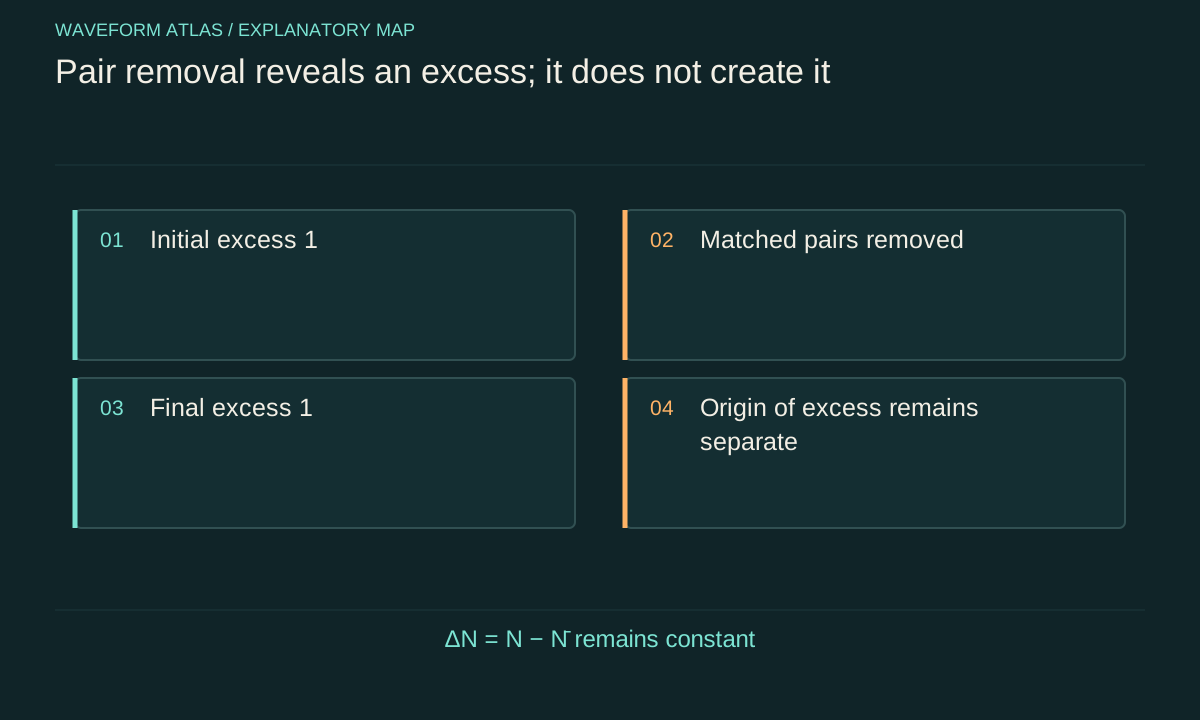
Consider an illustrative box containing 1,000,001 particles of a species and 1,000,000 antiparticles, with only pair annihilation allowed and no expansion or other reactions. Removing one of each leaves the difference N−N̄ unchanged. If all possible pairs annihilate, one particle remains. Annihilation has exposed the initial excess rather than created it.
If the box began with exactly equal numbers under those assumptions, pair removal would not spontaneously choose a net excess in the mean. Finite populations can fluctuate, and realistic systems exchange particles and have additional reactions, but those are extra ingredients that must be modeled. The simple subtraction is useful because it isolates the logical point. A mechanism that preferentially removes equal pairs cannot alone explain the origin of a conserved particle-minus-antiparticle difference. It can strongly change the total population while leaving the asymmetry unchanged.
A rate equation makes the same point dynamically
In a simplified homogeneous nonexpanding model, pair annihilation contributes the same loss term to particle and antiparticle number densities: dn/dt = −⟨σv⟩nn̄ and dn̄/dt = −⟨σv⟩nn̄. Subtracting gives d(n−n̄)/dt = 0. Reverse pair creation, if included symmetrically, also adds equal terms and leaves the difference unchanged.
The equation assumes a specified reaction channel, averaged cross section, and a coarse-grained population description. It is not a complete model of the early universe. Its value is to show explicitly why reaction efficiency and asymmetry generation are different quantities. Increasing the annihilation rate depletes matched populations faster but does not supply a source term for their difference. To generate a net asymmetry from a symmetric state, the larger dynamical model must contain the appropriate asymmetry-producing ingredients or a different initial condition.
Expansion changes densities and competes with reactions
In an expanding homogeneous universe, a conserved number density dilutes as the volume grows. A schematic equation includes a term 3Hn, where H is the expansion rate. For pair annihilation alone, subtracting the particle and antiparticle equations gives d(n−n̄)/dt+3H(n−n̄)=0. The corresponding comoving difference remains constant under those assumptions.
Reaction rates also compete with expansion. When interactions are fast compared with expansion, populations can track an approximate equilibrium. When they become too slow, the abundance can depart from equilibrium or freeze out. This does not mean every particle has annihilated, and the residual abundance depends on the rates and history. The freeze-out question concerns how much of a population survives; the asymmetry question concerns the origin of a net difference. They are coupled in realistic models but should not be treated as synonymous.
Baryons are not the same inventory as electron–positron pairs
The cosmological baryon asymmetry concerns baryon number carried by particles such as protons and neutrons, together with the underlying quark description. Electron–positron annihilation is a clear electromagnetic example, but it does not by itself explain the net baryon abundance. Electrons are leptons, and a neutral universe relates their abundance to positive charge without making them baryons.
Likewise, dark matter abundance is a distinct question. Some dark-matter models involve particle–antiparticle annihilation or asymmetry, but identifying a laboratory positron reaction does not establish which model describes cosmic dark matter. A careful account names the species and conserved or approximately conserved quantity under discussion. The broad words matter and antimatter can conceal several different particle inventories. Keeping baryon number, lepton number, electric charge, and total energy separate prevents an attractive elementary example from being asked to solve a different cosmological problem.
The baryon-to-photon ratio is a specific comparison
Cosmology often expresses the net baryon abundance relative to photon number density. This ratio is not the same as a present-day baryon-to-antibaryon ratio and should not be interpreted as a literal count of one surviving baryon beside a fixed number of annihilation partners. The photon population has its own thermal history and entropy transfers.
The PDG discussion places the inferred ratio at roughly six parts in ten billion in the standard cosmological framework, with estimates connected to light-element abundances and the cosmic microwave background. The precise inference depends on datasets and model assumptions. The educational point is the scale and definition: a small net excess relative to a large radiation population can seed the later ordinary matter content. That statement does not identify how the excess was generated, and it does not mean every currently observed photon came directly from one simple baryon–antibaryon annihilation event.
Standard baryogenesis needs more than annihilation
In the standard class of baryogenesis arguments, generating an asymmetry dynamically from a symmetric starting point involves baryon-number-changing processes, violation of charge-conjugation and combined charge-parity symmetries, and departure from thermal equilibrium under the usual assumptions. These ingredients are often associated with Sakharov's conditions. They are a framework for constructing models, not the announcement of one experimentally established cosmic mechanism.
The qualifications matter. Alternative assumptions about fundamental symmetries or cosmological history can alter the argument, so the conditions should not be promoted into an unrestricted theorem about every imaginable theory. The ordinary annihilation of a matched pair is not enough because it removes equal and opposite contributions. A viable model must generate the required sign and magnitude, avoid erasing the result later, and remain compatible with other observations. The reaction rate is only one component of that test.
Laboratory symmetry tests constrain ingredients
Measurements of matter and antimatter properties and of charge-parity violation in specified reactions test parts of the physics relevant to asymmetry models. They can constrain couplings, exclude parameter ranges, or reveal discrepancies with a standard prediction. A laboratory asymmetry in one decay is not automatically a complete explanation of the cosmic abundance.
The connection requires a model linking that measured process to conditions in the early universe, including temperatures, reaction networks, and departure from equilibrium. A result consistent with established particle physics can still be valuable by narrowing alternatives. Conversely, a proposed cosmological explanation must survive laboratory limits as well as astronomical evidence. Avoid equating the words asymmetry in these two settings without stating the bridge. One refers to a measured difference between specified processes; the other refers to an integrated population history across cosmological evolution.
Antimatter observations do not all answer the same question
Antiparticles can be produced in high-energy interactions and studied in laboratories or cosmic-ray environments. Their existence confirms that antimatter is not absent in an absolute sense. The cosmological issue is the large-scale net composition and the lack of an equal primordial antimatter counterpart in the observable matter inventory, within observational constraints.
A detected positron is therefore not by itself evidence for a nearby antimatter star or a resolution of the abundance problem. Its production mechanism must be assessed. Similarly, observing annihilation radiation identifies an interaction or population under a model but does not uniquely reconstruct the universe's initial conditions. Background sources, transport, and astrophysical environments complicate that inference. The useful scientific question is which hypotheses predict the measured spatial, spectral, and temporal distribution, and which independent observations distinguish them. A single reaction signature cannot carry the entire cosmological interpretation.
What remains separate and what connects them
Annihilation and cosmic asymmetry are connected through reaction networks and energy transfer, but they answer different questions. The local process explains how matched particles can be converted into products. The cosmological model explains how populations and net quantum numbers evolve as the universe expands and cools. A successful account needs both levels without confusing them.
The simple box and rate-equation examples establish a limited but robust conclusion: symmetric pair removal preserves the existing difference under the stated assumptions. They do not prove a particular baryogenesis theory or rule out every alternative initial condition. The remaining task is to identify and test the physics that generated and preserved the observed net abundance. Keeping that task explicit respects both the precision of laboratory annihilation measurements and the genuine scope of the unresolved cosmological question.
The toy box assumes no exchange with its surroundings. If particles escape preferentially, its local difference can change while the larger closed system preserves the relevant total. Cosmological arguments likewise require a stated volume and transport model; a local imbalance is not automatically a globally generated asymmetry.
What to take forward
- Removing one particle and one antiparticle preserves their number difference.
- Expansion and freeze-out determine abundance evolution but do not alone generate a net asymmetry.
- Laboratory CP tests constrain ingredients; a cosmological explanation requires a complete model.
Go to the original work.
These links identify the sources behind specific claims. Verification scope varies by source and is stated below.
- 1 / Official researchBig-Bang Cosmology — Olive and Peacock, Particle Data Group 2026 ↗
K. A. Olive and J. A. Peacock. Big-Bang Cosmology. Particle Data Group, 2026 review (revised August 2025), Sections 22.3.6–22.3.7.
Baryon asymmetry is a separate cosmological problem; standard baryogenesis ingredients and abundance inference
Verification scope: Official PDF Section 22.3.6 inspected for baryogenesis; Section 22.3.7, equation (22.55) and following Planck-derived η=(6.12±0.04)×10⁻¹⁰, inspected for abundance. No full-review verification claimed.
- 2 / Official researchAntimatter — CERN ↗
Matter-antimatter reactions and distinction from the cosmic abundance problem
Verification scope: Official institutional overview inspected
- 3 / Official researchKinematics — Particle Data Group 2026, Jackson; reviewed by Miller and Tovey ↗
Four-momentum, Lorentz transformations, center-of-momentum energy and two-body kinematics
Verification scope: Official 2026 PDF inspected, particularly sections 49.1, 49.2 and 49.4; review text itself reviewed August 2021
- 4 / University teachingDavid Tong — Quantum Field Theory, section 3: Interacting Fields ↗
Unitary scattering operator and four-momentum conservation in scattering amplitudes
Verification scope: Author-hosted indexed scattering passages inspected; direct page fetch intermittently failed
- 5 / Official researchParticle Data Group 2026: Particle Properties ↗
Current particle-property reference and electron listing
Verification scope: Official 2026 index inspected; no invented precision values
Found a problem with a claim or calculation? Send the page, the claim and the evidence. Read how these articles were prepared.