Two uses of disappearance need different questions
When an interference fringe is dark, the measured intensity in a selected location or output mode is small. When an electron and positron annihilate into photons, the selected final particle inventory no longer contains that incoming pair. The first statement concerns an amplitude in a mode; the second concerns a reaction between particle sectors.
Both can be described using quantum amplitudes, but the shared language does not erase the distinction. Ask what was present initially, what interaction or optical element acted, and which outputs were measured. A missing signal at one detector can result from redirection, absorption, mode mismatch, or destructive interference. It does not identify annihilation without reaction-specific evidence. Conversely, detecting the products of an electron–positron reaction provides positive evidence for particle conversion rather than merely observing a dark region. The complete input-output account is the useful comparison.
A lossless two-port model keeps all energy visible
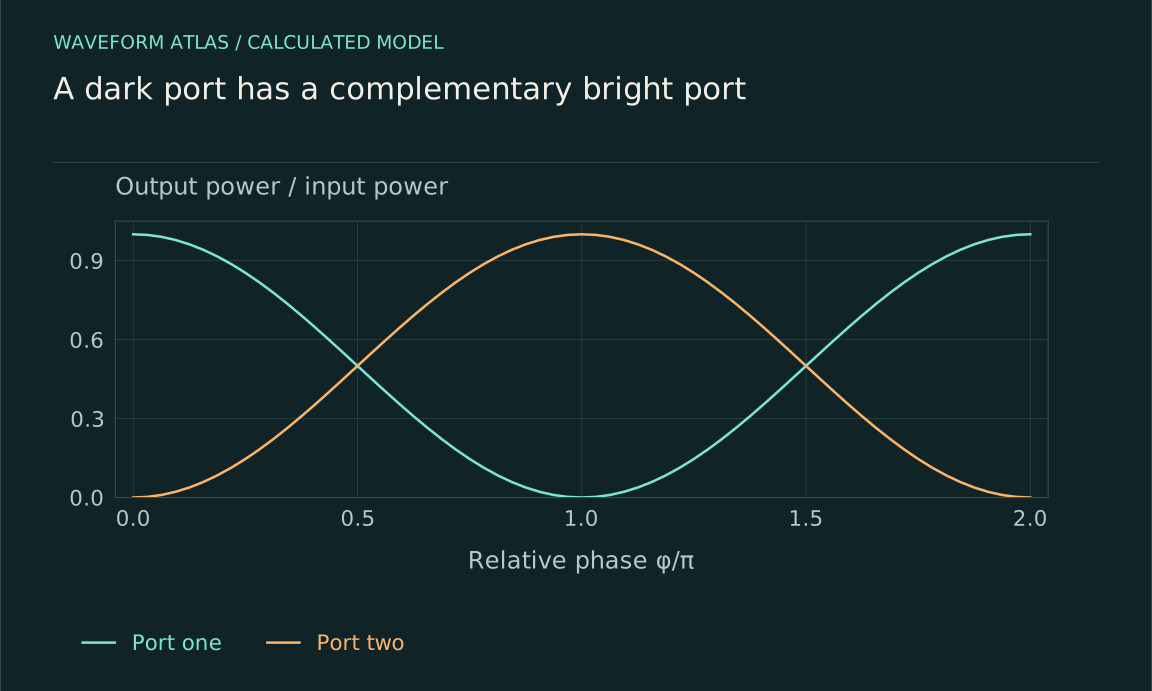
Consider an ideal balanced interferometer with one input and two output ports. With a suitable phase convention, output powers can be written P1 = Pin cos²(φ/2) and P2 = Pin sin²(φ/2), where φ is the relative path phase. Their sum is Pin for every phase. At φ = π, the first port is dark and the second carries all the input power.
For an illustrative 1-milliwatt input, φ = 0 gives 1 milliwatt and zero in the two ports, while φ = π/2 gives 0.5 milliwatt in each. The darkness is a redistribution controlled by phase, not destruction of the total field energy. Real devices add loss and imperfect contrast, so a measured budget should include those channels. The ideal model is useful because it shows exactly where a claim of energy cancellation fails if only one output is monitored.
Local field cancellation is not a global energy statement
Electromagnetic energy density contains both electric and magnetic contributions. In a standing wave formed by counterpropagating waves, an electric-field node can coexist with magnetic-field energy. Energy also moves and exchanges between field components according to Maxwell's equations and the boundary conditions. Looking only at one electric-field amplitude at one point is therefore incomplete.
For mechanical waves, a displacement node can coexist with strain or motion elsewhere in the system. A local detector measures a particular variable with a finite spatial response. The absence of that signal does not establish absence of all energy in the larger wave. A global cancellation claim requires a complete field and source account, including the work needed to establish the superposition. This is why a sketch of two opposite arrows crossing out is not a sufficient physical model of where the energy went.
Single-photon interference does not require splitting energy into nothing
A single photon entering an ideal interferometer can be described as a superposition over path modes. The amplitudes recombine at the output, producing phase-dependent detection probabilities. A dark port means the probability amplitude for that output vanishes under the ideal conditions; the photon is detected in another allowed output when the device and detector are lossless and efficient.
This does not require a particle–antiparticle partner. It also does not imply that a photon was destroyed at the dark port and recreated at the bright one. The mode transformation evolves the state across the complete interferometer. A detector may absorb the photon when it records it, but that later interaction is a separate process with its own energy transfer. Keeping propagation, interference, and detection distinct avoids assigning an annihilation event to every absence of a click.
Opposite electric charges are not opposite wave amplitudes
An electron and positron carry opposite charge, but their energies are positive and their quantum states are not related by simply multiplying one classical wave by minus one. A relative phase of π between two optical amplitudes changes their interference. Replacing an electron with a positron changes particle species and quantum numbers.
The electric fields of opposite charges can partly cancel at selected locations or at large distances, producing a neutral or dipolar configuration. That field cancellation does not itself remove the charges. Positronium is a particularly clear example: the pair can form a neutral bound state before it decays. The later annihilation is governed by the interaction and allowed final states. A neutral total charge is compatible with stored positive energy and a nontrivial quantum state, so charge cancellation should not be used as a shortcut explanation for particle disappearance.
Reaction amplitudes can interfere without changing the distinction
Quantum electrodynamics can assign several contributing amplitudes to the same electron–positron final channel. Those amplitudes interfere before probabilities are calculated. This affects angular distributions and reaction rates. It does not turn the physical process into the same thing as two classical beams canceling at a detector.
The alternatives in the calculation lead to the same specified final state, and their amplitudes are summed coherently when they are indistinguishable. The final state still contains reaction products carrying the required conserved quantities. A destructive contribution can suppress one channel or direction while other allowed outcomes remain. This is a useful subtlety: interference is a general rule for combining quantum alternatives and can occur within an annihilation calculation, but the word annihilation identifies the change in external particle content. The two concepts operate at different descriptive levels.
Absorption adds a genuine energy destination
A lossy interferometric device can use interference to control how efficiently incoming energy enters an absorber. Coherent perfect absorption is a specific example involving matched coherent inputs and a dissipative structure. The outgoing fields can vanish under selected conditions because energy is transferred into internal degrees of freedom, not because a lossless superposition destroys it.
The distinction matters when comparing a dark port with an absorber. In the former ideal case, another output carries the energy. In the latter, heat or other internal excitation can carry it. A calorimetric or complete power measurement can distinguish these outcomes. Neither mechanism is an electron–positron annihilation unless the relevant particle reaction actually occurs. The same visual impression of little outgoing light can therefore arise from very different dynamics, each requiring its own system boundary and evidence.
The annihilation operator is another source of confusion
In quantum oscillator notation, an annihilation operator lowers the occupation of a mode: a|n⟩ = √n|n−1⟩. Its name does not mean every use of the operator describes a particle–antiparticle reaction. It is a mathematical operation used in many interaction Hamiltonians and measurement models, including ordinary photon absorption and mode coupling.
The relation a|0⟩ = 0 also requires care. The zero on the right is the zero vector, indicating that the operator finds no excitation to remove from vacuum. It is not a normalized physical final state called nothingness. A physical quantum process must be represented with the appropriate complete dynamics or measurement operation and normalization. Confusing the operator's algebra with the everyday meaning of annihilation can generate false claims that a vanishing amplitude proves the universe's state has disappeared.
Design an experiment that distinguishes the mechanisms
For interference, vary relative phase while monitoring all accessible output ports. Complementary power changes with a stable total support redistribution. For absorption, measure total outgoing power and a relevant dissipative response, allowing for storage and scattering. For particle annihilation, measure characteristic products, energy-momentum correlations, and source conditions.
A single dark detector cannot perform all three tests. Detector efficiency, bandwidth, polarization acceptance, and geometry must be calibrated in each case. If one output becomes dark while another brightens, the energy route is explicit. If heat rises, a material loss route is plausible. If correlated reaction products appear with the expected kinematics, particle conversion is supported. The point is not to demand every instrument for every experiment, but to choose an observable that discriminates the leading explanations rather than infer a mechanism from the word disappearance.
What to take forward
- A dark lossless output port redirects probability and energy into other modes.
- Opposite charge is a different concept from opposite optical phase.
- Interference can occur within reaction amplitudes without making annihilation a classical cancellation process.
Go to the original work.
These links identify the sources behind specific claims. Verification scope varies by source and is stated below.
- 1 / University teachingQuantum Optical Communication — Jeffrey H. Shapiro, readings and lecture slides ↗
Jeffrey H. Shapiro. Quantum Optical Communication — Jeffrey H. Shapiro, readings and lecture slides. 2016.
Author-written quantum attenuator, amplifier, detection and parametric interaction framework
Verification scope: Official course materials and topic mapping inspected
- 2 / University teachingDavid Tong — Quantum Field Theory, section 6: Quantum Electrodynamics ↗
Electron-positron annihilation into photons and other allowed QED channels
Verification scope: Author-hosted indexed section text inspected; direct page fetch intermittently failed
- 3 / University teachingFundamentals of Photonics: Quantum Electronics — lecture notes ↗
Franz X. Kärtner. Fundamentals of Photonics: Quantum Electronics — lecture notes. 2006.
Population dynamics, absorption/gain, Rabi oscillations and coupled modes
Verification scope: Official author-written course materials and topic mapping inspected
- 4 / University teachingElectromagnetics and Applications — lecture notes ↗
David H. Staelin. Electromagnetics and Applications — lecture notes. 2009.
Poynting theorem, boundary conditions, material response and polarization
Verification scope: Official author-written course and topic records inspected
- 5 / University teachingWave Propagation — Triantaphyllos Akylas, lecture notes ↗
Triantaphyllos Akylas. Wave Propagation — Triantaphyllos Akylas, lecture notes. 2017.
Transient wave propagation, elastic modes, interfaces and water waves
Verification scope: Official chapter contents and author-written course records inspected
- 6 / Official researchParticle Data Group: Atomic and nuclear properties of positronium ↗
Approximate vacuum singlet/triplet lifetimes and predominant photon channels
Verification scope: Official property table inspected; 2025 table explicitly identified
- 7 / University teachingDavid Tong — Quantum Field Theory, section 3: Interacting Fields ↗
Unitary scattering operator and four-momentum conservation in scattering amplitudes
Verification scope: Author-hosted indexed scattering passages inspected; direct page fetch intermittently failed
- 8 / Primary theoryCoherent Perfect Absorbers: Time-Reversed Lasers ↗
Y. D. Chong, L. Ge, H. Cao, and A. D. Stone. Physical Review Letters 105(5), 053901 (2010).
DOI: 10.1103/PhysRevLett.105.053901
Matched coherent inputs and loss can suppress all outgoing channels at selected frequencies
Verification scope: Publisher abstract and author-hosted paper excerpts inspected
- 9 / University teachingElectromagnetics and Applications, Chapter 9 — David H. Staelin ↗
David H. Staelin. Electromagnetics and Applications, Chapter 9: Electromagnetic Waves. 2009.
Waves in lossy media and complex material response
Verification scope: Official chapter equations/excerpts inspected; not a claim of full-course review
- 10 / University teachingDavid Tong — Quantum Field Theory, section 2: Free Fields ↗
Fock space includes sectors with different particle numbers; interactions connect sectors
Verification scope: Author-hosted indexed section text inspected; scope limited to Fock-space construction
- 11 / Official researchParticle Detectors at Accelerators — Particle Data Group 2026 ↗
Scintillation, semiconductor response, timing, energy calibration and finite detector resolution
Verification scope: Official PDF detector sections and timing/calibration passages inspected; not a claim to have read all 128 pages
- 12 / Official researchKinematics — Particle Data Group 2026, Jackson; reviewed by Miller and Tovey ↗
Four-momentum, Lorentz transformations, center-of-momentum energy and two-body kinematics
Verification scope: Official 2026 PDF inspected, particularly sections 49.1, 49.2 and 49.4; review text itself reviewed August 2021
Found a problem with a claim or calculation? Send the page, the claim and the evidence. Read how these articles were prepared.