An adjective cannot replace an equation of motion
Two things can be opposite in position, direction, sign or phase while sharing almost every other property. The adjective tells us about a comparison, not what will happen next. To predict an encounter, one must specify the objects, the quantity being compared and the interaction law governing their evolution.
This is easy to see with everyday vectors. Two equal forces in opposite directions can sum to zero on one body, while two equal velocities in opposite directions describe two bodies moving apart or toward each other depending on their positions. The same word points to different mathematical operations and different physical questions.
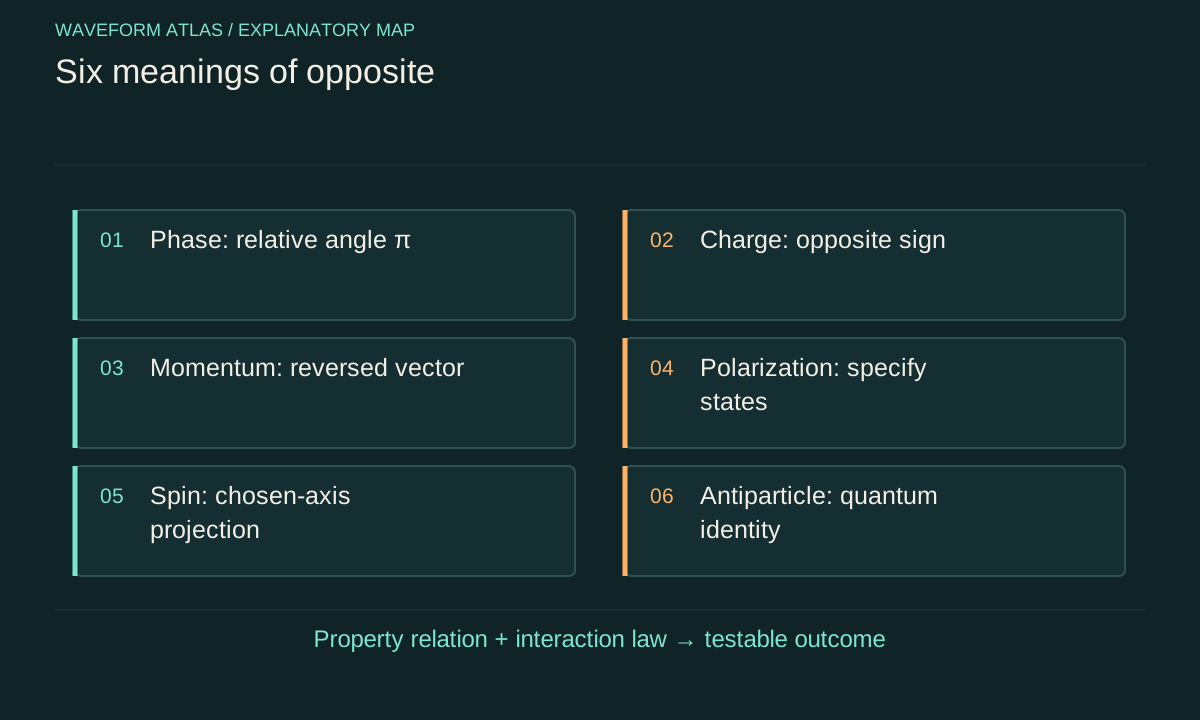
In wave and quantum discussions, the ambiguity becomes more consequential. Opposite phase is not opposite electric charge; orthogonal polarization is not an antiparticle relationship; zero total momentum is not zero total energy. Treating these as one cancellation principle produces predictions that fail conservation or overlook ordinary dynamics. A precise discussion begins by replacing the bare adjective with a complete statement such as “equal optical amplitudes with relative phase π in the same detected mode.” That statement can actually be calculated.
A useful distinction is between a zero mean and a zero distribution. If an instrument records equally many values +1 and −1, its average is zero while its variance is one. Replacing that record with a claim that nothing happened discards measurable fluctuations. The same discipline applies whenever opposite contributions are averaged before the underlying outcomes are examined, especially in spin and interference measurements.
Opposite phase concerns an amplitude relationship
Two coherent scalar fields with relative phase π have opposite complex amplitudes when their magnitudes are equal. If they occupy the same mode at the same time, their contributions can cancel in that measured amplitude. Unequal magnitudes leave a residual, and mismatched polarization or frequency can prevent complete cancellation.
For amplitudes A and −0.8A, the sum is 0.2A. The associated intensity in a simple common-mode model is proportional to 0.04|A|², not zero. This original example shows that a phase statement alone is incomplete. Amplitude, overlap and coherence also matter.
The energy account requires the full arrangement. A dark interferometer port can be accompanied by a bright complementary port. A standing wave can have nodes while storing energy elsewhere or in another part of its dynamical cycle. Destructive interference is therefore a statement about a field observable in a specified region or mode. It is not a general rule that opposite-phase sources destroy all energy or convert matter into nothing.
Opposite charge predicts a force, not a particle identity
In the electrostatic point-charge model, the sign of q₁q₂ determines whether the force is attractive or repulsive. Opposite signs give attraction. The law does not say that the particles are each other’s antiparticles, that they must collide, or that they disappear upon approaching.
An electron and proton have opposite electric charges and can form a hydrogen atom. They remain distinct constituents of a bound quantum system. An electron and positron also have opposite charges, but their particle identities allow annihilation channels that are not available to the electron–proton pair in the same way.
The difference is not a small correction to a universal cancellation principle. Charge is one conserved property among several. Mass, spin, species and other quantum numbers affect the allowed dynamics. Even an attractive encounter can scatter if the initial energy and angular momentum do not permit capture without additional energy transfer. A charge sign tells us part of the force law; it does not supply the complete final-state prediction.
Opposite momentum defines a frame-dependent vector sum
Two particles with equal and opposite momenta have zero total momentum in the chosen frame. They can nevertheless carry substantial kinetic energy. For equal nonrelativistic masses moving at speeds ±v, the total kinetic energy is mv² while the total momentum vanishes.
The outcome still depends on the interaction. They may scatter elastically, excite internal states, stick through dissipation or react into different products. Conservation constrains these possibilities without selecting one. Their initial separation and impact parameter also matter: opposite momenta do not guarantee that their trajectories intersect.
Momentum is frame-dependent. In the center-of-mass frame, a two-particle system has equal and opposite momenta by construction, but that fact does not make every collision an annihilation event. A boost changes the laboratory momenta while leaving the underlying reaction identity unchanged. The useful question is what energy is available in the center-of-mass system and which channels the interaction permits, not whether a diagram happens to draw arrows pointing toward each other.
Polarization requires a state convention
For light traveling in a specified direction, polarization describes the vector behavior of the transverse electric field. Horizontal and vertical linear polarizations are orthogonal. Multiplying a horizontal Jones vector by −1 gives the same isolated polarization state with a global phase change, not vertical polarization.
This distinction affects interference. Orthogonal polarizations have zero inner product in an ideal polarization-insensitive intensity measurement, so the cross term vanishes. They do not cancel each other. A polarizer can project both onto a common axis, allowing the transmitted components to interfere when other coherence conditions are met.
Circular-polarization labels need particular care when propagation direction changes because handedness conventions depend on the viewing or coordinate convention. A statement that two beams have “opposite polarization” should therefore name their Jones vectors, Stokes vectors or a clear preparation and measurement. The word opposite can otherwise mean either a phase sign, an orthogonal state or reversed handedness. These are different operations with different observable consequences.
Spin projections are defined by an axis
For a spin-one-half system, measuring spin along a chosen axis gives one of two projection values, +ℏ/2 or −ℏ/2. These opposite outcomes refer to that measurement axis. They do not describe tiny classical balls spinning clockwise and counterclockwise in a fixed literal sense.
A state prepared with definite positive z projection has equal probabilities for positive and negative x projection. Rotating the measurement axis changes the outcome distribution. Thus “opposite spin” is incomplete unless the preparation and comparison axes are specified.
For two particles, opposite outcomes along one axis do not by themselves establish an entangled singlet state. A simple product preparation can produce opposite z results while giving different correlations along other axes. The distinction can be tested through measurements in more than one basis. Spin language becomes precise when it names the observable and the joint state, rather than treating opposite labels as a mechanism that makes the particles combine, cancel or annihilate. The projection relationship constrains a measurement; dynamics still requires a Hamiltonian and an interaction.
Antiparticles are related by more than charge sign
An antiparticle has the same mass and spin magnitude as its corresponding particle, with appropriate additive quantum numbers reversed. Electric charge is one example, but neutral particles can also have distinct antiparticles. The neutron and antineutron illustrate why neutrality does not settle the issue.
Some particles, such as the photon, are their own antiparticles. The classification therefore cannot be reduced to a positive-versus-negative charge chart. Nor should unsettled questions about particular particle identities be silently resolved by a simplified diagram. A careful example uses established cases and states the relevant quantum numbers.
Particle–antiparticle annihilation is a reaction into other allowed excitations, not disappearance of total energy. The outgoing products must carry the conserved quantities. An encounter can have competing channels, and the outcome depends on energy, state and interaction probabilities. Antiparticle identity makes certain reactions possible; it does not mean that any pair with one opposite property must undergo the same process. This is the most important boundary between a useful property comparison and an invented universal law of opposites.
Turn the comparison into a testable question
A productive analysis follows a short sequence. Identify the objects and the property that is opposite. State the reference frame, axis or phase convention. Write the interaction or transformation that connects the initial state to possible outputs. Then choose an observable that distinguishes those outputs and check conservation over the complete system.
For example, a phase-opposed optical claim suggests a phase scan and measurements of both output ports. A charge-attraction claim suggests trajectories or bound-state spectroscopy. A spin-correlation claim suggests several measurement axes. An annihilation claim suggests product identification and an energy-momentum ledger. These experiments differ because the underlying statements differ.
The word opposite can still be a useful starting question. It directs attention to a sign, orientation or relation worth investigating. It becomes misleading only when it is promoted into a stand-alone mechanism. The correct next step is always to name the specific quantity and dynamics. That habit keeps interference, attraction, collision, polarization, spin and antiparticle reactions connected by clear reasoning without pretending they are the same physical event.
What to take forward
- Name the property, reference convention and interaction before predicting an outcome.
- Zero amplitude, zero total charge and zero total momentum are different statements.
- Opposite properties do not define a universal collapse or annihilation mechanism.
Go to the original work.
These links identify the sources behind specific claims. Verification scope varies by source and is stated below.
- 1 / University teachingBarton Zwiebach, MIT 8.04: Chapter 2, Experiments with photons ↗
Barton Zwiebach (2016). Chapter 2: Experiments with photons. MIT 8.04 Quantum Physics I, lecture notes, 9 February 2016, pp. 1–8.
Beam-splitter phase conventions, two-path amplitude transformations and Mach–Zehnder recombination.
Verification scope: MIT-hosted lecture-note text and beam-splitter equations inspected.
- 2 / University teachingUniversity Physics Volume 1, 16.6: Standing Waves and Resonance ↗
University Physics Volume 1, 16.6: Standing Waves and Resonance. https://openstax.org/books/university-physics-volume-1/pages/16-6-standing-waves-and-resonance
Superposition of counterpropagating waves and the location of nodes and antinodes.
Verification scope: Publisher-hosted textbook equations and explanations inspected.
- 3 / University teachingOpenStax University Physics: Coulomb’s Law ↗
OpenStax University Physics: Coulomb’s Law. https://openstax.org/books/university-physics-volume-2/pages/5-3-coulombs-law
Electrostatic force depends on charge product and separation; opposite charge signs attract under the point-charge electrostatic model.
Verification scope: Official textbook equation and scope inspected.
- 4 / University teachingUniversity Physics Volume 3, 11.1: Introduction to Particle Physics ↗
University Physics Volume 3, 11.1: Introduction to Particle Physics. https://openstax.org/books/university-physics-volume-3/pages/11-1-introduction-to-particle-physics
Particle/antiparticle identities and examples of distinct neutral antiparticles and self-conjugate particles.
Verification scope: Publisher-hosted particle/antiparticle section inspected; unresolved neutrino identity is not inferred from its introductory table.
- 5 / University teachingUniversity Physics Volume 3, 1.7: Polarization ↗
University Physics Volume 3, 1.7: Polarization. https://openstax.org/books/university-physics-volume-3/pages/1-7-polarization
Optical polarization, projections through a linear analyzer and Malus's law.
Verification scope: Publisher-hosted textbook page inspected.
- 6 / Official researchCERN: Antimatter ↗
CERN: Antimatter. https://home.cern/science/physics/antimatter
The electron–positron relationship and the need to identify the actual particle species.
Verification scope: Institutional overview inspected; simplified outreach language is not used as a claim that charge alone fixes the reaction.
- 7 / University teachingBarton Zwiebach: Spin One-half, Bras, Kets, and Operators ↗
Barton Zwiebach: Spin One-half, Bras, Kets, and Operators. https://ocw.mit.edu/courses/8-05-quantum-physics-ii-fall-2013/a56c316e4ec548d8bd0a554fac9a74e8_MIT8_05F13_Chap_02.pdf
Spin-one-half projection outcomes, noncommuting axes, Pauli representation and arbitrary-axis spin states.
Verification scope: Correct MIT chapter PDF inspected, including Stern–Gerlach and sequential-axis examples; original probability examples independently calculated.
Found a problem with a claim or calculation? Send the page, the claim and the evidence. Read how these articles were prepared.