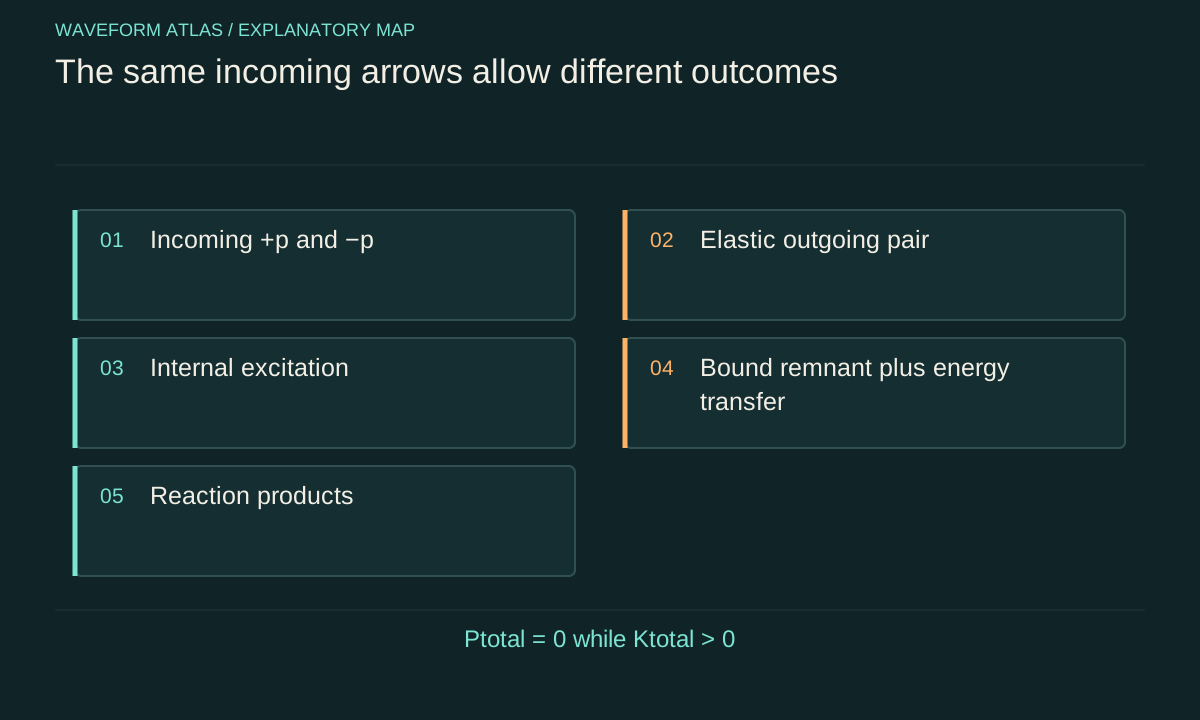
Specify the frame and the vectors
Momentum has both magnitude and direction. Two equal and opposite momenta satisfy p₁ + p₂ = 0 in a particular reference frame. That frame is the center-of-mass frame for a simple isolated two-particle system. The relation is useful because it simplifies the outgoing momentum ledger.
It is not a statement that the particles have opposite identities, phases or charges. Two identical neutral objects can satisfy it, as can two charged particles or two photons. Their interactions can be entirely different. The vector relationship alone contains no information about which forces or reaction channels are present.
The frame qualification matters. A laboratory moving relative to the center of mass generally assigns a nonzero total momentum. The physical encounter has not changed; only its description has. A claim that a special outcome occurs merely because the arrows look opposite in one diagram should therefore be checked against a frame-independent account of the available collision energy and the specified dynamics.
Opposite velocities are not always opposite momenta
For nonrelativistic particles, momentum is mv. If two particles have different masses and equal but opposite velocities, their momenta do not cancel. The heavier particle carries the larger momentum magnitude. Conversely, equal and opposite momenta imply different speeds when the masses differ.
Take illustrative masses one and three kilograms with velocities +3 and −1 meters per second. Their momenta are +3 and −3 kilogram meters per second, so the center of mass is at rest. Their kinetic energies are 4.5 and 1.5 joules, totaling six joules.
This example exposes two separate distinctions. Velocity direction does not determine momentum balance without mass information, and momentum balance does not determine energy balance without the appropriate kinetic-energy relation. At relativistic speeds, p = γmv replaces the simple formula, but the need to specify both vector momentum and energy remains. A clear collision diagram should label the quantities actually being balanced instead of using identical arrows to imply several different equalities at once.
Zero total momentum leaves relative kinetic energy
For two equal masses m moving at speeds ±v, total momentum is zero and total kinetic energy is mv². If they rebound elastically, that energy remains in outgoing motion. If they stick, it must be transferred to internal energy or another channel. The same incoming vector sum permits both outcomes.
More generally, nonrelativistic kinetic energy separates into ½M Vcm² + ½μvrel². The first term describes common center-of-mass motion, and the second describes the encounter. In the center-of-mass frame, the first term vanishes while the relative term remains.
This decomposition explains why head-on collisions can be energetic despite a zero momentum sum. It also prevents confusing a stationary final remnant with an energy-free event. A remnant may contain heat, deformation, excitation or rest-energy changes, while outgoing radiation carries another share. The vector cancellation is one constraint; the scalar energy ledger is another. Both must close for a physically plausible account of the encounter.
Interactive model: Account for a one-dimensional collision. Enable JavaScript to adjust its controls.
v₁′ = (1 − em₂)/(1 + m₂); v₂′ = (1 + e)/(1 + m₂)
Body 1 has mass 1 and initial velocity 1; body 2 starts at rest. An isolated one-dimensional encounter uses restitution 0 ≤ e ≤ 1. Lost translational kinetic energy becomes internal modes, not missing energy.
Opposing directions do not guarantee intersection
Two trajectories can have opposite velocity directions while passing on parallel displaced lines. The impact parameter describes their transverse offset in a simple scattering geometry. A nonzero offset changes the closest approach and angular momentum, and may prevent direct contact for finite objects.
Even when an attractive force bends the paths, the outcome depends on initial energy and angular momentum. A pair can deflect and separate instead of colliding or binding. For waves, finite beam width and spatial overlap similarly matter: opposite propagation directions do not ensure that the relevant modes overlap sufficiently to interact or interfere.
A useful experiment therefore records geometry as well as speed. If the claimed effect depends on head-on contact, uncertainty in alignment belongs in the prediction. Changing the impact parameter is a discriminating control because it can alter interaction strength or outgoing angles while leaving the momentum directions broadly opposite. A mechanism that ignores this dependence may be relying on the visual symbolism of arrows rather than the actual spatial encounter.
Elastic scattering preserves identities while changing directions
In elastic scattering, the relevant total kinetic energy is conserved along with momentum, and the particles retain their internal states under the chosen definition. Equal-mass objects in one dimension provide a simple illustration: an ideal elastic head-on collision exchanges their velocities.
That outcome can look like the objects bounced, or like identical labels passed through, depending on how they are tracked. For truly identical quantum particles, labeling individual histories introduces additional subtleties. The measured outgoing state should be described through observable momenta and correlations rather than an untestable assignment of identity to a particular path.
The central lesson is that opposite incoming momenta are perfectly compatible with two outgoing objects. No merger or annihilation is required. The scattering angle distribution is determined by the interaction, not by conservation alone. Conservation narrows the allowed set of outputs; a force law or scattering amplitude supplies their probabilities. Confusing these roles turns a kinematic diagram into an unsupported dynamical prediction.
Inelastic outcomes need an internal or external energy channel
An inelastic encounter transfers some kinetic energy into internal excitation, deformation, heat or other products. Total energy remains conserved when those channels are included. A sticking collision is one familiar limit, but many inelastic encounters still leave two outgoing objects.
For the earlier one- and three-kilogram example with zero total momentum, a stationary composite would need to contain or export the initial six joules. If only four joules of internal heating were measured, the remaining two joules would require another channel or an uncertainty explanation. The arithmetic is simple enough to make missing assumptions visible.
In a quantum system, internal excitation energies can be discrete, and thresholds determine which channels are accessible. The incoming relative energy must be sufficient for the proposed excitation after momentum constraints are satisfied. Opposite momentum does not remove these requirements. A credible inelastic interpretation predicts both the altered outgoing motion and the receiving energy channel, rather than describing reduced speed as energy that was canceled by the opposite approach.
Particle reactions add identity constraints
A reaction can replace the incoming species with different outgoing particles. Which reactions are allowed depends on charge, energy, momentum and other relevant quantum numbers, together with the interaction. Electron–positron annihilation and D–T fusion are different examples even if both are drawn with particles approaching head-on.
In the low-motion electron–positron two-photon case, opposite outgoing photon momenta allow a zero total momentum while carrying positive energy. In D–T fusion, a neutron and helium nucleus share energy according to their masses and the reaction kinematics. The fact that both obey conservation does not make their mechanisms interchangeable.
An experiment that claims a reaction must therefore identify products, not merely show that incoming objects ceased to follow their original paths. Scattering outside detector acceptance can mimic disappearance. Internal excitation can mimic an energy deficit. Product spectroscopy and coincidence measurements connect the event to a specific channel. The incoming momentum relation is useful preparation information, but it is not a substitute for the outgoing identity evidence.
Relativistic collision energy is best expressed invariantly
At high energies, the available center-of-mass energy is obtained from the total energy-momentum four-vector. In a conventional form, Ecm² = Etot² − c²|Ptot|². In the center-of-mass frame, total momentum vanishes and Ecm equals the total energy there.
This relation explains why colliding beams and a beam striking a stationary target can differ greatly in useful center-of-mass energy even when a laboratory beam energy sounds similar. Some laboratory energy belongs to common motion of the final system rather than internal energy available for creating new states.
The formula is a kinematic constraint, not a reaction-rate prediction. A large Ecm can open channels, but cross sections and quantum numbers determine how often they occur. An article about opposite momenta should therefore avoid promising that sufficiently energetic opposing objects must annihilate or merge. The invariant energy tells us what may be accessible; the dynamics and measured products tell us what actually happens. No universal outcome follows from the sign of a momentum arrow alone.
Measure enough to distinguish the allowed exits
A useful encounter measurement records incoming energies and geometry, outgoing directions and energies, and any internal or reaction products relevant to the hypothesis. Detection acceptance matters: a missing particle may simply have left the instrument’s field of view or fallen below threshold.
The analysis should test more than one channel. Elastic scattering predicts a particular energy ledger; inelastic excitation predicts another; capture requires an energy-transfer route; a reaction predicts specific new identities. These alternatives can share the same initial total momentum, so the discriminating evidence lies in the outputs.
The strongest conclusion states both the kinematic preparation and the observed dynamics. Equal and opposite momenta are a convenient condition for analysis and experiment, not a mechanism in themselves. Keeping that distinction clear allows head-on encounters to be discussed accurately across mechanics, waves and particle physics without importing a false rule that opposing motion must cancel the objects or their energy.
What to take forward
- Equal and opposite momentum is frame-specific and does not mean zero energy.
- Impact parameter and interaction dynamics remain essential.
- Use outgoing identities and energy channels to distinguish scattering, capture and reaction.
Go to the original work.
These links identify the sources behind specific claims. Verification scope varies by source and is stated below.
- 1 / University teachingUniversity Physics Volume 3, 11.1: Introduction to Particle Physics ↗
University Physics Volume 3, 11.1: Introduction to Particle Physics. https://openstax.org/books/university-physics-volume-3/pages/11-1-introduction-to-particle-physics
Particle/antiparticle identities and examples of distinct neutral antiparticles and self-conjugate particles.
Verification scope: Publisher-hosted particle/antiparticle section inspected; unresolved neutrino identity is not inferred from its introductory table.
- 2 / Official researchITER: The magic cocktail of deuterium and tritium ↗
ITER: The magic cocktail of deuterium and tritium. https://www.iter.org/node/20687/magic-cocktail-deuterium-and-tritium
D–T reaction energy is approximately 17.6 MeV and reactivity depends on the fuel and particle distribution.
Verification scope: Official article and technical context inspected, 1 November 2026.
- 3 / University teachingUniversity Physics Volume 1, 9.4: Types of Collisions ↗
Samuel J. Ling; Jeff Sanny; William Moebs. University Physics Volume 1, 9.4: Types of Collisions. https://openstax.org/books/university-physics-volume-1/pages/9-4-types-of-collisions
Momentum conservation, elastic and inelastic collisions, and kinetic-energy accounting.
Verification scope: §9.4 Types of Collisions inspected; numerical examples in the article remain independent calculations.
- 4 / Official researchReview of Particle Physics 2024: 49. Kinematics ↗
D. Miller; D. R. Tovey; J. D. Jackson (2024). Review of Particle Physics 2024: 49. Kinematics. https://pdg.lbl.gov/2024/reviews/rpp2024-rev-kinematics.pdf
Four-momentum conservation, center-of-mass energy, decay phase space, rates, survival and two-body decay energies.
Verification scope: §49.1–49.4, especially §49.4.1–49.4.3 inspected; numerical examples in the article remain independent calculations.
Found a problem with a claim or calculation? Send the page, the claim and the evidence. Read how these articles were prepared.