A species relationship differs from a state relationship
Particle identity specifies what kind of excitation is present. Momentum, position and spin projection describe aspects of its state. Reversing one of those state variables does not ordinarily turn a particle into its antiparticle. An electron moving left remains an electron, and changing its spin preparation does not create a positron.
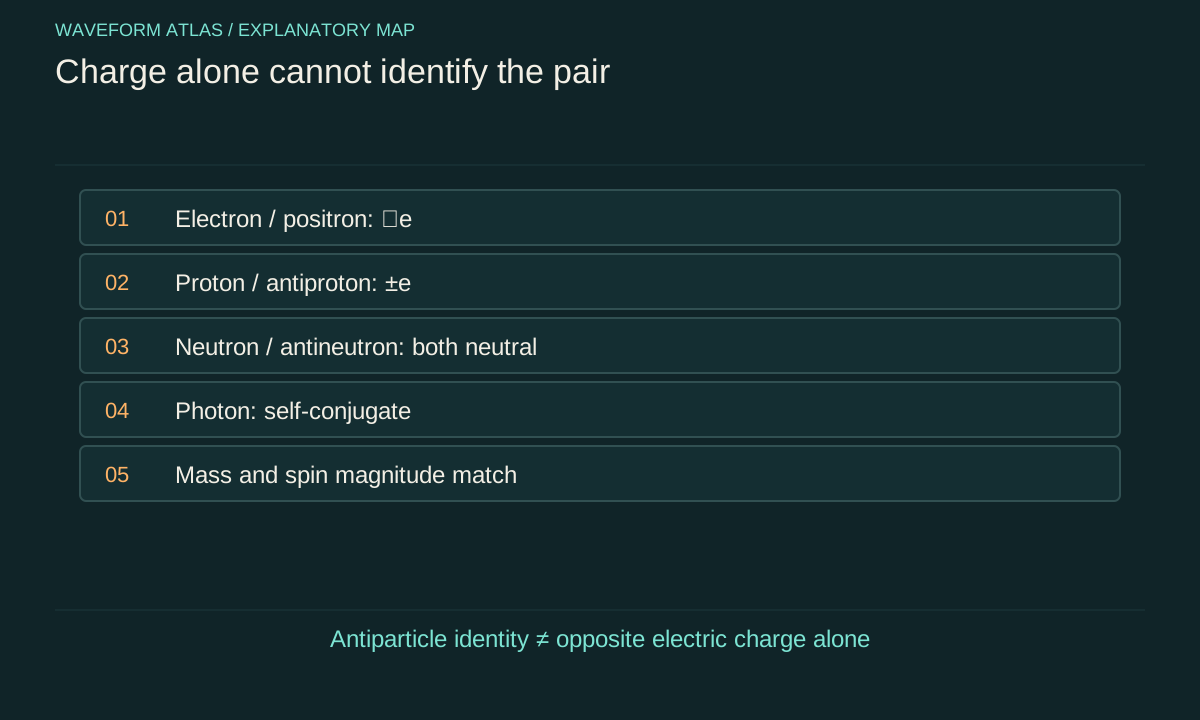
The antiparticle relationship is more specific. Corresponding particles share mass and spin magnitude, while appropriate additive quantum numbers have opposite signs. The electron–positron pair is familiar because electric charge makes part of that relationship visible. It is not the only defining information.
This distinction provides a useful test for explanations built around opposites. Ask whether the proposed operation changes a species label or merely changes a state of the same species. A field reversal can alter a trajectory, and a spin rotation can change measurement probabilities, without changing particle identity. Antimatter language should be reserved for the appropriate particle relationship rather than used as a dramatic synonym for reversed direction or phase.
Opposite charge is necessary for some pairs but insufficient
The electron and positron have charges −e and +e. The proton and antiproton have charges +e and −e. Yet an electron and proton also have opposite charges and are not each other’s antiparticles. Their masses and internal quantum properties are different.
A simple comparison table therefore needs several columns. Charge alone cannot distinguish the electron’s antiparticle from every other positively charged object. Spin magnitude, mass and the relevant species quantum numbers constrain the identification. Experimental identification also uses interaction and decay signatures where appropriate.
The practical consequence is that electromagnetic attraction does not establish an antimatter encounter. A negatively charged particle attracted to a positive target could be participating in ordinary scattering, atomic binding or many other processes. To claim an antiparticle, the measurement must identify the species with enough information to exclude those alternatives. The sign of a deflected track can be one ingredient, but momentum measurement and other detector responses are usually needed to turn that sign into a particle identity.
Neutral particles expose the limitation of the charge picture
A neutron and antineutron are both electrically neutral, yet they are distinct particle species. Their constituent quark content and relevant additive quantum numbers differ. This example immediately disproves the idea that antiparticle means merely a particle with negative electric charge replacing positive charge.
Neutrality also does not imply absence of electromagnetic structure. Composite neutral particles can have magnetic moments and internal charge distributions. Those properties can help characterize them, but a complete identity statement belongs to the underlying particle description.
The example should not be stretched into a claim that every neutral particle has a distinct antiparticle. Some are self-conjugate, and other cases require more careful treatment. The correct classification is species-specific. A useful educational diagram includes at least one neutral distinct pair and one self-conjugate case, so the reader sees both possibilities. It should resist forcing all particles into a plus-minus grid that works only for the simplest charged examples.
A photon is its own antiparticle
The photon is an established example of a self-conjugate particle. There is no separate negatively charged anti-photon species balancing an ordinary positive photon; photons are electrically neutral. Their polarization and momentum states do not create such a distinction.
Two photons can have opposite momenta, orthogonal polarizations or a relative phase in an appropriate field description. Those are state relationships. Calling one an anti-photon because its wave amplitude has a minus sign would confuse the complex representation of a state with particle identity.
This point is particularly useful in optical discussions. Destructive interference can suppress a detection probability in one output mode without invoking photon–antiphoton annihilation. The ordinary optical transformation already explains the result. Photon interactions that create other particles or change frequencies require their own physical conditions and channels. Self-conjugacy does not make every meeting of two light waves a reaction, just as antiparticle identity does not make every possible encounter outcome identical.
Annihilation has products and conservation constraints
Annihilation is a reaction in which the incoming particle–antiparticle identities are replaced by other allowed excitations. The word does not mean energy, momentum or charge bookkeeping ceases to apply. The final state must carry the conserved totals.
For an electron–positron pair approximately at rest, a two-photon channel can yield photons near 511 keV in opposite directions under the appropriate spin and kinematic conditions. Their energies sum to the pair’s rest energy, and their momenta cancel. A single free photon could not satisfy both totals for that isolated initial state.
At higher incoming energy or with different particles, other channels can be available. The probability depends on the interaction and quantum state. A broad statement that matter and antimatter annihilate is useful introductory shorthand, but an experiment requires a specified initial pair and product distribution. Identifying the products is how the reaction is established; merely observing that an incoming track stopped is insufficient because absorption, scattering or detector limitations can also end a visible track.
An encounter can have competing channels
A particle–antiparticle pair can scatter rather than annihilate in a particular encounter. It may also form a bound state under suitable circumstances before subsequent evolution. Which outcome occurs is governed by amplitudes or cross sections for the available channels, not by a deterministic instruction attached to the word opposite.
The incoming energy distribution, spin state and surrounding environment can change the channel probabilities. A detector’s acceptance further changes which outcomes are recorded. An apparent absence of scattering in a narrow detector does not prove that every event annihilated, just as a missing annihilation signal may reflect poor sensitivity.
A quantitative model therefore predicts yields for all relevant channels and propagates them through the instrument response. This is the same discipline used elsewhere in reaction physics. Antiparticle identity narrows the possible interactions, but it does not remove the need for kinematics, dynamics and measurement. The useful question is not whether the pair has an abstract tendency to cancel; it is which outgoing states the specified preparation produces and with what probabilities.
Pair creation is the reverse bookkeeping lesson
Energy can also be converted into particle–antiparticle pairs when the complete initial and final states satisfy conservation and the interaction permits it. The existence of a sufficient energy total is necessary but not always sufficient, because momentum must be balanced as well.
A single photon in empty space cannot become an isolated electron–positron pair while conserving four-momentum. A nearby nucleus or another photon can participate in a process that supplies the required momentum balance. The additional participant is not a decorative detail; it changes the allowed kinematics.
This reverse perspective clarifies annihilation. Rest energy can move into other forms, and other forms can create rest mass, but neither process is simply the arithmetic cancellation or appearance of charge signs. The complete reaction includes all participants and channels. A proposed mechanism should therefore show the full energy-momentum ledger rather than compare only the incoming photon energy with twice the electron rest energy and assume that threshold arithmetic alone guarantees a reaction.
Keep unsettled classifications explicitly unsettled
Not every particle-identity question is settled by an introductory table. In particular, whether neutrinos are their own antiparticles is a separate research question; a basic article should not quietly choose an answer because a symmetrical diagram looks cleaner. Established charged pairs, neutron–antineutron and photon examples are sufficient to teach the main distinction.
Likewise, precise equality tests between particle and antiparticle properties require specialized experiments and stated uncertainties. The theoretical relationship should not be presented as though this article independently measured an exact numerical equality. A source can support the framework without supporting an invented experimental precision.
This restraint improves the explanation. It shows which statements are defining features of the accepted description, which examples are established and which questions remain open. The aim is not to catalogue every possible particle, but to prevent a familiar sign analogy from overrunning the evidence. A reader who understands why charge alone is insufficient is already better equipped to evaluate a more advanced particle-physics claim.
Use identity-sensitive evidence for identity claims
A particle identification combines observables appropriate to the species: charge sign, momentum, energy deposition, timing, decay products or reaction signatures. Different instruments constrain different properties. A claim that an antiparticle was present should explain how the observed combination distinguishes it from ordinary alternatives.
A reaction claim then adds coincidence and conservation tests. Do the products have the expected energies and angular relationships? Does their timing connect them to the prepared incoming pair? Are backgrounds and detector efficiencies characterized? These questions turn an evocative antimatter description into an assessable experiment.
The final distinction is simple but powerful. Opposite phase compares amplitudes, opposite momentum compares vectors and opposite spin projection compares outcomes along an axis. Antiparticle identity compares species within a quantum theory. Only the last supplies the specific relationship discussed here, and even it does not determine every encounter outcome. Keeping those categories separate preserves both the ordinary meaning of interference and the distinctive physics of particle–antiparticle reactions.
What to take forward
- An antiparticle relationship is more specific than opposite electric charge.
- Neutral distinct antiparticles and self-conjugate particles both exist.
- Annihilation and pair creation require complete energy-momentum and product accounting.
Go to the original work.
These links identify the sources behind specific claims. Verification scope varies by source and is stated below.
- 1 / University teachingUniversity Physics Volume 3, 11.1: Introduction to Particle Physics ↗
University Physics Volume 3, 11.1: Introduction to Particle Physics. https://openstax.org/books/university-physics-volume-3/pages/11-1-introduction-to-particle-physics
Particle/antiparticle identities and examples of distinct neutral antiparticles and self-conjugate particles.
Verification scope: Publisher-hosted particle/antiparticle section inspected; unresolved neutrino identity is not inferred from its introductory table.
- 2 / Official researchCERN: Antimatter ↗
CERN: Antimatter. https://home.cern/science/physics/antimatter
The electron–positron relationship and the need to identify the actual particle species.
Verification scope: Institutional overview inspected; simplified outreach language is not used as a claim that charge alone fixes the reaction.
- 3 / University teachingBarton Zwiebach, MIT 8.04: Chapter 2, Experiments with photons ↗
Barton Zwiebach (2016). Chapter 2: Experiments with photons. MIT 8.04 Quantum Physics I, lecture notes, 9 February 2016, pp. 1–8.
Beam-splitter phase conventions, two-path amplitude transformations and Mach–Zehnder recombination.
Verification scope: MIT-hosted lecture-note text and beam-splitter equations inspected.
- 4 / University teachingUniversity Physics Volume 3, 11.2: Particle Conservation Laws ↗
Samuel J. Ling; Jeff Sanny; William Moebs. University Physics Volume 3, 11.2: Particle Conservation Laws. https://openstax.org/books/university-physics-volume-3/pages/11-2-particle-conservation-laws
Opposite baryon and lepton numbers for antiparticles.
Verification scope: Baryon Number Conservation and Lepton Number Conservation inspected; numerical examples in the article remain independent calculations.
Found a problem with a claim or calculation? Send the page, the claim and the evidence. Read how these articles were prepared.