Write the complex field explicitly
A simple monochromatic paraxial vortex field can be written E(r,φ,z,t)=A(r,z)exp[i(kz+ℓφ−ωt)] with additional propagation phases included when needed. The radial envelope A sets the amplitude, while ℓφ supplies azimuthal phase winding. This expression separates the spatial angular dependence from the rapid temporal oscillation. It also identifies the chosen propagation axis about which the angle φ is measured.
The model is scalar and paraxial, so it suppresses some vector and strongly focused-field effects. That is a useful approximation for teaching the basic winding mechanism, not a universal electromagnetic solution. A real beam has finite extent and diffraction. Its radial and longitudinal structure must satisfy the relevant wave equation, rather than being selected independently without regard to propagation.
Count phase around a closed loop
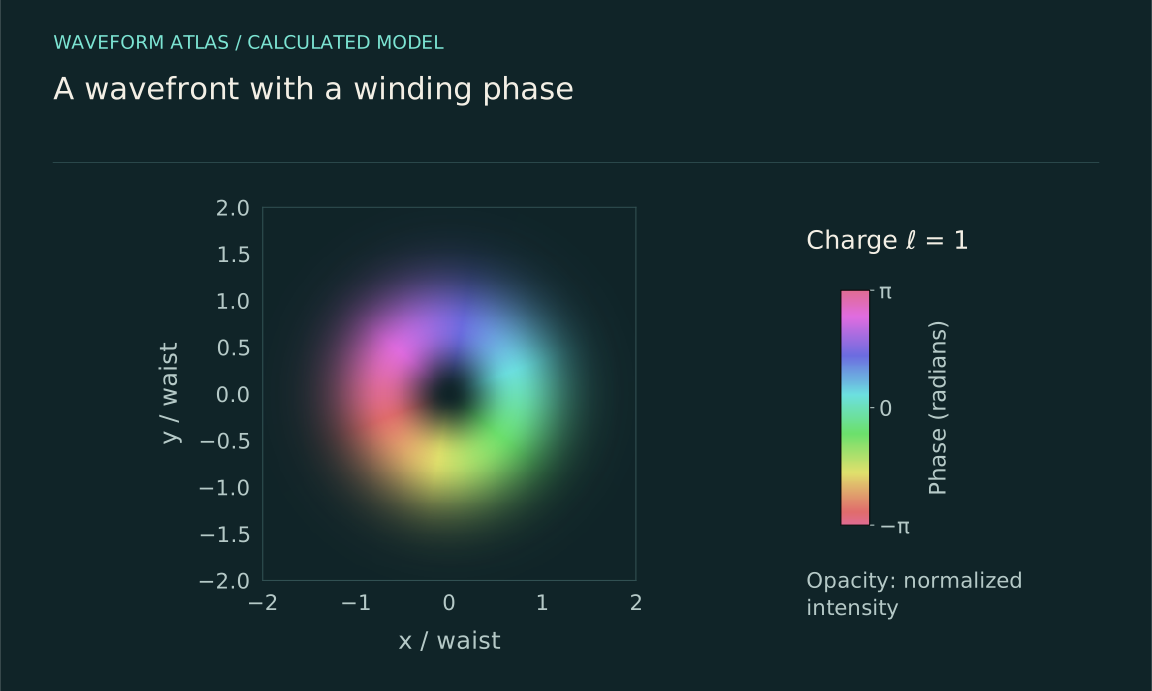
Choose a loop that encloses the axis and does not cross a zero of the field. Follow the phase continuously around it. For exp(iℓφ), the total change is 2πℓ. Single-valuedness requires integer ℓ in this smooth angular eigenmode. The integer is the winding number or topological charge associated with the enclosed singularity, with sign determined by the angle and phase conventions.
Phase is commonly measured modulo 2π, so a plotted phase wheel contains apparent jumps where the colour scale wraps. Those display jumps do not by themselves represent physical discontinuities. Unwrapping must follow the loop consistently. A noninteger phase ramp imposed over one turn requires a discontinuity or a more complicated field description; it should not be treated as the same smooth single angular mode with a fractional integer label.
The core has undefined phase
At a point where the complex amplitude vanishes, its phase is undefined. A regular vortex mode has such a core, allowing nonzero phase winding around it without a contradiction at the centre. The central darkness is therefore connected to the field's phase structure in that mode. It is not evidence that energy throughout the beam has disappeared or that a particle has been annihilated at the axis.
The core position can move, split or interact with other singularities under propagation and perturbation. A loop's measured winding remains unchanged while the field stays nonzero on the loop and no singularity crosses it, under continuous evolution. This topological statement has conditions. It does not mean every intensity feature is immune to noise, or that any arbitrary beam carrying a winding label must preserve its shape through every device.
Interactive model: A structured beam carries a phase winding. Enable JavaScript to adjust its controls.
u ∝ r^|ℓ| e⁻ʳ² eⁱℓφ
Transverse p = 0 Laguerre–Gaussian-like mode in dimensionless waist coordinates. Opacity encodes normalized intensity; cyclic color encodes phase. Paraxial pure modes have orbital angular momentum ℓℏ per photon.
A ring does not determine the winding
The intensity |E|² removes the phase factor, so modes with +ℓ and −ℓ can have identical radial intensity. An annular field with no winding can also have a similar dark centre. A camera image therefore cannot uniquely identify the phase singularity or its sign. The phase information must be obtained through interference, mode projection or another appropriately calibrated measurement.
This ambiguity is a useful test of interpretation. Present two calculated fields with the same amplitude and opposite phase winding to the analysis procedure. If the procedure assigns the same signed charge from intensity alone without additional assumptions, it is not extracting enough information. An intensity-only classification can be valid within a tightly specified family, but the family and its preparation assumptions must be stated.
Constant-phase surfaces have a helical geometry
Ignoring additional propagation phases for the local illustration, a constant phase satisfies kz+ℓφ=constant at fixed time. Increasing φ by 2π changes z along that branch by −ℓ times the wavelength. This gives a helical equal-phase surface. The sign depends on the chosen axis and phase convention. The drawing is a representation of phase, not a material ribbon embedded in the beam.
A monochromatic pure angular mode can still have a stationary rotationally symmetric intensity. The factor exp(−iωt) changes the overall phase without changing |E|². Visible intensity rotation usually requires additional structure, such as a superposition of modes with a changing relative phase. Distinguishing the rotating phase representation from a rotating brightness pattern prevents a common misreading of animated vortex illustrations.
Relate phase winding to orbital angular momentum
In the scalar paraxial model, the generator of rotations about the chosen axis is L_z=−iℏ∂/∂φ. Acting on exp(iℓφ) gives ℓℏ times the same angular function. A normalized single-photon mode of this form therefore has a definite orbital angular-momentum value about that axis within the model. For a classical beam, the corresponding angular-momentum flux relates to power and optical frequency.
The result applies to an angular eigenmode with appropriate radial and polarization assumptions. A superposition has a distribution of ℓ values, and a displaced axis changes the orbital accounting. Local phase gradients can help describe momentum flow, but should not be turned into literal photon trajectories without a justified measurement model. The experimentally meaningful quantities are the mode content, field correlations and transferred angular momentum.
Radial structure changes with the mode family
For a simple zero-radial-index Laguerre–Gaussian-like envelope, amplitude scales as r^|ℓ| exp(−r²/w²). Its intensity is proportional to r^(2|ℓ|)exp(−2r²/w²). Differentiating the logarithm shows that the radial maximum occurs at r=w√(|ℓ|/2) for nonzero ℓ. Higher winding in this chosen family therefore moves the bright ring outward for fixed w.
That radius is a property of the specified family, not a universal measurement of charge from every ring. Changing the radial mode, waist or optical system can alter the radius independently. A beam with the same ℓ can have several radial rings. When comparing modes, record radial indices and normalization as well as winding. Otherwise a change in spot size can be mistaken for a change in angular momentum.
Propagation and apertures can mix angular content
A centered rotationally symmetric system can preserve angular mode labels under appropriate conditions. An off-axis aperture, asymmetric aberration or scattering element can mix them. The outgoing beam may retain some total power while a detector matched to the original mode sees a large reduction. That is a change in mode content, not necessarily absorption or a loss of all coherence.
Measure the output angular spectrum and total collected power separately. If the transformation is stable and sufficiently well characterized, an inverse or mode converter can recover selected structure. Random fluctuations require a statistical description. The diagnostic question is which amplitudes and phase relations changed, not whether the output still resembles the original doughnut image.
Topology does not guarantee a protected quantum state
A winding number can remain identifiable while coherence between different angular alternatives is lost. Conversely, a coherent transformation can change winding while preserving the quantum state information in a new mode basis. These are different properties. A topological phase feature is not automatically an error-correcting code or a proof that environmental interactions cannot reveal information about the state.
If a proposal claims robustness, specify the perturbation class and the observable that remains stable. Test throughput, angular-mode populations and relative phases under those perturbations. A stable intensity ring alone supplies limited evidence. The useful conclusion may be that a particular mode label survives a tested deformation, while phase-sensitive information requires additional control or calibration.
Record the viewing direction, propagation direction and definition of increasing azimuth. Reversing the camera view can reverse the apparent handedness of a pattern without changing the physical beam. A mirror can also alter the relation between laboratory coordinates and mode labels. These bookkeeping details matter when comparing source settings, interferograms and measured torque signs.
A complete description gives the complex-field convention, axis, radial mode, polarization and measurement method. It labels calculated phase surfaces as explanatory geometry and measured interferograms as data. With those elements specified, a helical phase becomes a precise spatial property that can be created, transformed and measured, rather than a suggestion that the beam is a physically twisted object whose quantum state must somehow break.
An integer winding and mean orbital angular momentum need not agree for an arbitrary superposition. On a ring, take amplitudes √0.75 in ℓ=0 and √0.25 in ℓ=2. The mean angular momentum is 0.5ℏ. Yet the complex field as a function of angle traces a circle centred at √0.75 with radius √0.25, which does not enclose the origin, so its net phase winding is zero. This calculated example assumes the same radial and polarization factors. It shows why measuring one topological charge is not generally a complete measurement of the angular-momentum distribution.
With real Laguerre–Gaussian radial profiles, the relative mode amplitudes vary with radius and the winding can depend on which loop is chosen. The identical-envelope comparison above is an idealization.
What to take forward
- Helical phase changes by 2πℓ around a nonzero closed loop.
- Opposite winding signs can have identical intensity.
- Winding and mean angular momentum are not identical for arbitrary superpositions.
Go to the original work.
These links identify the sources behind specific claims. Verification scope varies by source and is stated below.
- 1 / Primary theoryAllen et al. (1992), Orbital angular momentum of light and the transformation of Laguerre-Gaussian laser modes ↗
L. Allen; M. W. Beijersbergen; R. J. C. Spreeuw; J. P. Woerdman. Physical Review A 45, 8185 (1992).
Paraxial Laguerre–Gaussian modes can carry defined orbital angular momentum and be transformed between mode bases.
Verification scope: Publisher abstract and publication metadata inspected.
Found a problem with a claim or calculation? Send the page, the claim and the evidence. Read how these articles were prepared.