Choose an orthonormal angular basis
On an ideal ring, angular functions exp(iℓφ)/√(2π) with integer ℓ form an orthonormal basis. They are eigenfunctions of L_z=−iℏ∂/∂φ with eigenvalues ℓℏ. A normalized state can be expanded as a sum of these functions with complex coefficients c_ℓ, whose squared magnitudes sum to one. This model isolates angular structure without additional radial complications.
For an optical beam, radial modes and polarization must also be specified. Two fields with different radial profiles may not interfere with the same visibility as the ideal ring functions. State the complete mode basis used by the preparation and detector. The angular label is one part of the state, not a complete description of every spatial or vector property.
Form an equal opposite-mode superposition
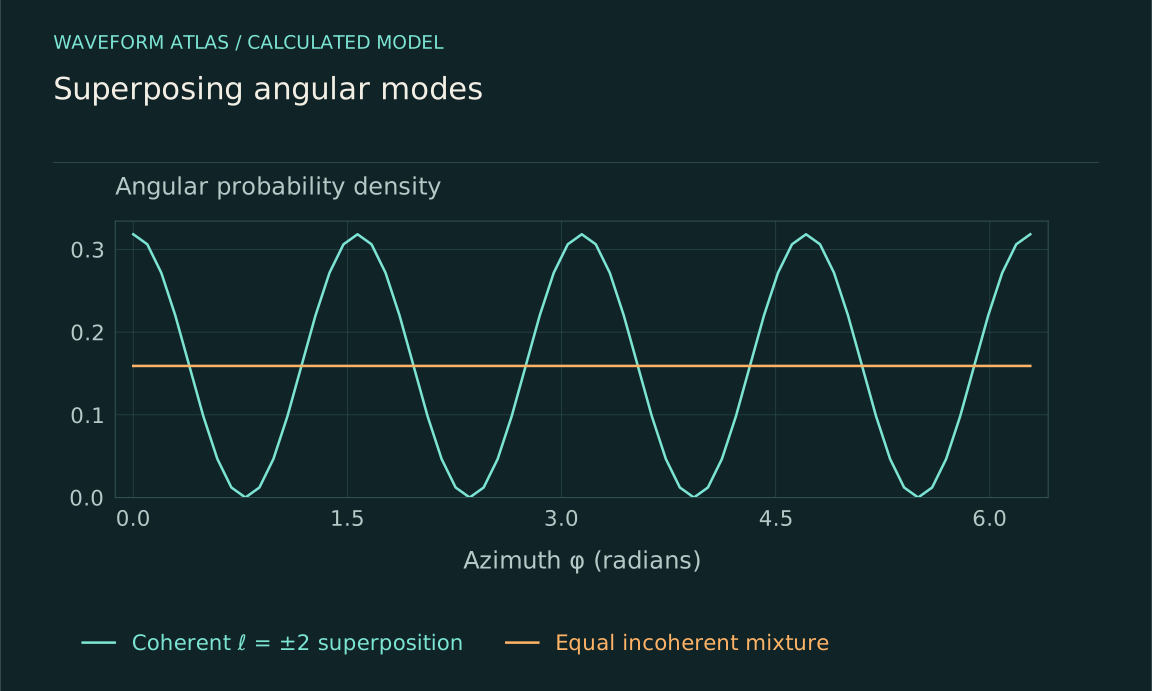
For nonzero ℓ, consider ψ(φ)=[exp(iℓφ)+exp(iδ)exp(−iℓφ)]/√(4π). Orthogonality ensures normalization. Its angular density is [1+cos(2ℓφ−δ)]/(2π). The interference term produces 2|ℓ| lobes around the ring. The relative phase δ sets their orientation, while the probabilities of measuring +ℓ or −ℓ remain one half each.
For ℓ=2, the density has four lobes. Changing δ by π/2 rotates the pattern by 22.5 degrees under the stated convention. This is a calculated ideal example, not a measured image. The spatial pattern reveals phase information that an angular-momentum population measurement discards. Both measurements are valid, but they answer different questions about the same prepared state.
Compare the incoherent mixture
An equal incoherent mixture of +ℓ and −ℓ has the same one-half populations but no fixed relative phase. Its angular density is uniform in the ideal ring model because the interference cross term is absent. The pure superposition and mixture therefore agree in one measurement basis and differ in another. Measuring only the angular-momentum histogram cannot distinguish them.
In density-matrix language, the diagonal entries give populations and the off-diagonal entries encode coherence in this basis. A change in those off-diagonal terms can alter the lobe contrast without changing the populations. This is why a claimed loss of angular coherence needs a complementary-basis measurement rather than simply observing that the source still produces equal numbers of positive and negative angular outcomes.
Zero mean does not mean no angular uncertainty
The equal opposite-mode superposition has mean angular momentum zero, but its variance is ℓ²ℏ². An angular-momentum measurement returns one of the nonzero alternatives in this ideal state. The equal mixture has the same mean and variance in that basis. Neither is the same state as a definite zero-angular-momentum mode, which has zero variance there.
This example separates three ideas often compressed into the word cancellation: cancellation of a mean, destructive interference at a particular angle, and absence of the entire state. The first two can occur while the state remains normalized and physically active. Measure the distribution or a phase-sensitive observable before treating a zero expectation value as evidence that opposite angular properties destroyed one another.
Rotation changes relative phase predictably
An active rotation through angle α acts on an angular eigenmode with phase exp(−iℓα) under the usual convention. A superposition of different ℓ values therefore acquires different component phases. Its intensity pattern can rotate even though its angular-momentum populations remain unchanged. A single eigenmode with rotationally symmetric density can acquire a phase without any visible intensity change.
A passive rotation of coordinates describes the same physical state in new axes and should not be mistaken for an applied torque. Record the laboratory reference used to compare patterns. An image that rotates because the camera moved is different from a state transformed by an optical element. The mathematics can look similar, but the energy and angular-momentum exchanges belong only to the active physical process.
Time evolution need not rotate the pattern
For a free particle on an ideal ring, energy is ℓ²ℏ²/(2I), with rotational inertia I. The +ℓ and −ℓ modes are degenerate, so their relative phase remains constant under that Hamiltonian. Their coherent lobe pattern can therefore remain stationary. Opposite angular components do not automatically imply visible counterrotation or a rotating interference image.
A superposition of modes with different energies accumulates a relative phase at their energy difference divided by ℏ. Its angular pattern can evolve accordingly. In optical fields, different temporal frequencies or imposed phase modulation can also rotate a pattern. State the Hamiltonian or frequency difference that generates the motion rather than animating a static superposition as though rotation were an inevitable consequence of its labels.
A phase mask can shift the entire angular spectrum
Multiplying a ring state by exp(iqφ), with integer q, maps each angular label ℓ to ℓ+q. Relative differences between labels remain unchanged. The transformation is unitary in the ideal angular model and preserves the information in their coefficients. It changes the mean angular momentum by qℏ for a normalized single-particle state, with a corresponding reaction on the physical device that implements it.
This provides a simple example of changing twist without erasing coherence. A superposition can emerge in a different pair of angular modes while retaining its relative phase. A detector matched only to the original labels may report little signal. Reconfiguring the detector or applying the inverse mask can reveal the preserved state. Losses and finite-aperture effects must be added for a real implementation.
Experimental quantum correlations have been reported
Mair and colleagues reported entanglement involving photon spatial modes carrying orbital angular momentum. The verified primary abstract identifies a quantum correlation experiment using these modes. It establishes that angular spatial structure can support quantum superposition and entanglement rather than being intrinsically incompatible with them. Our account does not reproduce the paper's full apparatus or statistical analysis.
A single classical beam with a patterned intensity is not the same evidence. Classical fields can display interference and correlations among their spatial and polarization components. A specifically quantum claim requires an appropriate preparation and witness. Use the primary experiment at its actual scope and avoid treating every petal-shaped image as proof of entanglement or every angular-mode transformation as a measurement-induced state reduction.
Environmental records can suppress accessible interference
If different angular alternatives become correlated with distinguishable environmental states, tracing over that environment reduces their off-diagonal coherence. The reduction depends on the overlap of those environmental records. Loss, scattering or polarization correlations can contribute in an actual apparatus. The resulting angular populations may remain unchanged, so a population-only test can miss the effect.
Technical relative-phase fluctuations can also wash out an averaged pattern. Recording a reference can sometimes separate that uncertainty from inaccessible environmental information. Compare individual trials, phase-referenced averages and intentionally randomized controls. The same smooth ring in an averaged image can arise from different mechanisms, and the available records determine which explanations the experiment can distinguish.
Measure in more than one basis
Use an angular-mode sorter or equivalent projection to estimate populations, then project into superpositions to estimate relative-phase information. For a two-mode subspace, several controlled reference phases can constrain the relevant density-matrix elements. Include detector efficiencies and cross-talk in the reconstruction, and check that the inferred matrix remains physical within uncertainty.
Report survival probability alongside the reconstructed state of detected events. A clean conditional superposition can coexist with substantial loss. Also disclose the assumed subspace: unmeasured radial or angular modes can make an apparently complete two-state reconstruction incomplete. A calibrated wide-aperture power or count measurement helps assess leakage beyond the modes used in the coherence analysis.
The phase of a sum of angular modes can have zeros and spatial structure that differ from a pure vortex. Assigning the whole superposition one integer charge may be ambiguous unless a specific nonzero loop and field component are defined. The angular-momentum spectrum and the topology of a particular phase map are related but not identical descriptions.
A clear report gives the coefficients or measured populations and coherences in the stated basis, then separately describes any phase singularities. That separation prevents a change in visible core structure from being mistaken for destruction of the state. Angular superpositions remain ordinary quantum states with testable interference, conserved normalization and explicit interactions that determine how their information evolves.
Unequal amplitudes provide a quantitative coherence check. For probabilities p and 1−p in two matching angular modes, an ideal coherent interference term has visibility 2√[p(1−p)] when no other background is present. With p=0.9, the maximum visibility is 0.6 even though the state is pure. Reduced contrast therefore does not automatically mean reduced coherence; population imbalance can explain it. Measure the populations independently and compare the observed visibility with that allowed maximum. Background, radial mismatch and phase noise can reduce it further. This calculated example identifies which additional measurements are needed before a lobe contrast is interpreted as a density-matrix coherence estimate.
Keep the radial overlap calibration fixed during phase scans, so that a changing spatial match cannot imitate a changing coherence.
What to take forward
- A coherent angular superposition differs from a population mixture.
- Zero mean angular momentum can coexist with nonzero variance.
- Relative phases require measurements in a complementary basis.
Go to the original work.
These links identify the sources behind specific claims. Verification scope varies by source and is stated below.
- 1 / University teachingMIT Quantum Physics I: lecture notes ↗
Course materials cover normalization, observables, wells, scattering and angular momentum.
Verification scope: Official course index inspected; linked lecture topics verified.
- 2 / Primary theoryAllen et al. (1992), Orbital angular momentum of light and the transformation of Laguerre-Gaussian laser modes ↗
Paraxial Laguerre–Gaussian modes can carry defined orbital angular momentum and be transformed between mode bases.
Verification scope: Publisher abstract and publication metadata inspected.
- 3 / Primary experimentMair et al. (2001), Entanglement of the orbital angular momentum states of photons ↗
Reported entanglement involving photon spatial modes carrying orbital angular momentum.
Verification scope: Primary-paper abstract in PubMed and publisher metadata inspected; DOI 10.1038/35085529 verified; detailed statistical analysis not reproduced.
Found a problem with a claim or calculation? Send the page, the claim and the evidence. Read how these articles were prepared.