Identify the measurement problem being addressed
A unitary measurement interaction produces correlations between system alternatives and apparatus records. Environmental decoherence can suppress local interference and stabilize certain records. The remaining foundational question is how this joint description relates to a definite reported outcome. Different accounts may modify the dynamics, add physical structure, retain the global state or reinterpret the role of the state assignment.
The word collapse is itself ambiguous. It can mean an operational update conditioned on a record, a real stochastic physical process or an effective description within a broader theory. Arguments become confused when one speaker uses the word in the first sense and another in the second. Before comparing interpretations, specify which claim is at issue. A rule for updating predictions after learning a result is not automatically a new force acting on the system.
Operational use does not settle ontology
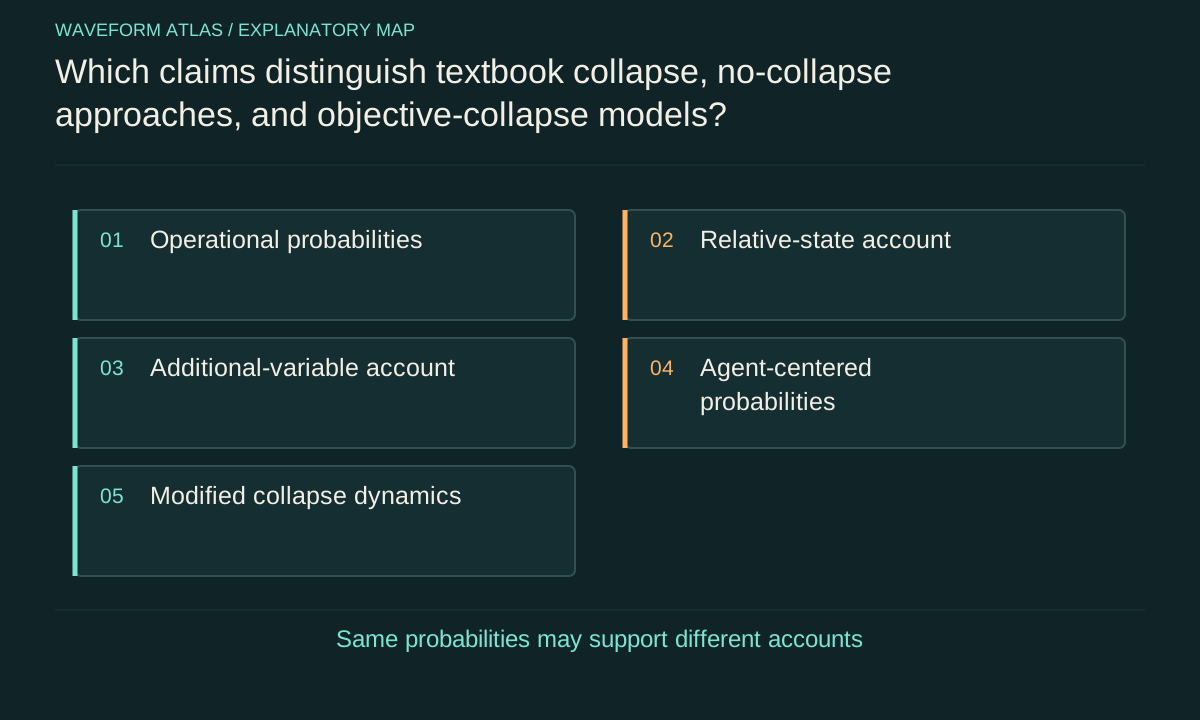
An operational account emphasizes preparations, transformations, measurement effects and outcome probabilities. It is sufficient for many laboratory tasks. Given a state ρ and effects E_j, calculate Tr(ρE_j), then use an instrument if later measurements are involved. This framework tells an experimentalist how to make predictions without requiring agreement on every question about the ultimate nature of the quantum state.
That practical neutrality should not be mistaken for a claim that all foundational questions are meaningless. It is a deliberate level of description. A device characterization can be successful while a broader explanatory issue remains open. Conversely, adopting an ontological story does not remove the need for calibration or a correct probability calculation. The operational framework provides a common language in which competing accounts can state where they agree and where an additional assumption might matter.
Here “operational” names the textbook calculation framework; it is not a claim that every view grouped under the Copenhagen label makes identical interpretive commitments.
Relative-state approaches retain global evolution
Everett’s original program applies quantum dynamics to the combined system, apparatus and observer rather than introducing a separate physical reduction at measurement. The resulting state contains correlated records, and subsystem descriptions are understood relative to other parts of that state. This is the origin of a family of no-collapse approaches often discussed under the many-worlds label. The original formulation and later elaborations should not be treated as one completely uniform doctrine.
The central explanatory task is then to connect the global state, stable record structure and observed probability statistics. An animation that simply draws multiple worlds does not perform that task. The approach keeps the unitary dynamics but changes the account of what a definite record means within the whole description. Its agreement with ordinary laboratory predictions is not itself a direct observation of every element of its ontology.
The 1957 “Relative State” journal article and the longer “Theory of the Universal Wave Function,” reprinted in 1973, are separate texts and are listed separately below.
Additional-variable approaches add physical structure
Bohm’s 1952 work provides an example of an account with additional variables describing individual systems. Its primary abstract explicitly states agreement with usual predictions while the mathematical framework retains its specified form. The important point for this comparison is that a wavefunction need not be treated as the complete physical description in every interpretation. Additional structure can change the account of individual processes without necessarily changing the measured distribution in the regime considered.
Such approaches must be assessed through their actual equations and assumptions, not through the vague phrase hidden variables. Bell tests constrain local hidden-variable descriptions under defined assumptions; they do not eliminate every possible theory with additional variables. A fair comparison asks how the theory represents records, reproduces the probability rule and handles correlations. It does not assume that adding variables automatically restores every classical intuition about locality or preexisting values.
Agent-centered accounts interpret probability differently
QBism treats quantum probabilities and state assignments in relation to an agent’s expectations rather than as a direct inventory of observer-independent properties encoded by an objective state. Fuchs and Schack describe the Born rule as an empirically motivated normative constraint on probability assignments. This is a distinct interpretive position about what the formalism is doing, not a proposal that arbitrary beliefs can override experimental frequencies.
A reader should resist turning that position into the claim that consciousness physically creates matter. The relevant issue is the meaning of probability and state assignment in the theory. As with other interpretations, one should distinguish the proponents’ philosophical commitments from the operational predictions shared with standard calculations. The brief summary here identifies that commitment; it does not claim to resolve the wider debate over whether an agent-centered account supplies the most satisfactory explanation.
Objective-collapse theories alter dynamics
Objective-collapse models introduce physical changes to state evolution intended to produce definite outcomes without relying on a special observer. Because they modify the dynamics, they can predict departures from ordinary quantum theory, including extra coherence loss, heating or radiation in particular implementations. This makes them different from accounts that preserve all standard observable predictions in the same regime.
The label does not identify one equation. A model must specify its operators, noise, rates, length scales and any dissipation. Penrose’s gravitational motivation and a particular Diósi–Penrose implementation should likewise be distinguished. Experimental exclusions attach to the specified predictions. Calling a model an interpretation does not exempt it from a failed test, and calling it a new theory does not establish that its predicted effects occur. The empirical question follows the dynamics, not the label.
For example, Donadi and colleagues’ underground radiation search excludes the specific natural parameter-free DP implementation they test. It does not experimentally choose between all interpretations that retain the usual operational probabilities.
Use a simple equivalence test
Imagine two descriptions that assign the same initial density operator, the same transformation channel and the same measurement effects to every step of a protocol. They necessarily predict the same outcome probabilities for that protocol. No amount of repetition of exactly that measurement can distinguish them statistically. More trials reduce uncertainty about the shared prediction; they do not create a difference that the models do not contain.
To move forward, ask whether the descriptions differ for another accessible preparation, transformation or observable. A modified collapse law might diverge at larger mass or longer coherence time. Two empirically equivalent interpretations may instead remain distinguished by explanatory criteria rather than a proposed experiment. Stating this honestly is more useful than announcing that a familiar two-slit pattern proves one account. The experiment must be matched to an actual difference in predictions.
Keep thought experiments and laboratory tests separate
A thought experiment can expose tensions between assumptions even when its ideal apparatus is not currently practical. For example, treating a large observer and laboratory as a coherent quantum system raises questions about combining different state assignments and records. The logical analysis can be valuable, but an imagined perfect reversal of a macroscopic laboratory is not an accomplished experiment. The physical feasibility and the interpretive assumptions should be stated independently.
Laboratory analogues generally implement a limited set of degrees of freedom and operations. Their conclusions concern that implementation and the assumptions used to map it onto the thought experiment. Describing a small quantum memory as a conscious observer adds a claim the apparatus does not establish. The right question is which logical or physical feature was tested, not whether a dramatic name makes the experiment equivalent to every aspect of the imagined scenario.
Compare explanations without inventing a winner
A useful comparison asks what each account takes as fundamental, how it treats records, whether it preserves standard dynamics and what additional assumptions it needs. It distinguishes established experimental statistics from unresolved explanatory questions. Where a theory makes new predictions, it identifies the relevant tests. Where accounts remain empirically equivalent for the protocol, it says so rather than manufacturing a laboratory verdict.
Readers do not need to adopt an interpretation to use the atlas’s calculations. They do need to know when a sentence goes beyond those calculations. Saying that an apparatus becomes correlated with a system is an operationally modeled interaction. Saying that one branch physically disappears, that all branches persist or that the state expresses an agent’s expectations adds an account of that interaction. Keeping those statements visible makes disagreement more precise and allows evidence to do the work it can actually do.
This comparison is deliberately selective rather than an exhaustive taxonomy of quantum foundations. Labels often contain multiple variants, and their proponents can disagree about details. A reader evaluating a stronger claim should identify the exact formulation and its proposed empirical difference. The short summaries here establish conceptual boundaries; they do not claim that a popularity ranking or a single familiar experiment has settled the broader debate.
What to take forward
- Shared measurement statistics do not select a unique ontology.
- Objective-collapse dynamics can make additional testable predictions.
- Compare actual assumptions and equations rather than interpretation labels.
Go to the original work.
These links identify the sources behind specific claims. Verification scope varies by source and is stated below.
- 1 / University teachingPreskill, Quantum Information, Chapter 3: Measurement and Evolution ↗
J. Preskill (2018). Lecture Notes for Ph219/CS219, Chapter 3: Foundations II: Measurement and Evolution, updated October 2018. Caltech.
Quantum measurement operators and instruments, channels, dephasing, amplitude damping and open-system evolution. Not a detector-calibration or sampling-statistics handbook.
Verification scope: Author-hosted lecture PDF inspected for relevant sections; not an exhaustive audit of every lecture derivation.
- 2 / Primary theoryDecoherence, einselection, and the quantum origins of the classical ↗
Wojciech H. Zurek. Reviews of Modern Physics 75, 715 (2003). Linked record is the author preprint.
DOI: 10.1103/RevModPhys.75.715
Environmental monitoring, preferred records and suppression of local interference.
Verification scope: Author-posted review abstract and APS bibliographic record inspected; source supports the decoherence framework, not an independent audit of each apparatus or biological state.
- 3 / University teachingPreskill, Quantum Information, Chapter 2: States and Ensembles ↗
Preskill, J. Quantum Information, Chapter 2: States and Ensembles. Caltech lecture notes (2015 version).
Pure states, density operators, partial trace, pure-state entanglement, Born probabilities and quantum erasure. Does not supply mixed-state witnesses, entropy or quadrature formulas cited elsewhere.
Verification scope: Author-hosted lecture PDF inspected for relevant foundational definitions; independent elementary examples are worked in the article.
- 4 / Primary theoryThe Theory of the Universal Wave Function ↗
Everett, H., III (1973). The Theory of the Universal Wave Function. In B. S. DeWitt and N. Graham (eds.), The Many-Worlds Interpretation of Quantum Mechanics. Princeton University Press. Long exposition, distinct from the 1957 journal article.
Original account of applying quantum dynamics to apparatus and observers without a separate reduction process.
Verification scope: University-hosted collection title and contents inspected. This link is the long exposition reprinted in 1973; the separately cited 1957 article has its own DOI.
- 5 / Primary theoryA Suggested Interpretation of the Quantum Theory in Terms of Hidden Variables I ↗
David Bohm. Physical Review 85, 166 (1952).
Original hidden-variable interpretation and its stated agreement with usual predictions under the specified mathematical framework.
Verification scope: Primary publisher abstract and bibliographic record inspected; not a full-paper audit.
- 6 / Primary theoryQuantum-Bayesian Coherence: The No-Nonsense Version ↗
Christopher A. Fuchs; Rüdiger Schack. Reviews of Modern Physics 85, 1693 (2013). Linked record is the author preprint.
DOI: 10.1103/RevModPhys.85.1693
Authors’ account of quantum probabilities and the Born rule in QBism.
Verification scope: Author-posted abstract and publication record inspected; summary is restricted to the stated interpretive position.
- 7 / Primary theoryModels of wave-function collapse, underlying theories, and experimental tests ↗
A. Bassi, K. Lochan, S. Satin, T. P. Singh, and H. Ulbricht. Reviews of Modern Physics 85(2), 471–527 (2013). Linked record is the author preprint.
DOI: 10.1103/RevModPhys.85.471
Research authors’ synthesis of stochastic collapse dynamics, motivation and distinct experimental signatures.
Verification scope: Author-posted abstract and APS journal record inspected. Supports collapse-model motivation, dynamical modifications and experimental signatures; not the article’s independent calculations or reporting advice.
- 8 / Primary theory“Relative State” Formulation of Quantum Mechanics ↗
Hugh Everett III. Reviews of Modern Physics 29, 454 (1957).
DOI: 10.1103/RevModPhys.29.454
Original short journal formulation of the relative-state approach.
Verification scope: APS article identity and bibliographic record inspected; the longer exposition is linked separately.
- 9 / Primary experimentUnderground test of gravity-related wave function collapse ↗
Sandro Donadi; Kristian Piscicchia; Catalina Curceanu; Lajos Diósi; Matthias Laubenstein; Angelo Bassi. Nature Physics 17, 74–78 (2021).
DOI: 10.1038/s41567-020-1008-4
Gran Sasso spontaneous-radiation test and exclusion of the natural parameter-free implementation considered in that paper.
Verification scope: Publisher abstract and publication record inspected; published online 7 September 2020, journal issue 2021. Scope is the tested stochastic implementation, not every gravity-related reduction proposal.
Found a problem with a claim or calculation? Send the page, the claim and the evidence. Read how these articles were prepared.