Small-particle Rayleigh scattering
Adjust the controls, inspect the calculated response and use the reading links to place the model in its physical context.
Interactive model: Small-particle Rayleigh scattering. Enable JavaScript to adjust its controls.
Cross-section scaling ∝ λ⁻⁴; angular shape ∝ 1 + cos²θ
Unpolarized light, a fixed isolated particle much smaller than every selected wavelength, and fixed optical properties. The curves show relative differential cross section in the Rayleigh limit; multiple scattering and Mie corrections are omitted.
What this model assumes
Unpolarized light, a fixed isolated particle much smaller than every selected wavelength, and fixed optical properties. The curves show relative differential cross section in the Rayleigh limit; multiple scattering and Mie corrections are omitted.
How to explore it
Begin with the default values. Change one control at a time and watch both the graph and the readouts. Then reset the model and change another parameter. This isolates which input produces the effect you are seeing.
The plotted values are generated from the displayed equation. Downloading the calculated data lets you inspect the numerical series or compare it with a calculation of your own. The data are synthetic model outputs, not observations from an apparatus.
Before carrying a prediction into an experiment, match the model’s assumptions to the actual system: the relevant degrees of freedom, boundary conditions, noise, losses and measurement convention. The linked articles explain which comparison is physically meaningful.
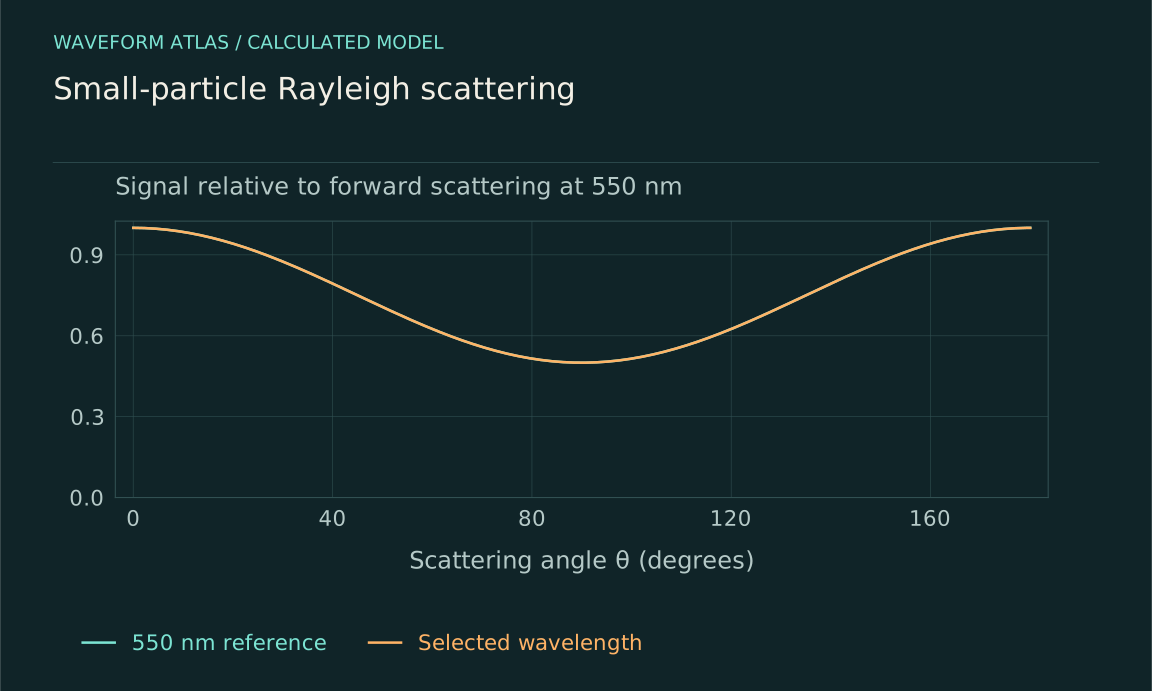
Calculated model curves. Unpolarized light, a fixed isolated particle much smaller than every selected wavelength, and fixed optical properties. The curves show relative differential cross section in the Rayleigh limit; multiple scattering and Mie corrections are omitted. Default control values are used in this fixed figure.
Download SVG ↓Scattering
What changes when a wave scatters?
How does an interaction redistribute an incoming wave among outgoing possibilities?
Same energy or changed energy?
What distinguishes elastic and inelastic scattering?
Reading an angular scattering pattern
What can the direction of scattered intensity reveal about a target?
Cross section as an interaction measure
Why is a cross section not simply the object’s geometric area?
One scattering event or many
How does repeated scattering change transport through a medium?
Interference between scattered amplitudes
When does scattering preserve phase information and reveal structure?
Scattering that records a path
When does an outgoing particle carry information about an alternative?
Recovering information after scattering
Under what conditions can transmitted wavefronts be measured or corrected?
Measure an interaction without confusing it with absorption
How can angular coverage and transmission measurements prevent a false loss claim?
What a new scattering result must demonstrate
How can a surprising pattern be tested against geometry and apparatus artifacts?