A short force sets new initial conditions
For a mass–spring oscillator, a brief force primarily changes momentum while displacement remains nearly continuous. Integrating the equation of motion across an ideal impulse gives m[v(0⁺) − v(0⁻)] = J. The subsequent motion follows the oscillator's ordinary equation with that updated velocity. The impulse is therefore a compact way to specify a state change, not a separate law of motion.
The approximation is valid when the force duration is short compared with the relevant oscillation period and when displacement during the force is negligible for the desired accuracy. If contact lasts a substantial fraction of a cycle, the force can interact with the evolving displacement and phase. Then its full time dependence must be retained rather than represented only by its integral.
The undamped response is explicit
For an oscillator initially at rest with natural angular frequency ω₀, an impulse J at time zero gives x(t) = [J/(mω₀)]sin(ω₀t) for later times. The amplitude is proportional to impulse and inversely proportional to mass and frequency. Initial energy is J²/(2m), which alternates between kinetic and spring energy afterward in the ideal undamped model.
Choose m = 2 kilograms, ω₀ = 5 radians per second and J = 1 newton-second. The velocity jump is 0.5 meters per second, the displacement amplitude is 0.1 meter and the energy is 0.25 joule. These are original illustrative numbers. A real device may violate the small-displacement approximation at that amplitude, so the arithmetic is a model demonstration rather than an engineering specification.
Damping turns the response into a ringdown
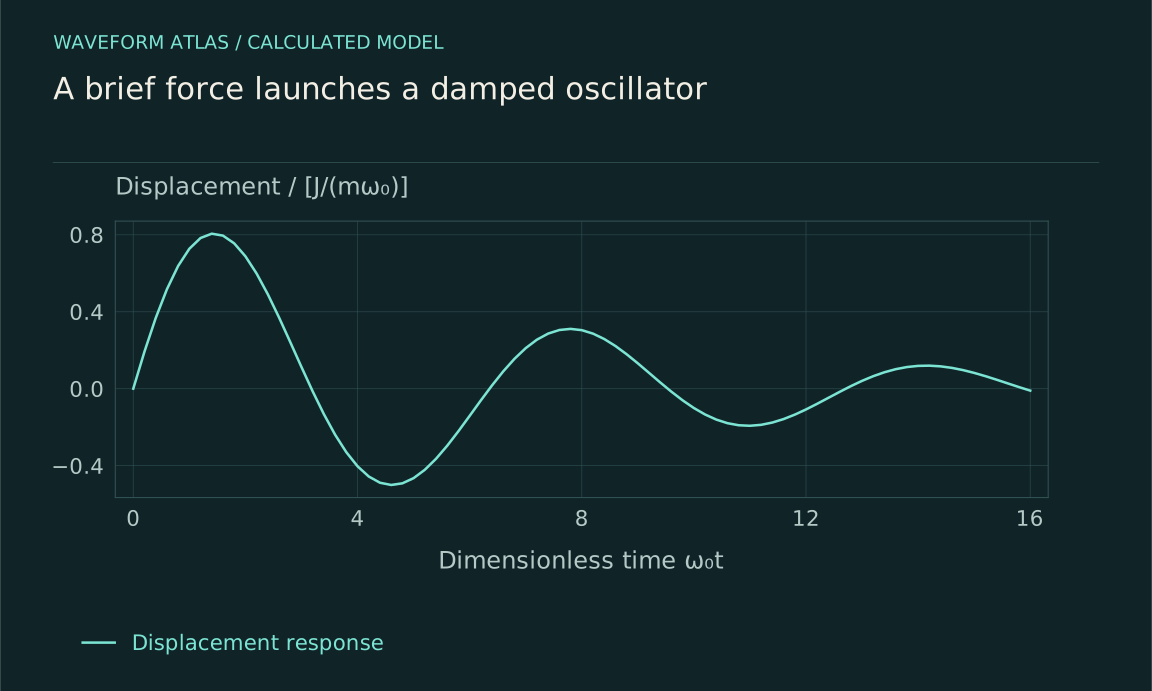
For m ẍ + b ẋ + kx = Jδ(t), define γ = b/(2m) and ω₀² = k/m. In the underdamped regime, ω_d = √(ω₀² − γ²), and the response from rest is x(t) = [J/(mω_d)]exp(−γt)sin(ω_dt). The envelope decays while the oscillator continues to exchange kinetic and potential energy.
The amplitude decay rate is γ. An energy-like envelope scales approximately as exp(−2γt) in the weakly damped regime, so amplitude and energy lifetimes differ. State which quantity was fitted. Critical and overdamped regimes have different functional forms and should not be forced into a sinusoidal ringdown fit simply because an impulse was applied.
Interactive model: A brief push leaves a ringing response. Enable JavaScript to adjust its controls.
F = J/Δt during the pulse; J = 1
Unit-mass, unit-frequency oscillator initially at rest, driven by one rectangular force pulse with fixed external impulse J = 1. Restoring forces act during the pulse, so residual energy depends on duration.
A force history is a sum of small impulses
For a linear time-invariant system, the response to an arbitrary force can be written as a convolution with the unit impulse response h(t). In symbols, x(t) = ∫h(t − τ)F(τ)dτ, plus any response from preexisting initial conditions. The integral adds the delayed response to every small piece of forcing.
This relation explains why measuring an impulse response can characterize a system over a useful band. It also states the assumptions: linearity and time invariance. If the impact changes stiffness, temperature or contact geometry, one fixed h may no longer predict later behavior. If the response depends on amplitude, the superposition used in the convolution fails.
Short duration broadens the force spectrum
A rectangular force pulse of duration Δt and total impulse J has a Fourier amplitude proportional to J times a sinc function of frequency and duration, with a phase factor set by timing. Its first spectral zero occurs at angular frequency 2π/Δt. Shortening the pulse at fixed impulse moves that zero outward, extending the approximately flat low-frequency forcing band.
This does not guarantee equal energy in every mode. Each mode has its own coupling and response. It also does not mean an arbitrarily short physical impact is harmless: maintaining fixed impulse while shortening duration increases typical force. Contact mechanics, material limits and sensor bandwidth can become important. The ideal delta pulse summarizes a band-limited approximation, not a physically unlimited spectrum.
Spatial shape selects modes
For a distributed system with mode shapes φ_n(x), the force couples through a spatial overlap with each mode. A point impulse at x₀ gives a modal impulse proportional to φ_n(x₀), under a chosen normalization. A distributed force can reinforce or cancel across a mode shape. The same total impulse can therefore produce very different modal energy distributions.
A strike at the center of an ideal fixed-end string does not couple equally to all modes. Modes with a node at that point have zero point-force coupling in the ideal symmetry. Moving the strike away from the center changes the selection. This is a direct, testable reason that where an object is struck changes its sound and subsequent motion.
The sensor has its own modal selection
A detector at a mode node can miss that mode even when the impact excites it strongly elsewhere. Measured response is the product of excitation coupling, propagation and detection sensitivity. A weak spectral peak can therefore mean weak excitation, weak detection or genuine damping. One sensor position rarely distinguishes all three.
Move the sensor or use several measurement points to reconstruct mode shapes. Calibrate whether the detector measures displacement, velocity or acceleration, since their spectral weights differ by factors of frequency. An accelerometer emphasizes high-frequency motion relative to a displacement sensor. Comparing raw spectra from those instruments without converting their response can misidentify which modes carry most energy.
Preexisting motion adds a phase-dependent term
If the oscillator is already moving, the impulse response adds to its existing solution in the linear model. The final amplitude depends on the phase at the impulse time. A kick can increase or decrease the chosen mode's energy. The energy change is pJ/m + J²/(2m) for an ideal instantaneous momentum shift, with p evaluated immediately before the kick.
This is why a ringdown experiment should either start from a reproducibly quiet state or measure the initial motion. Averaging impacts at random phases can hide coherent cancellation and produce a different energy average from phase-locked impacts. The preparation is part of the response measurement, especially when the aim is to suppress an existing vibration rather than excite a quiet system.
Estimate a response with calibrated input
An impact hammer or actuator can provide a measured force-time signal. Dividing or fitting the output relative to that input in the frequency domain estimates a transfer function over the band where the force has sufficient content and the sensors are reliable. Frequencies near input spectral zeros cannot be characterized accurately by naive division.
Repeated impacts can improve uncertainty estimates, but only if their force histories and target states are comparable. Nonlinear contact can vary from hit to hit. Preserve each input record and use it in the analysis rather than assume every strike is identical. Check whether the inferred transfer function changes with impact amplitude, which would signal a limit of the linear model.
Interpret the ringdown as a mode-resolved result
A measured impulse response reveals resonances, damping and propagation paths accessible through the chosen input and output locations. It does not necessarily reveal every mode of the system. State the bandwidth, spatial geometry and measured variable when presenting the result. A missing peak is not proof that the corresponding mode does not exist.
The impulse-response framework connects a short intervention to a long subsequent motion through a testable linear model. Its value is the separation of force history, system dynamics and observation. Keeping those pieces explicit explains why one brief strike can create a complex spectrum while still allowing a precise account of the modes and energy it excites.
A centered string strike has a predictable selection rule
For an ideal string of length L fixed at both ends, mode shapes are proportional to sin(nπx/L). A point impulse at x = L/2 couples in proportion to sin(nπ/2). Even-numbered modes have zero coupling in this ideal geometry, while odd-numbered modes have alternating signs. The sign affects phase, not the positivity of modal energy.
Move the impact point to L/3 and the coupling becomes sin(nπ/3), suppressing modes whose index is a multiple of three instead. These are original consequences of the stated mode shapes. A real finite contact area averages the shape over that area and can weaken high-order coupling. Unequal tension, flexible supports or large motion can alter the mode functions and the exact selection rule.
The detector can impose a second selection. If it also sits at L/2, even modes are invisible there even when an off-center impact excites them. Observing only odd peaks therefore does not tell whether the source or detector caused the omission. Moving one while holding the other fixed distinguishes the possibilities. This is a compact example of why an impulse response belongs to an input–output pair, not solely to the material in isolation.
For quantitative modal energy, normalize each mode using its effective mass and measured coordinate. Raw spectral peak height depends on damping, observation time and sensor response as well as energy. Integrating a calibrated modal contribution is generally more meaningful than ranking uncorrected peak heights. The selection-rule example gives a testable geometry check before a more elaborate damping or material interpretation is attempted.
What to take forward
- An impulse changes velocity and sets subsequent initial conditions.
- Force duration and spatial overlap determine mode excitation.
- A measured transfer function includes both source and sensor coupling.
Go to the original work.
These links identify the sources behind specific claims. Verification scope varies by source and is stated below.
- 1 / University teachingMIT Differential Equations: Impulses and impulse response ↗
Impulse forcing, pre- and post-impulse initial conditions and oscillator response.
Verification scope: Official course page inspected, including worked-example topics. Oscillator formulas and numerical scenarios are independently derived.
- 2 / University teachingOpenStax University Physics Volume 1: Impulse and Collisions ↗
Impulse as the integral of force and the change of momentum.
Verification scope: Open textbook section inspected; used for impulse as force integrated over time and change of momentum.
- 3 / University teachingMIT Physics III: Vibrations and Waves ↗
Yen-Jie Lee. MIT Physics III: Vibrations and Waves. 2016.
Wave equations, interfaces, optics and propagation in media.
Verification scope: MIT course outline inspected; article derivations are independent textbook-level explanations.
Found a problem with a claim or calculation? Send the page, the claim and the evidence. Read how these articles were prepared.