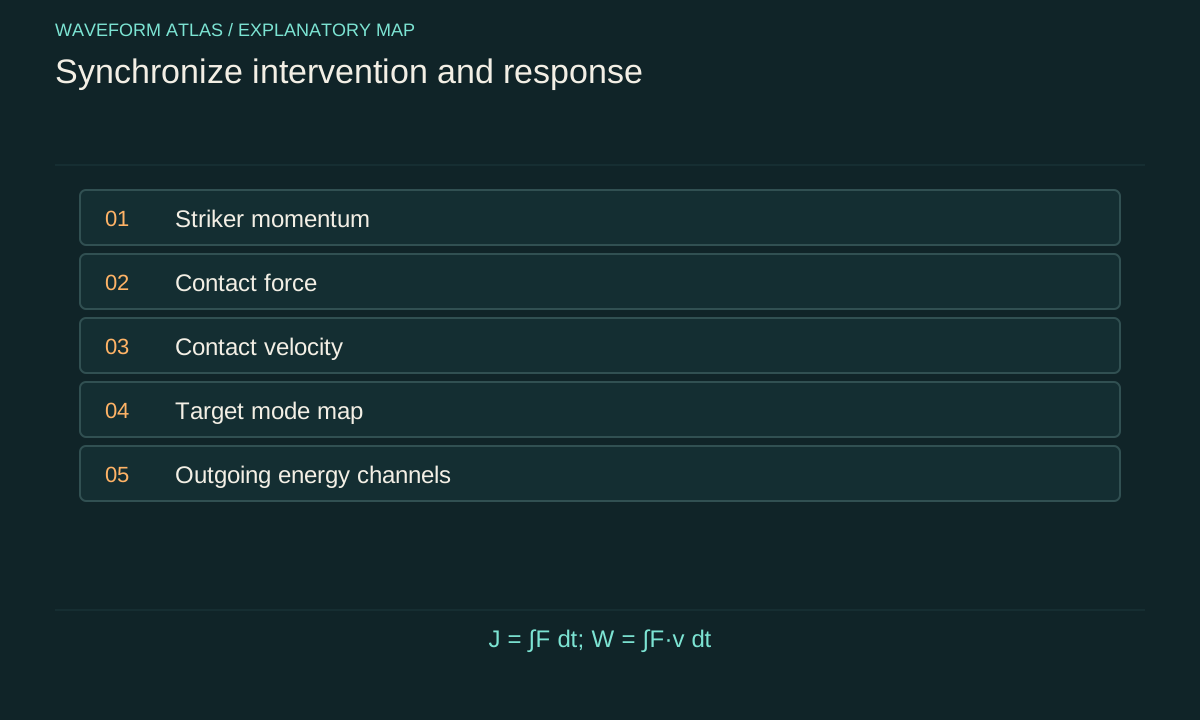
Define what success means before striking
An intervention might aim to reduce a particular mode, flatten a region, lower total mechanical energy or shorten settling time. These objectives are different. A force can improve one while worsening another, such as suppressing a low-frequency motion while exciting high-frequency vibration. Choose the metric before collecting data so the analysis follows the intended task.
State the system boundary and observation interval. If the striker, target supports or surrounding fluid are excluded, their exchanges must appear as external work and impulse. A short interval captures injection and redistribution; a longer one includes ringdown and dissipation. Reporting both can reveal a sequence that a single final amplitude would hide.
Measure the actual force-time record
A commanded actuator signal is not necessarily the contact force. Compliance, rebound and target motion can change the force waveform. Use a calibrated force sensor or a justified dynamical reconstruction, with bandwidth sufficient for the contact duration. Integrating the measured force gives impulse, while its spectrum indicates which target frequencies can be excited.
Sensor saturation can underestimate a sharp peak and corrupt the integral. A low-bandwidth sensor can broaden the pulse while preserving some low-frequency content, but that should be verified rather than assumed. Compare the force-derived impulse with the striker's measured momentum change as an independent check. Disagreement identifies a calibration, external-force or system-boundary issue to resolve.
Track the striker before and after
Measure its incoming and outgoing velocity, and rotation if relevant. The change in striker kinetic energy constrains energy transferred through contact, while momentum change constrains impulse. If an actuator continues driving during contact, its supplied work must also be included. A freely falling projectile and a powered paddle are different energy sources even if their visible contact motion looks similar.
For a simple nonrelativistic striker of mass m, kinetic energy is mv²/2. A rebound can reverse momentum with only a small energy change, while sticking can transfer substantial energy into target motion and internal channels. Record direction as well as speed. An unsigned speed trace cannot establish the impulse vector or distinguish a rebound from continued forward motion.
Work requires force and velocity synchronization
Mechanical work at the contact is W = ∫F(t)v_contact(t)dt in one dimension, with the appropriate vector product in general. Force and velocity must share a clock and sign convention. A timing offset can change their inferred correlation and even the apparent sign of work in an oscillating system.
If contact slips, rotates or spreads over an area, one point's velocity may not represent the full power transfer. Use the appropriate distributed or generalized-coordinate expression. The measurement can still be practical, but its approximation should be stated. Impulse alone does not determine work, so an accurate force integral cannot replace a synchronized motion measurement when energy transfer is the claim.
Characterize the target before impact
Measure the preexisting wave's amplitude, phase, spectrum and spatial pattern. A small timing change can place the strike at a different phase, altering its work. The target may also drift in temperature, tension or boundary conditions between runs. These variables affect both the incoming state and the response to the same force.
A reproducible preparation allows phase-locked comparisons. If preparation varies, record the state on each run and condition or model the analysis appropriately. Do not average unmatched phases and then describe the result as one deterministic response. The distribution of initial states is part of the experiment, particularly when the intervention is intended to remove rather than add motion.
Use two complementary reference runs
An unstruck-wave run shows ordinary propagation and damping over the same time interval. A strike applied to an initially quiet target shows what the intervention creates on its own. In a linear model, the combined response follows from adding those fields with the correct timing. Deviations can reveal nonlinear contact or target dynamics, provided source and detector changes are controlled.
The comparison must use the measured force histories, not merely nominally identical strikes. Target motion can change contact duration, so a strike on a quiet target may not deliver the same input as one on a moving wave. That difference is itself part of the interaction and should be modeled rather than hidden by calling both trials the same impact.
Resolve modes and outgoing flux
Map target motion across enough positions to estimate the relevant mode amplitudes or traveling-wave components. A single sensor can sit near a node or miss a changed polarization. Spectral analysis reveals energy moved away from the original frequency, while spatial phase distinguishes propagation from local ringdown. Convert the measured variable to energy using the appropriate model.
Extend coverage to outgoing waves or estimate their flux through the observation boundary. A local energy decrease can be export rather than dissipation. In fluid experiments, droplets and bulk flow can carry substantial energy outside a surface-wave measurement. In structures, supports and acoustic radiation can matter. State which channels are measured and which remain bounded only indirectly.
Propagate calibration uncertainty into the balance
Energy and momentum estimates share mass, spatial and timing calibrations. Their errors are often correlated. A consistent uncertainty analysis preserves those correlations when calculating residuals. A small residual compared with the total input can still be significant if uncertainty is lower, while a visually large difference may be inconclusive if calibration is poor.
For a simple velocity-derived energy, relative speed uncertainty contributes about twice its value to relative kinetic-energy uncertainty when errors are small and mass is known. Force–velocity work can be even more sensitive to phase calibration. Use repeated reference measurements to estimate drift, and report the uncertainty of the final energy balance rather than only instrument specifications in isolation.
Separate immediate control from later dissipation
Right after impact, energy may be redistributed among coherent modes. Later, those modes decay through internal friction, viscosity or radiation. A final quiet state does not reveal how much energy the strike removed immediately versus how much it injected and then allowed to dissipate. Time-resolved mode energies distinguish these histories.
This matters for evaluating a control strategy. A violent intervention can produce a short visible suppression followed by large hidden vibration or heating. A gentler phase-matched intervention may remove the target-mode energy with less collateral excitation. The comparison should use the task's actual metrics and measured work, not just the first frame in which the original pattern looks flat.
Make the conclusion match the measured ledger
A strong report states the target-mode change, total resolved mechanical-energy change, striker energy change, contact work and unmeasured channels with uncertainty. It identifies whether the intervention mainly extracts energy, redirects it or injects a new disturbance. If only local displacement was measured, retain that narrower conclusion.
The measurement design should leave the user able to follow the energy and momentum through the event. That is what distinguishes damping from apparent suppression caused by phase, geometry or filtering. An impact experiment becomes explanatory when the intervention is measured as carefully as the wave it alters.
Compare energy extraction with passive waiting
Suppose the target mode would decay from one joule to 0.8 joule during the chosen observation interval without intervention. With a strike, it ends at 0.2 joule. The intervention-associated improvement relative to passive waiting is 0.6 joule in that mode, while the total decrease from the initial state is 0.8 joule. These are different quantities. The comparison should report both and include any energy injected into other modes.
If contact work is measured as negative 0.5 joule and another resolved mode gains 0.1 joule, the remaining balance still requires the ordinary damping and outgoing channels over the interval. Synthetic numbers like these are useful for checking signs and definitions before analyzing real data. They should never be presented as experimental results without an actual acquisition and calibration record.
The baseline can also change under intervention. A strike may alter contact, tension or temperature and thereby change later damping. In that case, subtracting the unstruck decay curve is not a complete mechanism model. Measure the post-impact resonance and ringdown to determine whether the target dynamics changed. The difference between state control and parameter change can matter for repeated operation.
Finally, evaluate repeatability across independently prepared runs. A few selected successful impacts do not establish reliable suppression. Report the distribution of final mode energy, control work and residual excitation. If the protocol uses feedback or postselection, include that rule. The energy account and success probability together describe what the intervention can actually deliver.
Use the same integration limits when comparing control work and target energy. Energy entering or leaving between mismatched time windows can look like a failed balance. Mark the contact interval and the later observation interval separately so readers can see which transfers each number includes.
That alignment of time windows is essential for a reproducible balance.
What to take forward
- Measure force and contact velocity together to determine work.
- Compare with both an unstruck wave and an initially quiet struck target.
- Report target-mode suppression separately from total resolved energy change.
Go to the original work.
These links identify the sources behind specific claims. Verification scope varies by source and is stated below.
- 1 / University teachingOpenStax University Physics Volume 1: Impulse and Collisions ↗
Impulse as the integral of force and the change of momentum.
Verification scope: Open textbook section inspected; used for impulse as force integrated over time and change of momentum.
- 2 / University teachingMIT Differential Equations: Impulses and impulse response ↗
Impulse forcing, pre- and post-impulse initial conditions and oscillator response.
Verification scope: Official course page inspected, including worked-example topics.
- 3 / University teachingMIT Physics III: Vibrations and Waves ↗
Yen-Jie Lee. MIT Physics III: Vibrations and Waves. 2016.
Wave equations, interfaces, optics and propagation in media.
Verification scope: MIT course outline inspected; article derivations are independent textbook-level explanations.
- 4 / University teachingMIT Interfacial Phenomena: lecture notes ↗
Surface tension, inertia, viscosity, capillary length and dimensionless flow comparisons.
Verification scope: Official lecture-note excerpt inspected.
Found a problem with a claim or calculation? Send the page, the claim and the evidence. Read how these articles were prepared.