Timing changes the work
An oscillator's state moves through displacement and momentum as it evolves. A short force changes momentum almost instantaneously while leaving displacement approximately fixed. The same impulse applied at different points in that cycle therefore produces different final energies and amplitudes. Timing is a physical control parameter, not a minor experimental detail.
The effect can be understood without invoking friction. A coherent actuator can take energy from the oscillator when its force opposes the motion and give energy back when aligned with it. The energy goes to or comes from the actuator and its power supply. A complete account includes that exchange rather than calling every reduction in amplitude dissipation.
Derive the energy change
For a mass m with momentum p, an impulse J gives p′ = p + J. If position is unchanged during the ideal kick, potential energy is unchanged. The kinetic-energy difference is [(p + J)² − p²]/(2m), or pJ/m + J²/(2m). The sign of the cross term determines whether the kick can remove energy.
For fixed J, sufficiently negative pJ gives a net decrease. If p is zero, the kick always adds J²/(2m). If J = −p, it removes all instantaneous kinetic energy, but any potential energy remains. This last condition is often confused with stopping the oscillator entirely. It only sets velocity to zero at the current displacement.
Equilibrium crossing allows an ideal stop
At an equilibrium crossing of an ideal harmonic oscillator, displacement is zero and all its mechanical energy is kinetic. Applying J = −p at that instant sets both displacement and momentum to zero. The oscillator then remains at rest in the ideal unforced model. The actuator has removed the oscillator's energy.
At a turning point, momentum is already zero and potential energy is maximal. A momentum impulse cannot remove that potential energy while leaving position unchanged; it adds kinetic energy. To stop at a nonzero displacement, a separate change in force balance or a controlled displacement trajectory is required. The phase-space picture makes the difference immediately visible.
A numerical example fixes signs
Let m = 1 kilogram and the oscillator cross equilibrium with velocity +2 meters per second. Its energy is 2 joules. An impulse J = −2 newton-seconds stops it and changes energy by −2 joules. The same impulse applied when the velocity is −2 meters per second increases the speed magnitude to four and the energy to 8 joules, a gain of 6 joules.
At a turning point of that same orbit, the impulse adds 2 joules of kinetic energy to the existing 2 joules of potential energy, giving 4 joules total. These are original ideal-model calculations. They show why the phrase same strike does not imply same effect: the preexisting state determines the work associated with the momentum change.
A phase formula predicts a control curve
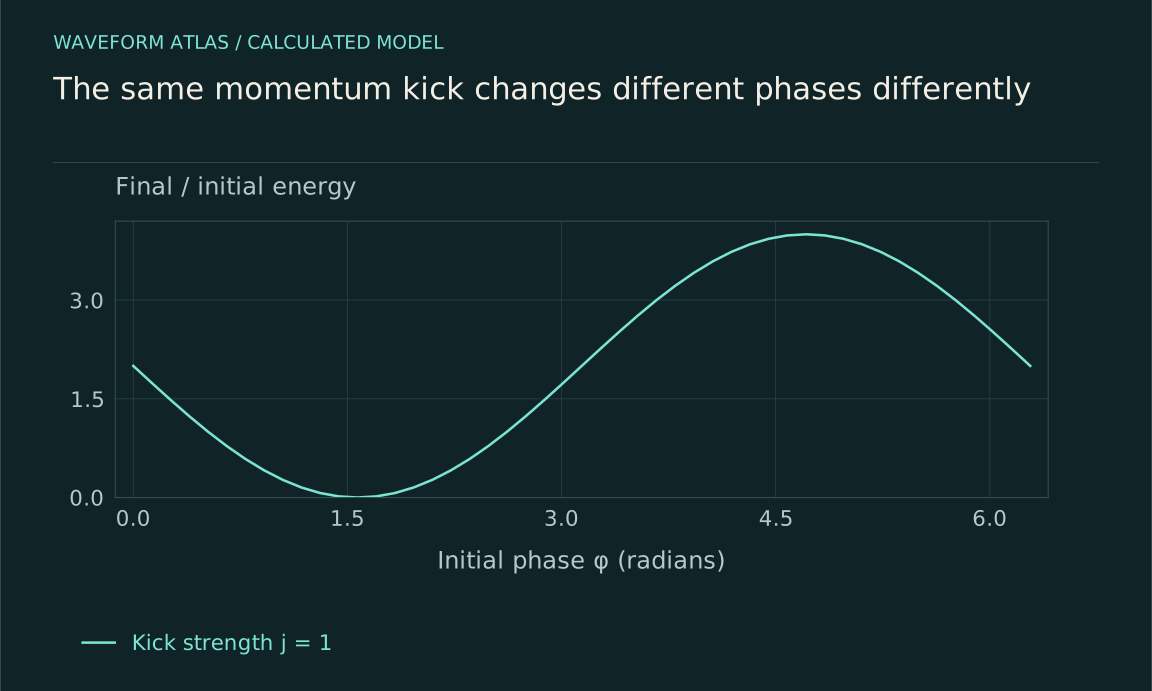
Write x = A cos φ and p = −mωA sin φ immediately before the kick. With dimensionless kick strength j = J/(mωA), the final energy divided by the initial energy is 1 − 2j sin φ + j². The curve is periodic in phase. It gives a direct prediction for a phase-scanned experiment in the ideal harmonic model.
For j = 1, the ratio ranges from zero to four as phase varies. The minimum occurs when the kick exactly opposes the momentum at the appropriate equilibrium crossing. A random phase average removes the sine term and leaves mean energy ratio 1 + j². Thus unsynchronized kicks heat this ideal ensemble on average even though a carefully timed kick can stop one realization.
Timing error leaves residual energy
Suppose the impulse is chosen to cancel momentum at the intended equilibrium crossing, but applied with a small phase error ε. Using the phase formula near the optimum gives residual energy approximately proportional to ε² for the ideal fixed kick. The exact coefficient follows the chosen normalization. Small timing errors therefore matter increasingly as the oscillation frequency rises for a fixed clock uncertainty.
The model also assumes the amplitude is known. An error in amplitude means the chosen impulse over- or under-cancels momentum. A practical controller needs both phase and amplitude estimates, along with actuator calibration. Measurement delay can create a systematic phase error even when the trigger appears synchronized to the displayed signal.
Finite force duration changes the simple kick
If the force acts over an appreciable part of a cycle, the oscillator moves during the intervention. Work becomes the full integral ∫F(t)v(t)dt, and the force spectrum and phase determine the response. A pulse with the same total impulse can then produce a different final state from an ideal instantaneous kick.
Use the measured force history in the oscillator equation or convolution model. The impulse approximation can be checked by comparing duration with period and by varying duration at fixed impulse. If the result changes beyond the short-pulse prediction, the finite-time dynamics are relevant. Treat that as a measurable correction, not as a mysterious failure of the momentum account.
One actuator cannot generally stop every mode
A distributed system contains many modes with different frequencies, phases and spatial couplings. A kick timed to remove energy from one mode can add energy to another. A point force has only a limited set of controllable projections. Simultaneous global suppression requires enough spatial and temporal control to address the relevant state components.
This limitation explains why an intervention can quiet a prominent resonance while creating broadband vibration. Measure the full response within the task's important band. If the goal is selective suppression, report the residual and newly excited modes separately. A successful single-mode strategy should not be described as complete arrest of a complex field unless that stronger result is actually measured.
Feedback and open-loop timing have different evidence
An open-loop protocol applies a predetermined kick based on a reproducible preparation. Feedback measures the evolving state and adjusts the force. Feedback can handle variation but introduces measurement noise, delay and actuator limits. The in-loop sensor can also appear quieter because the controller acts on its noise, so independent readout is valuable.
Compare performance against a no-control baseline and account for the control energy. A lower target-mode amplitude does not necessarily mean lower total system energy or lower electrical power use. The relevant metric follows the application: mode energy, peak displacement, settling time or another observable. Define it before optimizing the pulse timing.
Demonstrate phase-sensitive suppression directly
Repeat the same calibrated impulse over a range of initial phases and measure final displacement and velocity or an equivalent energy estimate. The predicted phase dependence distinguishes coherent work exchange from a phase-independent damping model. Include uncertainty in trigger timing, amplitude and impulse, and check that the oscillator remains in the linear regime.
The resulting curve tells a clearer story than one successful stopping event. It shows when the intervention removes energy, when it adds energy and how robust the control is to timing error. Impact timing is therefore a precise example of state-dependent work: the effect of a force cannot be understood from its size alone without the motion on which it acts.
Quantify timing tolerance near the stopping phase
For the ideal fixed kick j = 1, let the intended phase be φ = π/2 and the actual phase be π/2 + ε. The final energy ratio is 2 − 2cos ε, which is approximately ε² for small ε. A phase error of 0.1 radian leaves about 0.00999 of the initial energy, roughly one percent. This original calculation gives a concrete tolerance for the simplified stopping protocol.
Since ε = ωδt, the corresponding timing tolerance scales inversely with angular frequency. The same absolute trigger error is more damaging for a faster oscillator. Amplitude uncertainty supplies a separate error: if the kick strength is j = 1 + δ at the exact stopping phase, the residual energy ratio is δ². Small phase and strength errors therefore enter quadratically near the ideal optimum, while correlated errors require the full expression.
These favorable local scalings do not guarantee easy control. The controller must know the phase and amplitude before applying the pulse, and finite measurement delay can bias both. The actuator can have a nonzero duration or spatial coupling to other modes. The simple error calculation is a benchmark against which those additional limitations can be measured.
A practical test scans timing deliberately around the optimum and fits the resulting energy curve rather than reporting only the best trial. The width and depth of that curve reveal robustness and residual noise. Repeated trials at the nominal optimum then estimate preparation and control variability. This makes phase-sensitive suppression a reproducible protocol with a measured tolerance, rather than a single fortunate collision between a kick and an oscillation.
The measured tolerance should also include clock drift over the full acquisition, because a stable short-term trigger can still acquire a systematic phase offset between runs.
What to take forward
- Impulse fixes momentum change, while initial phase determines work.
- A momentum kick stops an ideal oscillator only when both final displacement and velocity vanish.
- Randomly timed kicks add energy on average in the simple model.
Go to the original work.
These links identify the sources behind specific claims. Verification scope varies by source and is stated below.
- 1 / University teachingOpenStax University Physics Volume 1: Impulse and Collisions ↗
Impulse as the integral of force and the change of momentum.
Verification scope: Open textbook section inspected; used for impulse as force integrated over time and change of momentum.
- 2 / University teachingMIT Differential Equations: Impulses and impulse response ↗
Impulse forcing, pre- and post-impulse initial conditions and oscillator response.
Verification scope: Official course page inspected, including worked-example topics. Oscillator formulas and numerical scenarios are independently derived.
- 3 / University teachingMIT Physics III: Vibrations and Waves ↗
Yen-Jie Lee. MIT Physics III: Vibrations and Waves. 2016.
Wave equations, interfaces, optics and propagation in media.
Verification scope: MIT course outline inspected; article derivations are independent textbook-level explanations.
Found a problem with a claim or calculation? Send the page, the claim and the evidence. Read how these articles were prepared.