A path record can be stored anywhere
In an interference experiment, which-path information means that some physical degree of freedom becomes correlated with the alternatives. The marker might be polarization, an internal atomic state, a recoil, a scattered photon or a dedicated detector. The information need not be displayed on a screen or read by a person. It matters because the joint state changes when the alternatives leave distinguishable records.
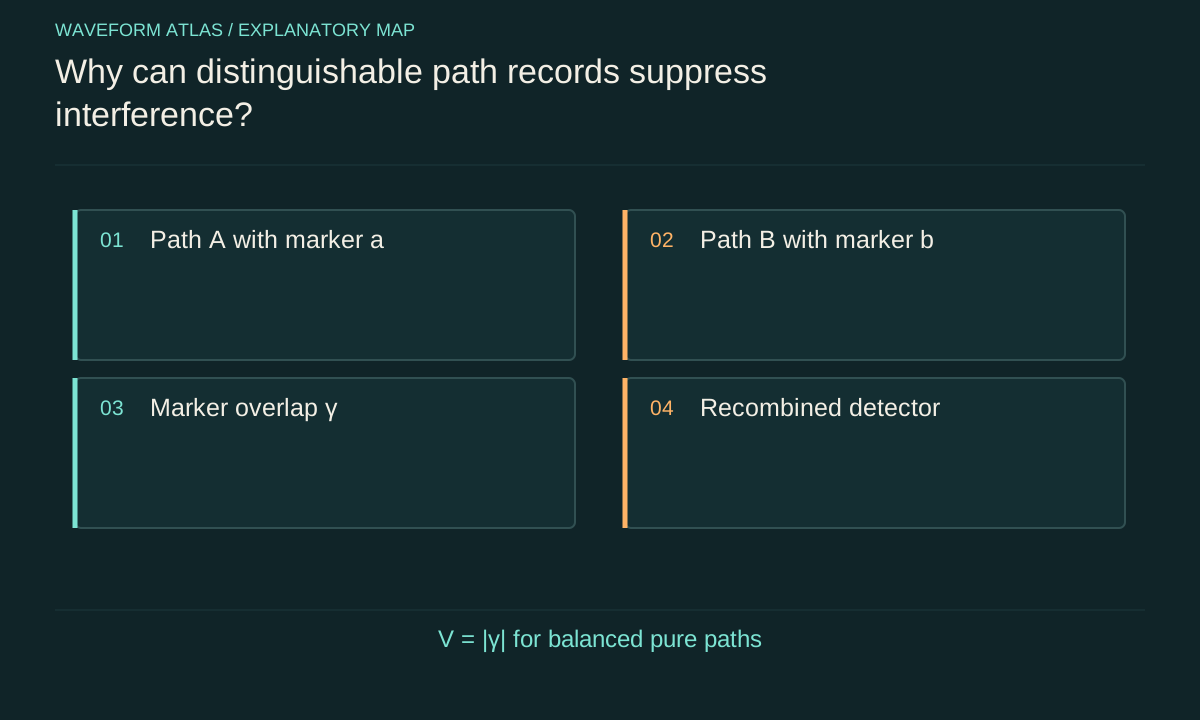
Start with equal path amplitudes and a marker in a ready state. A path-dependent interaction can produce (|A⟩|a⟩ + e^{iφ}|B⟩|b⟩)/√2. The path and marker are entangled when the marker states are not simply identical up to a phase and both path terms are present. The observable interference on the path subsystem depends on what is done with the marker and which joint or local measurements are performed.
Derive the local coherence
Tracing over the marker gives a path density matrix with diagonal entries one half and an off-diagonal term proportional to ⟨b|a⟩. Define γ = ⟨b|a⟩. Its magnitude measures how much coherence remains available to a path-only readout in this ideal model. If the marker states are identical, |γ| = 1. If they are orthogonal, γ = 0 and the local off-diagonal element vanishes.
The result is a statement about correlations, not about a mechanical collision necessarily knocking the particle off course. A marker can be encoded in an internal degree of freedom while leaving the gross path geometry unchanged. Conversely, a mechanical disturbance can alter a fringe through ordinary phase shifts or loss without creating a clean which-path record. The physical interaction should be modeled before the disappearance of contrast is assigned to a particular mechanism.
Connect the overlap to detector probabilities
For an ideal balanced recombiner, one output probability can be written p(φ) = [1 + Re(γe^{iφ})]/2 after choosing a phase convention. The phase of γ shifts the fringe, and its magnitude sets the visibility. If γ is real and equals 0.6, the maximum and minimum probabilities are 0.8 and 0.2. The visibility, defined as maximum minus minimum divided by their sum, is 0.6.
This calculation separates two effects often combined in a visual impression. A phase shift moves the positions of bright and dark fringes without necessarily lowering their contrast. A reduction in |γ| lowers the contrast. An experiment should therefore scan or otherwise estimate the phase-dependent distribution, rather than interpreting a smaller count at one fixed detector setting as a loss of coherence. That count might simply sit at a different point on a shifted fringe.
Include unequal path weights
If the path probabilities before recombination are p and 1−p, the ideal visibility becomes 2√[p(1−p)]|γ|. Even with identical marker states, unequal weights reduce the maximum contrast. For p = 0.9, the balance factor is 0.6. A measured visibility of 0.6 could therefore arise from perfect coherence with unequal paths, from balanced paths with marker overlap 0.6 or from combinations of the two.
Independent population measurements help break this ambiguity. Blocking each path in turn can characterize transmission and detector response, provided that the blocking operation does not change the rest of the apparatus in an unmodeled way. The visibility should be interpreted together with path weights, not as a universal direct measure of entanglement. A one-number contrast estimate can summarize the data, but it cannot identify every physical contribution without additional information.
Distinguishability and visibility trade off under assumptions
For equal path priors and pure marker states, optimal which-path distinguishability can be defined as D = √(1−|γ|²). Together with V = |γ|, this gives D² + V² = 1 in the ideal model. The equation expresses a precise information tradeoff: more distinguishable records leave less local interference. It is not a general statement that every experimental visibility and every informal measure of knowledge must satisfy equality.
Mixed markers, loss, unequal paths and imperfect readout require appropriate generalizations and often yield inequalities. A practical marker detector may also fail to attain optimal discrimination. The actual acquired information can then be less than the information available in the marker state. Distinguishing available information from information successfully read out prevents an experiment from claiming that the absence of a displayed path label means no path information existed physically.
For these equal priors the difference of the two normalized pure marker density matrices has eigenvalues ±√(1−|γ|²). Measuring its positive/negative eigenspaces gives the optimal success probability P_success = (1+D)/2. This explicit two-state calculation yields 0.9 at |γ|=0.6; the general visibility–information bound is the subject of Englert’s paper.
An unread environment can still mark the path
A scattered photon can carry information about a particle’s location even if no detector collects it. Gas collisions and thermal radiation can similarly correlate the environment with different paths. When those records are ignored, the path-only interference can be suppressed. This is a concrete route to environmental decoherence. The relevant quantity is the environmental state overlap, which depends on the interaction and distinguishability of the alternatives.
The effect is not determined solely by the number of surrounding particles or the temperature label. Wavelength, scattering geometry, interaction strength and path separation matter. An environmental mode unable to resolve the path difference may carry little distinguishing information. A useful calculation therefore connects the microscopic coupling to the overlap or decoherence rate. The general phrase “the environment observed it” is a mnemonic, not a substitute for that quantitative account.
Classical phase noise can imitate a reduced fringe
If the relative phase varies randomly between trials and is not recorded, averaging can wash out interference. A stable pure state in each run may then produce a reduced ensemble contrast. In some settings, this is operationally equivalent to a dephasing channel caused by an unobserved environment. Path-only data may not identify whether the phase randomness originated in the source, propagation or analyzer.
Reference monitoring and echo-like controls can help. If a recorded phase shift is corrected and contrast returns, the missing fringe was accessible through that record and control. Failure to restore it leaves several possibilities, including inaccurate correction and inaccessible environmental information. Recovery tests are therefore informative but must be interpreted with their control fidelity. They do not automatically distinguish every environmental channel from every proposed fundamental collapse process.
Recover conditional interference with a marker measurement
When the marker states are orthogonal, a measurement in a complementary marker basis can produce conditional path states with opposite relative phases. Sorting the path records according to those marker outcomes reveals a fringe in one subset and an antifringe in the other. Adding the subsets reproduces the flat unconditioned pattern. The joint correlations retain information that was absent from the path marginal.
This is the core logic of quantum erasure. It does not require changing a detection that already occurred. The later comparison reveals different conditional distributions within the same joint dataset. Nor does every act of deleting a stored label restore interference. The marker must be measured or controlled in a way that accesses the relevant coherence. Destroying a classical record after it has spread into an uncontrolled environment generally does not implement that operation.
Design controls that distinguish marking from loss
Measure both total detection probability and phase-dependent contrast. A decrease in total counts can indicate absorption or loss even when the surviving paths retain coherence. A decrease in normalized contrast can indicate marking, imbalance or phase averaging. If only successful detections are retained, report the selection probability and test whether it depends on the path or marker setting. Otherwise the conditioned ensemble may conceal an important channel.
Vary the marker interaction strength while holding the optical or mechanical alignment fixed as well as possible. Independently characterize the marker states or their distinguishability. Check whether the observed contrast follows the predicted overlap after correcting for measured imbalance and detector response. A matched trend across these observables is stronger evidence than a single before-and-after image in which several apparatus properties changed simultaneously.
Keep the physical conclusion narrow and useful
A which-path experiment can demonstrate that information stored in correlations limits local interference. It can quantify that relationship and show how joint measurements reveal conditional structure. It does not by itself establish a unique interpretation of measurement or a new objective-collapse law. Ordinary unitary entanglement already provides the basic mechanism described here.
The best account therefore names the paths, marker, overlap, recombination measurement and conditioning. It distinguishes phase shift, contrast reduction and loss, then states which controls support the proposed explanation. With those pieces in place, the familiar statement that knowing the path destroys interference becomes a precise physical claim: distinguishable records reduce a particular subsystem’s coherence under a specified measurement protocol, while the joint state may retain correlations accessible through a different experiment.
For the equal-prior pure-marker example with |γ| = 0.6, the ideal distinguishability is 0.8 and the optimal path-guessing success probability is 0.9. These three numbers describe different quantities: visibility, distinguishability and discrimination success. Reporting them under one generic label such as information would hide the operational definition. A real marker measurement that succeeds only 0.85 of the time need not contradict the overlap model; it may simply be suboptimal. Conversely, a claimed success exceeding the model’s optimum suggests that the assumed states, priors or calibration are wrong. This makes the overlap calculation a practical consistency check linking two independently measurable aspects of the apparatus, rather than merely a philosophical statement that paths and waves are incompatible.
What to take forward
- Physical marker distinguishability matters even when nobody reads the record.
- Visibility also depends on path balance and phase stability.
- Conditional recovery concerns joint correlations, not a change to past detections.
Go to the original work.
These links identify the sources behind specific claims. Verification scope varies by source and is stated below.
- 1 / University teachingPreskill, Quantum Information, Chapter 2: States and Ensembles ↗
Preskill, J. Quantum Information, Chapter 2: States and Ensembles. Caltech lecture notes (2015 version).
Pure states, density operators, partial trace, pure-state entanglement, Born probabilities and quantum erasure. Does not supply mixed-state witnesses, entropy or quadrature formulas cited elsewhere.
Verification scope: Author-hosted lecture PDF inspected for relevant foundational definitions; independent elementary examples are worked in the article.
- 2 / Primary theoryDecoherence, einselection, and the quantum origins of the classical ↗
Wojciech H. Zurek. Reviews of Modern Physics 75, 715 (2003). Linked record is the author preprint.
DOI: 10.1103/RevModPhys.75.715
Environmental monitoring, preferred records and suppression of local interference.
Verification scope: Author-posted review abstract and APS bibliographic record inspected; source supports the decoherence framework, not an independent audit of each apparatus or biological state.
- 3 / University teachingPreskill, Quantum Information, Chapter 3: Measurement and Evolution ↗
J. Preskill (2018). Lecture Notes for Ph219/CS219, Chapter 3: Foundations II: Measurement and Evolution, updated October 2018. Caltech.
Quantum measurement operators and instruments, channels, dephasing, amplitude damping and open-system evolution. Not a detector-calibration or sampling-statistics handbook.
Verification scope: Author-hosted lecture PDF inspected for relevant sections; not an exhaustive audit of every lecture derivation.
- 4 / Primary theoryFringe Visibility and Which-Way Information: An Inequality ↗
Berthold-Georg Englert. Physical Review Letters 77(11), 2154–2157 (1996).
DOI: 10.1103/PhysRevLett.77.2154
The relation between fringe visibility and available which-way information.
Verification scope: Publisher abstract and bibliographic record inspected. The atlas gives its own equal-prior pure-state derivation for D and binary guessing success; a full-paper audit is not claimed.
Found a problem with a claim or calculation? Send the page, the claim and the evidence. Read how these articles were prepared.