A certificate must exclude separable explanations
An entanglement witness is designed around a boundary: every separable state satisfies a particular inequality, while some entangled states violate it. Measuring a violation therefore rules out the separable class under the stated apparatus assumptions. The witness need not reconstruct every element of the density matrix. It can focus on a small set of observables that are especially informative for the intended state.
This efficiency comes with a limitation. A witness that detects one region of entangled states may miss others. Failure to violate it does not generally prove separability. The conclusion should be “not certified by this test” unless an additional argument makes the criterion complete for the state family. This asymmetry is common in experimental inference: a sufficient condition can establish a property without making its failure a proof of the opposite.
Start with a Bell-state fidelity bound
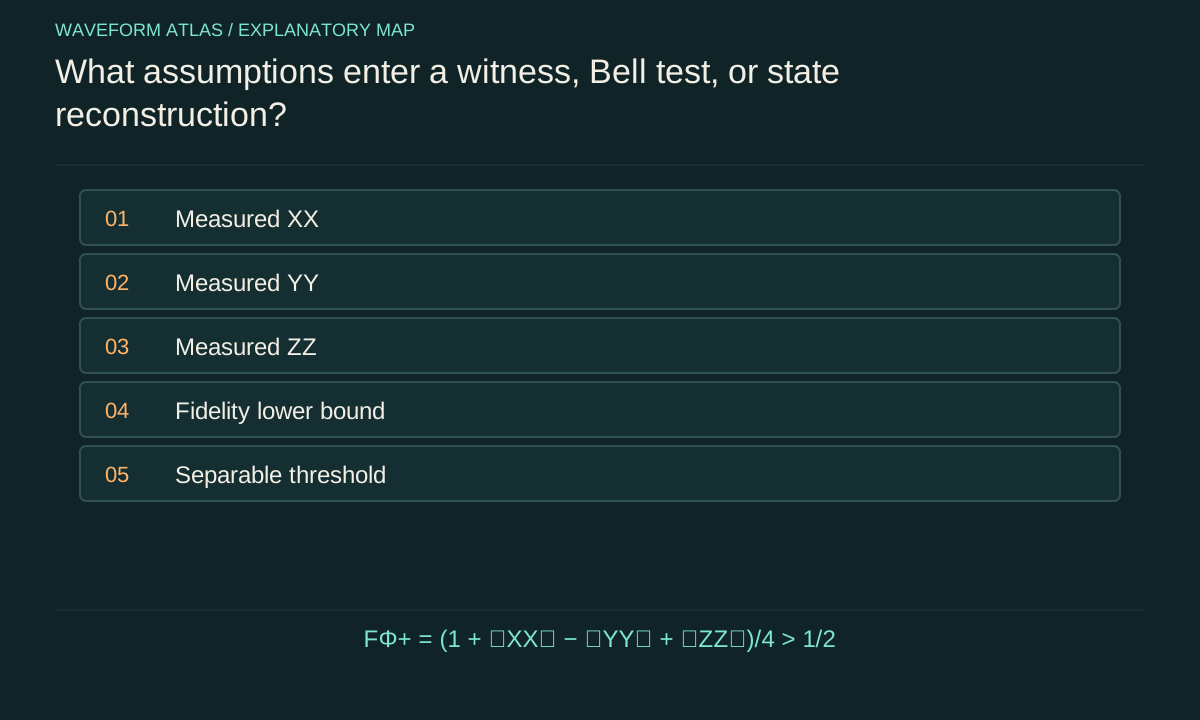
For two calibrated qubits, consider F = ⟨Φ+|ρ|Φ+⟩, where |Φ+⟩ = (|00⟩+|11⟩)/√2. Every product pure state has squared overlap with this Bell state at most one half. Since a separable mixed state is a convex combination of product states, it also has F ≤ 1/2. Therefore F > 1/2 is a sufficient entanglement certificate.
The bound can be understood through the Bell state’s equal Schmidt coefficients. A single product vector cannot align with both orthogonal Schmidt terms well enough to exceed one-half squared overlap. Convex mixing cannot improve on the largest value achieved by its components. This simple reasoning gives a physically meaningful threshold: the experiment need not prepare a perfect Bell pair, but it must demonstrate an overlap unattainable by every separable preparation.
Express the fidelity through measurable correlations
The Bell projector can be written (I⊗I + X⊗X − Y⊗Y + Z⊗Z)/4. Thus F = [1 + ⟨XX⟩ − ⟨YY⟩ + ⟨ZZ⟩]/4. Three local measurement settings suffice for this witness. Each correlation is estimated from pairs of outcomes assigned values plus one or minus one. Agreement contributes plus one and disagreement minus one for the corresponding setting.
The minus sign in front of YY is specific to |Φ+⟩. Another target Bell state has a different sign pattern. A sign error can turn a correct dataset into an incorrect certificate. The axes and outcome conventions should therefore be written explicitly, including any phase reference used to implement Y. A formula copied from another experiment is not valid until its target state and measurement conventions are matched.
Work a hypothetical dataset
Suppose the estimated correlations are ⟨XX⟩ = 0.78, ⟨YY⟩ = −0.74 and ⟨ZZ⟩ = 0.88. The witness gives F = (1+0.78+0.74+0.88)/4 = 0.85. This central value is well above the separable bound. It is still necessary to calculate uncertainty and systematic effects before claiming a certificate. The numbers are an original teaching example, not an experimental result.
If each correlation were estimated independently from N binary product outcomes, an approximate statistical variance for that correlation would be (1−C²)/N. The fidelity variance would combine the three contributions with a factor of one sixteenth. Shared drift or calibration errors can correlate the estimates and require additional covariance terms. A large number of trials reduces counting uncertainty but does not automatically remove a common axis miscalibration or detector bias.
The variance is an independent calculation: a product outcome Y = ±1 has Y² = 1, so Var(Y) = 1−C² and an independent sample mean has variance (1−C²)/N. The witness reference supplies the separability criterion, not the sample-statistics derivation.
Use a lower bound rather than only a central estimate
The following is this atlas’s methodological advice. A robust claim should show that the uncertainty-qualified fidelity remains above one half under the chosen statistical procedure. A central estimate of 0.52 with uncertainty 0.08 does not establish the same conclusion as 0.85 with a well-controlled uncertainty of 0.02. The confidence convention, treatment of nuisance parameters and any multiple comparisons should be stated. Error bars are part of the logical test, not decoration.
Systematic uncertainty may be asymmetric or non-Gaussian. It can be safer to bound its effect directly than to combine it with counting noise through an unjustified Gaussian approximation. If the measurement axes are only known within a range, calculate the worst compatible separability conclusion or use a suitable calibrated analysis. The witness is persuasive when its assumptions are tested, not when every uncertainty is compressed into a small-looking symmetric number.
Trusted devices and device independence differ
The fidelity witness assumes that the measured observables are the stated qubit Pauli operators. A Bell test instead constrains local hidden-variable correlations through the observed joint statistics and its experimental assumptions. A loophole-free implementation requires careful attention to detection, locality, trial definition and measurement choice. The two approaches answer related but different questions and demand different resources.
Hensen and colleagues’ 2015 experiment is a concrete Bell-test reference, while the fidelity calculation here illustrates a trusted-device witness. It would be inaccurate to describe a three-setting fidelity estimate automatically as a loophole-free demonstration of Bell nonlocality. It would also be inaccurate to dismiss it as meaningless because it uses calibration. Trusted-device certification is useful when those assumptions fit the task and are supported by independent measurements.
Tomography supplies more information at a cost
State tomography estimates a density operator from an informationally sufficient set of measurements. It can reveal a broader range of errors and support several entanglement analyses. It also requires more settings, a reconstruction procedure and careful treatment of finite data. A reconstructed matrix is an inference, not a direct photograph of the state. Positivity constraints and model assumptions affect the estimate and its uncertainty.
A targeted witness can be preferable when the scientific question is simply whether a known preparation is entangled. Tomography is useful when the state structure itself is uncertain or when many properties are needed. The choice should follow the task and available calibration. More elaborate reconstruction does not automatically produce stronger evidence if its added assumptions are poorly tested or its uncertainty is understated.
Continuous-variable witnesses need normalization
For mechanical or optical modes, witnesses can use quadrature variances and covariances. Their numerical thresholds depend on the quadrature convention and reference noise calibration. A sum of correlated variances below a separable bound can certify entanglement of the selected modes. The physical measurement must establish that the observed noise corresponds to those quadratures and that readout correlations have been accounted for.
The mechanical-oscillator experiment cited here illustrates this type of inference for collective motion. Its atom count or object mass does not replace the witness. Nor does a variance below a classical-looking noise level automatically prove entanglement unless the relevant separability bound is derived. The certificate needs the subsystem definition, commutation convention, calibration and uncertainty. These details are what connect a detector spectrum to a quantum-state claim.
Protect the certificate from selection bias
The following is this atlas’s methodological advice. A heralded protocol can legitimately certify the conditional output state, but the heralding rule must be explicit. If trials are selected using the same outcomes that enter the witness, a classical or separable dataset can acquire artificially favorable correlations. State-dependent detection can create a similar problem. Retain the attempt count, success probability and setting dependence so the selected ensemble can be modeled correctly.
A useful audit asks whether the selection could be decided before the certification outcomes were known, or whether a valid analysis explicitly includes the selection process. It also checks whether missing events were treated consistently across settings. A beautiful witness value in an undefined subset is not a complete certificate. The physical and statistical meaning of the ensemble must be established before the bound is applied.
Make the conclusion exactly as strong as the test
A complete witness report states the measured observables, separable bound, estimate, uncertainty, device assumptions and selection rule. It explains why the target state was chosen and what other states the test might miss. If the witness fails, it identifies whether improved precision, another measurement basis or a different certificate could resolve the question. If it succeeds, it names the certified subsystems and operating conditions.
This structure makes entanglement a reproducible inference rather than a label attached to correlated traces. The witness does not need to answer every foundational question or reveal every matrix element. Its strength is focused: a measured combination lies outside what separable preparations can produce under the stated model. That precise conclusion is enough to establish a useful quantum resource while leaving room for further characterization and more demanding tests.
For the hypothetical correlations 0.78, −0.74 and 0.88, take 1,000 independent product-outcome trials per setting and ignore systematic error only for this arithmetic exercise. The approximate fidelity variance is [(1−0.78²)+(1−0.74²)+(1−0.88²)]/16,000, about 0.0000669, giving a standard deviation near 0.0082. The statistical separation from one half is large in this ideal exercise. This does not authorize ignoring calibration in a real experiment; it shows how counting noise enters and why additional trials may cease to be the limiting improvement. If axis or efficiency uncertainty shifts the correlations by amounts larger than this scale, the apparatus characterization dominates. A credible certificate reports that distinction instead of quoting the smallest available error estimate.
What to take forward
- A witness violation is sufficient; a failed witness is usually inconclusive.
- Calibration, uncertainty and selection define the certificate’s scope.
- Tomography, trusted witnesses and Bell tests answer different questions.
Go to the original work.
These links identify the sources behind specific claims. Verification scope varies by source and is stated below.
- 1 / University teachingPreskill, Quantum Information, Chapter 2: States and Ensembles ↗
Preskill, J. Quantum Information, Chapter 2: States and Ensembles. Caltech lecture notes (2015 version).
Pure states, density operators, partial trace, pure-state entanglement, Born probabilities and quantum erasure. Does not supply mixed-state witnesses, entropy or quadrature formulas cited elsewhere.
Verification scope: Author-hosted lecture PDF inspected for relevant foundational definitions; independent elementary examples are worked in the article.
- 2 / University teachingPreskill, Quantum Information, Chapter 3: Measurement and Evolution ↗
J. Preskill (2018). Lecture Notes for Ph219/CS219, Chapter 3: Foundations II: Measurement and Evolution, updated October 2018. Caltech.
Quantum measurement operators and instruments, channels, dephasing, amplitude damping and open-system evolution. Not a detector-calibration or sampling-statistics handbook.
Verification scope: Author-hosted lecture PDF inspected for relevant sections; not an exhaustive audit of every lecture derivation.
- 3 / Primary experimentLoophole-free Bell inequality violation using electron spins separated by 1.3 kilometres ↗
B. Hensen et al.. Nature 526, 682–686 (2015).
A primary Bell-test example addressing detection and locality loopholes in its specified protocol.
Verification scope: Publisher-indexed abstract and citation record inspected, including the event-ready preparation and Bell-test scope; full apparatus reanalysis not performed.
- 4 / Primary experimentStabilized entanglement of massive mechanical oscillators ↗
C. F. Ockeloen-Korppi et al.. Nature 556, 478–482 (2018).
DOI: 10.1038/s41586-018-0038-x
Evidence for entanglement of collective mechanical motion inferred from calibrated correlation measurements.
Verification scope: Publisher abstract and bibliographic record inspected for collective mechanical modes and the reported experiment; no independent reanalysis of calibration or data.
- 5 / Primary theoryEntanglement detection ↗
Otfried Gühne; Géza Tóth. Physics Reports 474, 1–75 (2009). Linked record is the author preprint.
DOI: 10.1016/j.physrep.2009.02.004
Mixed-state separability, projector witnesses, noisy Bell-state thresholds and detection assumptions.
Verification scope: Author-posted full text inspected at sections 2.2, 2.5, 5.1 and 6.1, including Eqs. (28)–(29) and (103); not every page of the review audited.
- 6 / Primary theoryInseparability Criterion for Continuous Variable Systems ↗
Lu-Ming Duan; G. Giedke; J. I. Cirac; P. Zoller. Physical Review Letters 84, 2722 (2000). Linked record is the author preprint.
DOI: 10.1103/PhysRevLett.84.2722
Sufficient two-mode entanglement criterion using the sum of EPR-type quadrature variances.
Verification scope: Author-posted paper Theorem 1, Eqs. (2)–(3), and proof inspected. Uses [x,p]=i; a=1 gives the bound 2 used here.
Found a problem with a claim or calculation? Send the page, the claim and the evidence. Read how these articles were prepared.