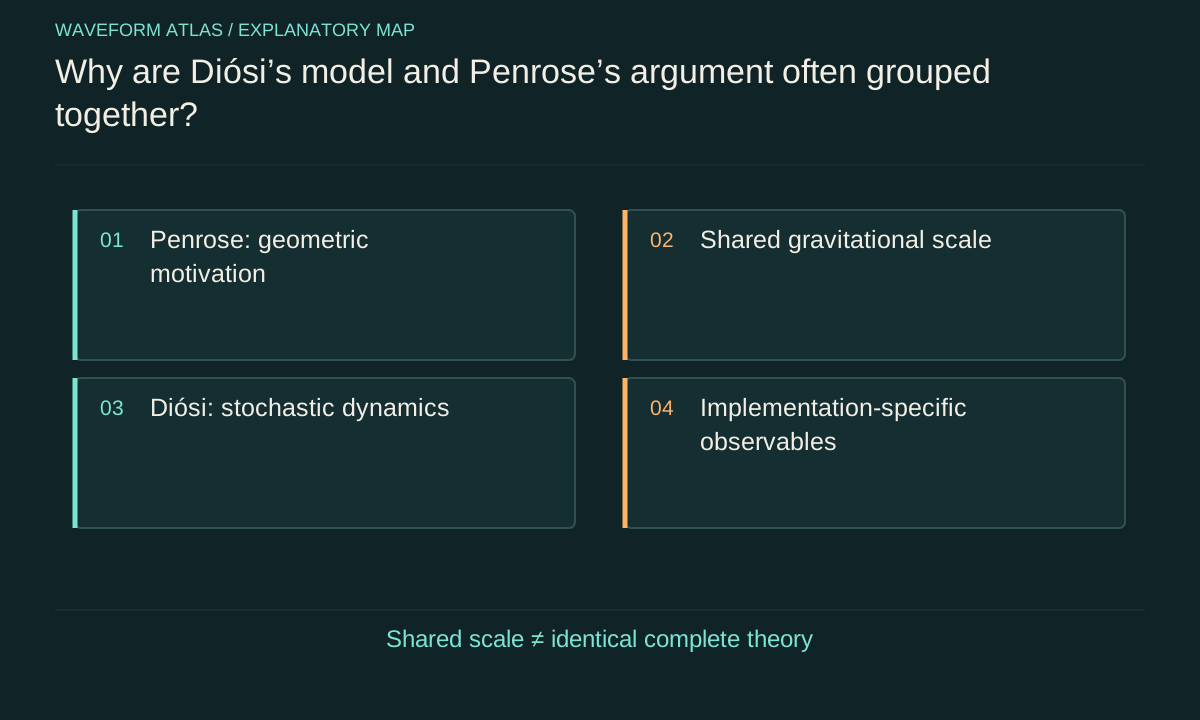
Explain why the names are paired
The combined label Diósi–Penrose is useful because two research programs connect gravitational differences between alternative mass configurations to a characteristic loss of quantum coherence or reduction timescale. It can also be misleading if it suggests that one complete, universally agreed theory is being referenced. A timescale, a conceptual argument and a stochastic evolution equation are different objects. They can overlap without being interchangeable.
Penrose’s argument emphasizes a tension in assigning a common time evolution to alternatives associated with different spacetime geometries. Diósi’s approach supplies a stochastic gravitational construction in which the quantum state is affected by specified noise. The resulting gravitational energy scale can resemble the one in Penrose’s estimate. That relationship motivates the shared name, but it does not remove questions about the noise, mass-density resolution, conservation properties or the meaning of individual trajectories in a particular implementation.
The historical sources are Diósi’s 1987 master-equation paper and his 1989 stochastic-reduction paper. They supply distinct dynamics alongside Penrose’s later geometric argument; citing both avoids attributing the whole construction to either name alone.
Identify what a motivation contributes
A physical motivation tells us why an existing framework may be incomplete and which quantities might control the missing behavior. Penrose argues that the coexistence of distinct gravitational configurations makes a superposition unstable. This points toward a characteristic energy mismatch and the estimate τ approximately ℏ/E_G. It is a substantive proposal because it connects the issue to geometry and mass distribution rather than merely declaring that observation causes a jump.
Nevertheless, a motivation does not automatically determine a unique equation of motion. Several dynamical constructions could share a rough scaling and differ in their detailed predictions. They might produce different noise correlations, different energy changes or different behavior for internal degrees of freedom. To test one experimentally, the researcher must specify these features. Attributing all such choices directly to Penrose’s original argument would erase the distinction between the proposal’s guiding idea and the models built to implement it.
Identify what stochastic dynamics add
A stochastic model defines how random variables influence state evolution or an ensemble density operator. Its ingredients can include a noise correlation function, an operator through which the noise couples and a strength or length scale. A density-matrix equation predicts ensemble statistics; a corresponding trajectory description may provide a way to discuss individual conditioned or reduced states. The relationship between these descriptions needs care, because the same ensemble evolution can sometimes admit different trajectory representations.
For a gravity-related construction, the coupling is typically tied to mass density. Specifying that coupling makes it possible to calculate suppression of coherences and, in suitable models, momentum diffusion or heating. Those secondary effects are not decorative additions. They can make the model vulnerable to observations that do not resemble a textbook measurement at all. An experimentally useful theory must retain all of its consequences, including inconvenient ones, rather than selecting only the visually appealing localization behavior.
Make regularization physically visible
A mass-density description at arbitrarily short distances can generate divergent or otherwise unacceptable predictions in a simple stochastic construction. Introducing a finite spatial resolution or smearing scale makes the model calculable. Once that scale controls measurable fluctuations, it is a physical parameter of the implementation. It cannot be dismissed as a harmless mathematical detail whenever an experiment constrains it.
There are several distinct choices a writer should separate: the measured size of a body, the width of its center-of-mass wavepacket, the microscopic spread assigned to nuclear mass and a model’s explicit cutoff. These lengths need not be equal. Using the body radius where an experimental paper uses a microscopic smearing parameter would produce an invalid comparison. The relevant question is not merely whether a number has units of metres, but what physical or mathematical operation that length defines in the stated dynamics.
Compare predictions using the same preparation
A fair model comparison starts with an identical prepared state and asks for an identical observable. For example, consider the off-diagonal density-matrix element between two center-of-mass locations. One model might predict an exponential suppression with a separation-dependent rate. Another might predict colored-noise behavior that depends on the duration and earlier evolution. An ordinary environmental model may also suppress that element through scattering or fluctuating forces.
If all three are displayed as a single falling line without their assumptions, the graphic communicates resemblance rather than discrimination. A more informative comparison varies separation, hold time and environmental conditions, then plots each model’s distinct prediction for the measured visibility. It also checks a second observable, such as heating, when the models require different accompanying effects. This strategy avoids deciding between theories on the basis of their names or on whether they use the word collapse.
Understand the radiation connection
The Gran Sasso study searched for spontaneous radiation associated with the particular Diósi–Penrose dynamics under investigation. In that framework, stochastic fluctuations affect charged constituents, leading to an emission prediction that can be compared with a low-background spectrum. The experiment excluded the natural parameter-free implementation considered by the authors. That is a concrete result about a concrete construction, not a generic verdict that gravity cannot influence quantum foundations.
This logic is similar to testing any theory through a consequence outside the setting that first motivated it. A model proposed to explain definite outcomes may also predict energy exchange or radiation. If those effects are absent at the predicted level, the model must be rejected or modified. Modification is scientifically legitimate when it is specified and tested, but it should not be presented as though the original prediction never existed. The parameter changes and their new consequences must remain visible.
Include current constraints with their conditions
The published 2026 XENONnT analysis investigates specified Markovian spontaneous-collapse dynamics using low-energy electronic-recoil data. Its Diósi–Penrose cutoff limit is R₀ greater than 4.9 × 10⁻¹⁰ metre at 90% confidence, or 4.5 × 10⁻¹⁰ metre at 95% confidence. The different values illustrate why a bound should never be quoted without its statistical convention. They are not inconsistent numbers; they summarize different confidence thresholds in the same analysis.
The result constrains the tested noise and emission model, including how the radiation from constituents is treated. It does not supply a direct measured lifetime for every possible branch geometry. Nor does it determine the correct interpretation of ordinary quantum mechanics. The strongest defensible statement is that particular dynamical implementations face stringent observational limits. A reader who wants to transfer the bound to another model must first show that the relevant observable prediction and parameter definitions actually match.
Parameter conventions matter when comparing experimental bounds. Majorana’s corrected 95% limit is R_DP > (2.54 ± 0.03) × 10⁻¹⁰ m. XENONnT reports R₀ under its own noise and mass-smearing prescription. Transferring either result into another construction requires matching the signal model and parameter normalization; similar parameter names or a shared ℏ/E_G timescale do not supply that conversion.
Read later clarifications as scoped arguments
The October 2026 clarification preprint explicitly distinguishes a phenomenological gravity-related lifetime criterion from the stochastic realization and density-resolution assumptions constrained by radiation searches. This helps prevent an overly broad reading of earlier headlines. It also identifies a real research obligation: alternatives with changed noise spectra or dissipation must provide their own quantitative predictions. Merely giving a model a more flexible name does not exempt it from experiment.
Because the clarification is a preprint, its publication status belongs in the account. Its abstract was inspected for the scope stated here; this atlas does not claim an independent full-paper audit or replication. The underlying experimental spectra and the logical issue of model scope should be discussed separately. A later theoretical interpretation can refine what follows from data, but it cannot transform a null radiation search into positive evidence that a particular collapse mechanism occurs.
Use a model identity card
Before comparing a claim with a bound, write a short identity card for the model. Specify the state variables, mass-density operator, smearing rule, noise statistics, time evolution and measured observable. State whether the model includes dissipation and whether it predicts an additional radiation or heating signal. Then name the parameters fixed independently and those adjusted in the comparison. This makes the comparison reproducible and exposes hidden differences between similarly named theories.
The shared Diósi–Penrose label can then do its proper work: it identifies a family resemblance and a historical connection. It should not replace the equations when a quantitative conclusion is being drawn. Penrose’s geometric motivation remains a foundational argument; a Diósi-style implementation supplies additional dynamics; an experiment constrains the predictions of that implementation. Keeping all three levels distinct allows both serious criticism and serious development of the research program without overstating either its successes or its exclusions.
Separate ensemble agreement from trajectory claims
Two descriptions can agree on a density operator while telling different stories about individual runs. For example, an ensemble dephasing channel can be represented through random phases or through a measurement-like decomposition under suitable conditions. Agreement at that level does not automatically establish a unique physical trajectory. A collapse theory must identify why its stochastic realization is physically privileged and which accessible predictions distinguish it from an ordinary open-system description.
This issue matters when an illustration shows a state abruptly selecting a branch. The picture is justified only if it represents the specified model’s individual-state dynamics, not merely the decay of an ensemble off-diagonal element. Keeping the ensemble and trajectory statements separate makes the model comparison more exact and prevents an animation from silently adding an ontological claim that the measured statistics alone do not determine.
What to take forward
- A shared gravitational scale does not imply a unique evolution equation.
- The density cutoff is part of a model when it changes measurable predictions.
- Match dynamics and parameter definitions before transferring an experimental bound.
Go to the original work.
These links identify the sources behind specific claims. Verification scope varies by source and is stated below.
- 1 / Primary theoryOn Gravity’s role in Quantum State Reduction ↗
Roger Penrose. General Relativity and Gravitation 28, 581 (1996).
Original argument connecting alternative mass distributions, spacetime and a proposed reduction timescale.
Verification scope: Publisher abstract and relevant displayed passages inspected; not a claim of independent replication or full-paper audit.
- 2 / Primary theoryModels of wave-function collapse, underlying theories, and experimental tests ↗
A. Bassi, K. Lochan, S. Satin, T. P. Singh, and H. Ulbricht. Reviews of Modern Physics 85(2), 471–527 (2013). Linked record is the author preprint.
DOI: 10.1103/RevModPhys.85.471
Research authors’ synthesis of stochastic collapse dynamics, motivation and distinct experimental signatures.
Verification scope: Author-posted abstract and APS journal record inspected. Supports collapse-model motivation, dynamical modifications and experimental signatures; not the article’s independent calculations or reporting advice.
- 3 / Primary theoryOn the Gravitization of Quantum Mechanics 1: Quantum State Reduction ↗
Roger Penrose. Foundations of Physics 44, 557–575 (2014).
DOI: 10.1007/s10701-013-9770-0
Later account of gravity-motivated modification of quantum dynamics and its physical motivation.
Verification scope: Publisher abstract and relevant displayed passages inspected; not a claim of independent replication or full-paper audit.
- 4 / University teachingPreskill, Quantum Information, Chapter 3: Measurement and Evolution ↗
J. Preskill (2018). Lecture Notes for Ph219/CS219, Chapter 3: Foundations II: Measurement and Evolution, updated October 2018. Caltech.
Quantum measurement operators and instruments, channels, dephasing, amplitude damping and open-system evolution. Not a detector-calibration or sampling-statistics handbook.
Verification scope: Author-hosted lecture PDF inspected for relevant sections; not an exhaustive audit of every lecture derivation.
- 5 / Primary theoryDid the Gran Sasso Experiment Rule Out the Diósi-Penrose Theory? Musing on the 2021 Result and the Present Experimental Status ↗
Curceanu, C.; Bortolotti, N.; Diósi, L.; Manti, S.; Piscicchia, K. (2026). Did the Gran Sasso Experiment Rule Out the Diósi-Penrose Theory? Musing on the 2021 Result and the Present Experimental Status. arXiv:2610.35608 (preprint).
Authors’ clarification of what the radiation bounds constrain; preprint dated 26 October 2026.
Verification scope: Indexed arXiv abstract and bibliographic record inspected. Full preprint was not accessible; used only for its stated distinction between phenomenological criterion and tested stochastic realization, not for numerical convention conversion or reporting standards.
- 6 / Primary experimentUnderground test of gravity-related wave function collapse ↗
Sandro Donadi; Kristian Piscicchia; Catalina Curceanu; Lajos Diósi; Matthias Laubenstein; Angelo Bassi. Nature Physics 17, 74–78 (2021).
DOI: 10.1038/s41567-020-1008-4
Gran Sasso spontaneous-radiation test and exclusion of the natural parameter-free implementation considered in that paper.
Verification scope: Publisher abstract and publication record inspected; published online 7 September 2020, journal issue 2021. Scope is the tested stochastic implementation, not every gravity-related reduction proposal.
- 7 / Primary experimentXENON Collaboration (2026), Challenging Spontaneous Quantum Collapse with the XENONnT Dark Matter Detector, Physical Review Letters 136, 120201 ↗
E. Aprile et al. (XENON Collaboration). Physical Review Letters 136, 120201 (2026).
Published 2026 radiation constraints on specified Markovian CSL and DP dynamics, including confidence-level-qualified cutoff bounds.
Verification scope: Official publisher PDF inspected for model definitions and results (pp. 2–5); reports R₀ > 4.9 × 10⁻¹⁰ m at 90% and > 4.5 × 10⁻¹⁰ m at 95% confidence. No independent likelihood reanalysis.
- 8 / Primary theoryModels for universal reduction of macroscopic quantum fluctuations ↗
Lajos Diósi. Physical Review A 40, 1165 (1989).
Diósi’s original stochastic state-reduction construction tied to mass-density fluctuations.
Verification scope: APS abstract and bibliographic record inspected; the full stochastic derivation was not independently audited.
- 9 / Primary theoryA universal master equation for the gravitational violation of quantum mechanics ↗
Lajos Diósi. Physics Letters A 120(8), 377–381 (1987).
DOI: 10.1016/0375-9601(87)90681-5
Early gravity-related master equation damping coherences between different mass distributions.
Verification scope: Publisher abstract and bibliographic record inspected.
- 10 / Primary experimentSearch for Spontaneous Radiation from Wave Function Collapse in the Majorana Demonstrator ↗
I. J. Arnquist et al. (Majorana Collaboration). Physical Review Letters 129, 080401 (2022).
DOI: 10.1103/PhysRevLett.129.080401
Germanium-detector search constraining specified spontaneous-collapse radiation models; use the 2023 erratum for corrected limits.
Verification scope: Publisher publication record and correction inspected. The original numerical bound is superseded by the linked erratum; no independent data reanalysis.
- 11 / Primary experimentErratum: Search for Spontaneous Radiation from Wave Function Collapse in the Majorana Demonstrator ↗
I. J. Arnquist et al. (Majorana Collaboration). Physical Review Letters 130, 239902 (2023).
DOI: 10.1103/PhysRevLett.130.239902
Correction to the Majorana radiation analysis: R_DP > (2.54 ± 0.03) × 10⁻¹⁰ m at 95% confidence in that paper’s convention.
Verification scope: Official one-page erratum read, including corrected DP result in the concluding paragraph; parameter conversion to another noise convention is not inferred.
Found a problem with a claim or calculation? Send the page, the claim and the evidence. Read how these articles were prepared.